

























































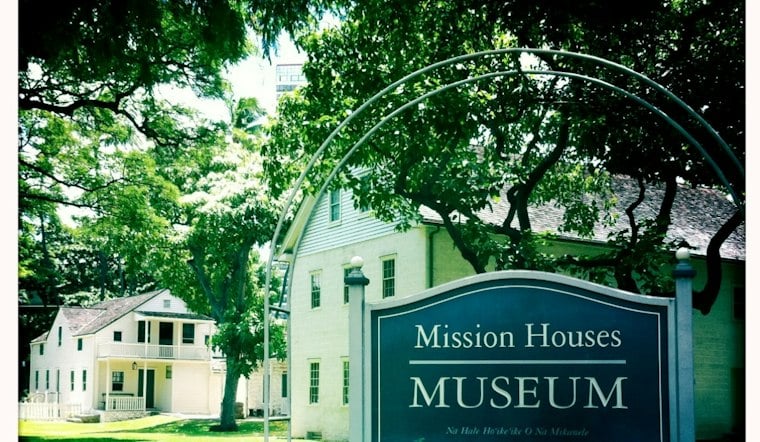
A concert honoring the music of Hawaiʻi's grandparents' generation is coming to one of Honolulu's oldest landmarks next month. Hawaiian Mission Houses Historic Site and Archives will present Mele Tūtū: Songs of our Grandparents on Saturday, October 10, at its Kahua Hoʻokipa stage at 553 S. King St., blending hula, chant, and hapa haole standards from the 1930s and 1940s into an evening built around the concept of mālama kūpuna, or caring for elders.
The event marks the next installment of the museum's ongoing Mele Program, according to Maui Now. Organizers said the mele and hula performed that evening evoke memories of family musicians, backyard gatherings, and kūpuna passing down family knowledge, and that the connection to elders helps maintain genealogies, histories, and the mana of revered generations. The performances will be brought to life by Hālau Hula Kamamolikolehua and Hālau Mele, with historical and contemporary cultural performances woven throughout the night.
Hālau Mele is co-directed by Kumu Sam ʻOhu Gon III and Kumu Māhealani Wong, per the same report. Gon trained in traditional chant under Kumu John Keola Lake and serves as Senior Scientist and Cultural Advisor for The Nature Conservancy in Hawaiʻi, where he specializes in integrating traditional Hawaiian ecological knowledge with modern science; he was designated a Living Treasure of Hawaiʻi in 2014. Hālau Hula Kamamolikolehua is led by Kumu Pōhai Souza, who began dancing hula at age three and trained for a decade under her aunt, the legendary kumu hula Maiki Aiu Lake, before graduating as a kumu in 1991 under Mae Kamamalu Klein, according to MidWeek Kauaʻi. Her hālau emphasizes an educational approach to hula centered on dance research and emotional expression rather than competition.
The Radio Era That Shaped a Generation's Songbook
The music at the center of Mele Tūtū traces back to an era when live performances and radio broadcasts carried Hawaiian culture across the islands, the continental United States, and abroad, the Maui Now report notes. Orchestras of the 1930s and 1940s played hapa haole music, jazz, and other popular Hawaiian styles, a genre that combined traditional Hawaiian lyrics and steel guitar with Western big band swing and English lyrics to reach mainland radio audiences, according to Steel Trappings. The flagship broadcast of that sound, Hawaiʻi Calls, made its first broadcast from Waikīkī Beach on July 3, 1935, eventually reaching more than 750 radio stations before ending its 40-year run in 1975 when government subsidies were discontinued, per Wikipedia. The show was recorded live in the courtyard of the Moana Hotel with the sound of Waikīkī's waves audible in the background.
That legacy carried forward through Territorial Airwaves, described in the Maui Now report as a descendant program of Hawaiʻi Calls in the 1970s and 1980s. Launched in 1979 by third-generation broadcaster Harry B. Soria Jr., the show aired weekly for more than 40 years to preserve vintage Hawaiian recordings from 1915 to 1959, specializing in rare 78-rpm and vinyl records and eventually building an archive of more than 10,000 recordings now housed at the Hawaii State Archives, according to Territorial Airwaves. For many kamaʻāina, the mele and hula of the 1930s and 1940s provide a direct connection to ancestors, since that era corresponds to the generation of grandparents and great-grandparents being honored at the October concert.
A Landmark Built for Preservation
The Kahua Hoʻokipa stage where Mele Tūtū will unfold is a coral-and-grass outdoor performance arena that Hawaiian Mission Houses built in 2011 specifically to host live music, chant, and historical theater on its downtown Honolulu grounds. The venue sits alongside some of the oldest structures in the islands. The site's Frame House, or Hale Laʻau, was built in 1821 from pre-cut timbers shipped from Boston around Cape Horn and is the oldest surviving wood-frame structure in Hawaiʻi, a distinction that earned it designation as a U.S. National Historic Landmark in 1962, according to Aloha State Daily. The house originally served as a New England-style residence for Protestant missionaries in Honolulu.
The grounds also hold the 1841 coral-block Printing House, known as Ka Hale Pai, where early missionaries and Native Hawaiians printed the first materials in written Hawaiian, work that helped build what is now the world's largest archive of Hawaiian-language books, per the National Endowment for the Humanities. Mele Tūtū follows prior installments of the museum's Mele Program, including Wahi Kapu – Forbidden Places in May 2025, which explored sacred and restricted sites in Hawaiian tradition through moʻolelo, mele, oli, and hula.
Why the Focus on Elders Resonates on Oʻahu
The emphasis on mālama kūpuna lands amid a demographic shift already reshaping Oʻahu. Roughly one in four Honolulu residents is over age 60, while 18.4% of Hawaiʻi's statewide population is 65 or older, according to Hoodline's reporting on Honolulu retirees. That high senior population has made kūpuna welfare and the transfer of knowledge between generations a major priority across the island, reinforcing why a concert built around grandparents' music carries weight beyond nostalgia.
Tickets, Timing and What to Expect
Seating for Mele Tūtū opens at 5:30 p.m. on October 10, with the performance beginning at 6:30 p.m., per the Maui Now report. Tickets cost $50. A cash bar offering beer, wine, water, and soft drinks will be available from 5:30 p.m. through intermission, and Daʻcuterie by Oʻahu Premier Picnics will sell gourmet charcuterie options for purchase.
Attendees can find metered street parking on Kawaiahaʻo Street, Mission Lane, or South Street, with additional parking available at the Civic Center municipal parking lot at 346 Alapaʻi Street. Event organizers said they will post weather or circumstance updates at missionhouses.org if needed.



