

























































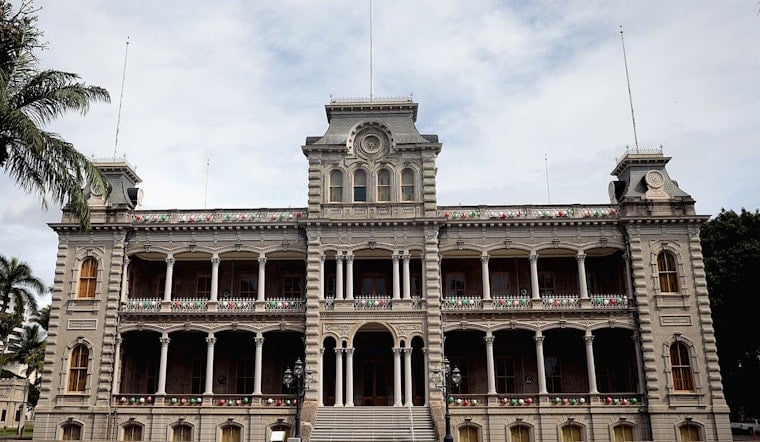
A free living-history walking tour returns to the grounds of ʻIolani Palace this Sunday, leading visitors through six historic stations that retrace the pivotal days surrounding the 1893 overthrow of the Hawaiian Kingdom. Titled Mai Poina: The Overthrow, the event runs from 4 to 6 p.m. and checks participants in at the ʻEwa end of the Hawaiʻi State Library, just steps from the palace itself.
The tour was created by playwright Victoria Nalani Kneubuhl and is being presented as part of Hawaiian History Month, according to the University of Hawaiʻi System. Malia Nobrega-Olivera is listed as the event contact, reachable by email at [email protected] or by phone at 808-286-5461. Organizers describe the walk as depicting pivotal events surrounding the overthrow, with a scholar discussion woven into the experience to unpack its lasting impacts.
From a 15-Hour Pageant to a Single Afternoon
Mai Poina did not start out as a two-hour stroll. Kneubuhl originally wrote the material as a sprawling 15-hour living history pageant called January 1893, staged with more than 50 actors across downtown Honolulu during the overthrow's 100th anniversary, according to the Hawaiʻi Ponoʻī Coalition. Over the following decades, the coalition condensed that marathon production into the more compact walking tour format that visitors experience today.
The tour incorporates costumed actors playing not just royal officials but everyday onlookers, including Japanese plantation workers, Chinese residents, and European immigrants, illustrating how the political crisis of 1893 rippled through Honolulu's diverse population. Writer Rachel Funk Heller has noted that Kneubuhl drew on archival documents and diaries to build perspective-driven vignettes at each station along the route, giving the production a granular, ground-level view of history rather than a strictly royal one.
Mai Poina is also one piece of a larger body of work. The walking tour forms part of a theatrical trilogy Kneubuhl wrote examining the fall of the Hawaiian Kingdom, alongside her plays The Annexation Debate and Trial of a Queen — the latter created for the Judiciary History Center of Hawaiʻi to mark the centennial of Queen Liliʻuokalani's 1895 military tribunal.
Why September, and Why the Palace
The timing is deliberate. Hawaiian History Month falls each September to coincide with Queen Liliʻuokalani's September 2, 1838 birthday; she served as Hawaiʻi's last reigning monarch until she was deposed on January 17, 1893, per the University of Hawaiʻi System News. Last year, Governor Josh Green signed Act 167 into law, formally codifying Hawaiian History Month in state statute — a monthlong observance that Native Hawaiian organizations had already been coordinating informally since 2020, according to HAWAIʻI Magazine.
The Hawaiʻi Ponoʻī Coalition, whose name translates to Hawaiʻi's Own and echoes the title of the Hawaiian national anthem written by King Kalākaua in 1874, has sponsored the Mai Poina tours alongside the University of Hawaiʻi since 2007, when it launched its first annual commemorations at ʻIolani Palace. This year's opening week of Hawaiian History Month also included a Memory Walk tracing Queen Liliʻuokalani's footsteps from St. Andrew's Cathedral to ʻIolani Palace on September 5, followed by a performance of Ka Lei Maile Aliʻi re-enacting the 1897 anti-annexation petition signing, which gathered more than 21,000 Native Hawaiian signatures opposing U.S. annexation. Earlier this month, the University of Hawaiʻi at Mānoa also opened its own campus commemorations with a lei tribute at the Queen Liliʻuokalani Center for Student Services, placing floral offerings on an altar in a nod to the flowers wrapped in newspapers that the queen received while imprisoned in ʻIolani Palace in 1895.
The palace grounds themselves carry the weight of the history being reenacted. Completed in 1882 as the official residence of the Hawaiian monarchy, ʻIolani Palace served as the physical site of the 1893 overthrow and remains the only official royal palace on U.S. soil, as Hoodline previously reported. After the overthrow, the building continued serving as a territorial and state capitol until the current Hawaii State Capitol opened in 1969.
A Federal Acknowledgment, Decades Later
The overthrow depicted in the tour also carries formal legal weight at the federal level. In November 1993, President Bill Clinton signed Public Law 103-150, known as the Apology Resolution, an official joint resolution of Congress acknowledging that the 1893 overthrow of the Hawaiian Kingdom was illegal and was carried out with U.S. diplomatic and military assistance. The resolution explicitly acknowledged that Native Hawaiians never directly relinquished their sovereignty, according to the Nation of Hawaii.
That federal acknowledgment sits alongside the state's more recent statutory recognition of Hawaiian History Month, underscoring how the events Mai Poina reenacts continue to resonate in ongoing conversations about Native Hawaiian sovereignty, historical memory, and reconciliation. Hoodline has previously covered the broader lineup of Hawaiian History Month programming, including the coalition's citywide cultural events and a free kamaʻāina celebration at ʻIolani Palace marking Kahoʻolawe's 50-year fight.





.jpg)