

























































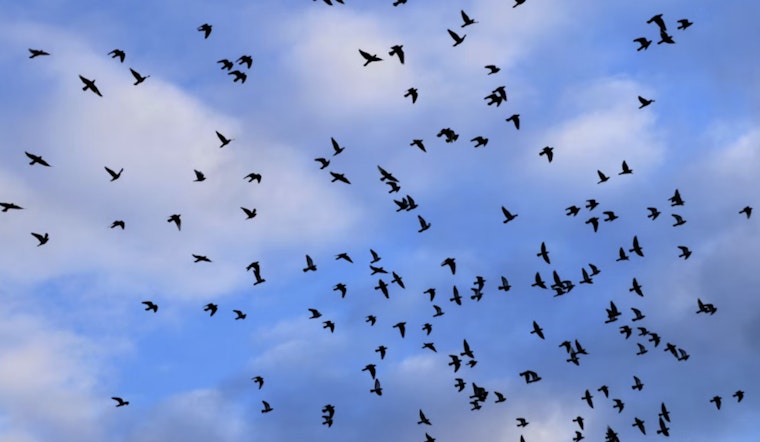
Just before sunset on a recent evening in Houston, about four dozen people stood on the grounds of Pershing Middle School, necks craned toward a brick chimney, watching thousands of tiny wings churn the sky before funneling, one after another, into the stack. By the time the light faded, a volunteer with a hand-held clicker had counted 605 chimney swifts disappearing into the chimney for the night.
The gathering was a Swift Night Out, a local observation event tied to a decades-old citizen science tradition, and it was organized by Birds Houston, the nonprofit formerly known as Houston Audubon before its rebrand away from its namesake's ties to slavery in August. Pam Smolen, board chair of Birds Houston, used the clicker to tally the birds and told Chron that counting swifts gets tricky when so many pour in at once. Smolen said the swifts observed that evening had finished breeding and were beginning their migration south.
A Chimney Almost Lost, Now a Seasonal Landmark
The Pershing Middle School chimney very nearly did not survive to host this year's crowd. During construction of the school's new campus in May 2007, Texas Parks and Wildlife Department game wardens and bird advocates warned developers that demolishing the old boiler stack would violate federal law, according to the same Chron report. Students and volunteers pushed to preserve the roost, and the brick chimney was ultimately incorporated into the rebuilt campus, where it still serves as a seasonal roost for migrating chimney swifts.
That legal backstop comes from the Migratory Bird Treaty Act, which makes it illegal to remove, seal off, or disturb an active chimney swift nest or roosting site without a federal permit — violations can carry fines up to $15,000 and six months in prison, according to Humane World for Animals. The law exists because swifts are built for masonry, not modern hardware: the species has extremely short legs and specialized feet adapted for clinging to rough vertical surfaces, and it cannot perch like most birds. Modern metal chimneys are unsuitable replacements for swift roosts, since the smooth flues cause the birds to slip.
Why the Birds Keep Moving Around the Neighborhood
Swift Night Out organizers were reportedly uncertain about which roost the birds would use until the day before the event, per the Chron account. Chimney swifts have moved between the Pershing Middle School chimney and an old ventilation shaft located less than a mile away at 4004 Bellaire Blvd., near a Whole Foods Market. Chimney swift movements can be unpredictable, and hunting hawks can send the birds elsewhere on a given night. Attendees at the event tried their hand at guessing the number of swifts that would appear before the count began.
The behavior on display at sunset reflects a seasonal shift in how the birds live. Chimney swifts nest as single, isolated pairs in separate structures during spring breeding, but after their young are raised they form communal roosts of hundreds or thousands of birds during fall migration — a shift that helps them conserve heat and share foraging information before heading to South America for winter, according to Birds Houston. Houston's swift gatherings tend to be largest during September and October, as birds from farther north arrive on their way south, and the swifts are expected to return again in spring.
A Species Built for Trees, Now Dependent on Brick
Chimney swifts historically nested and roosted in large hollow trees before adapting to brick chimneys and other human-built structures across the eastern United States and Canada, where they breed. That adaptation now cuts both ways: as old brick chimneys get capped or torn down, the birds lose the very structures they came to rely on. Birds Houston data cited by Chron shows chimney swift populations have fallen by more than 70 percent since the 1960s, a decline that mirrors a broader, well-documented crisis. Research published in the journal Science found North America has lost 2.9 billion breeding birds since 1970 — a 29 percent decline across wild bird populations, as Hoodline has reported.
Globally, the International Union for Conservation of Nature lists the chimney swift as “Vulnerable,” citing habitat loss from chimney capping alongside declines in the aerial insects the birds depend on, per Mass.gov. A single adult chimney swift can eat up to 12,000 flying insects a day, feeding exclusively on the wing on mosquitoes, flies, and airborne spiders, according to the Wild Bird Fund — a detail that underscores just how much free pest control the birds provide neighborhoods before they vanish into a chimney for the night.
How Houstonians Can Help — and Where to Watch Next
Birds Houston is encouraging residents to report chimney swift sightings as part of its “Swifts Over Houston” effort, which aims to raise awareness of the birds and their roosts. Homeowners with suitable masonry chimneys are asked to leave them uncapped and to keep the damper closed while swifts are present, since artificial chimneys and structures like those at the Nature Discovery Center in Bellaire's Russ Pittman Park can also provide alternative nesting and roosting places as brick chimneys disappear.
The Swift Night Out tradition itself traces back to a continent-wide citizen science effort started in 2001 by longtime swift researchers Paul and Georgean Kyle in Austin, and Birds Houston has hosted its own local version of the events for roughly 18 years. The organization's next Swift Night Out is scheduled for September 30 at Rice University. Smolen said the events help Houstonians simply notice the wildlife sharing their city, even if it is only visible for a few frantic minutes at dusk.


