

























































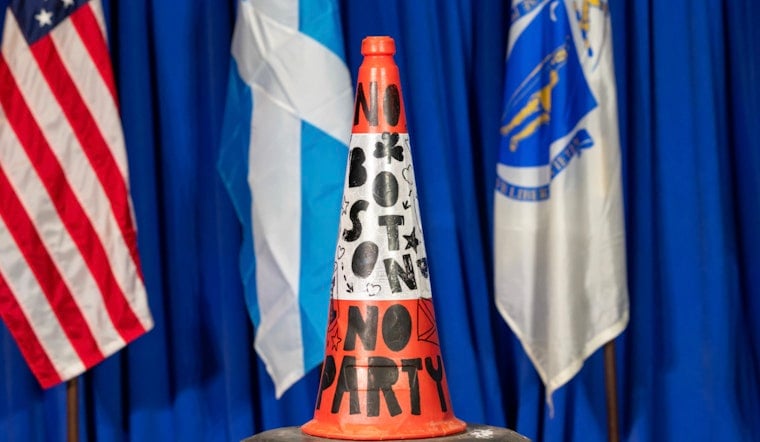
A single photo of a traffic cone perched atop a bronze statue in Glasgow has, over the past year, grown into an official diplomatic effort between Boston and Scotland, complete with a custom-decorated cone that flew across the Atlantic in business class and a push toward a formal sister-city agreement. What started as a mischievous prank tradition among Scottish soccer fans is now tied to mental health fundraising campaigns in two countries and a partnership set to be finalized during Tartan Week next spring.
The story traces back to Andrew Dobbie and Danny Campbell, who placed a traffic cone on the Duke of Wellington statue in Glasgow and watched the image go viral, according to WCVB. That photograph set into motion a series of events that eventually grew into a fundraiser for mental health charities, the station reported. Dobbie told WCVB that “any sport does its job well when it pulls people together,” adding that “football doesn't have to be only about football; it can be about love and connection and humanity.”
A Glasgow Tradition Crosses the Atlantic
The 1980s-era Glasgow “coning” tradition, in which pranksters scale the 1844 bronze equestrian statue of the Duke of Wellington outside the Gallery of Modern Art to crown him with a traffic cone, has long been an iconic fixture of Scottish irreverence, according to the Daily Record. During the 2026 FIFA World Cup, visiting Scottish fans brought that same custom to Massachusetts, placing traffic cones on several prominent Boston monuments, including bronze statues of Bruins legend Bobby Orr, Revolutionary War figure Paul Revere, and NBA legend Bill Russell. Boston Mayor Michelle Wu personally joined the trend by placing a cone on Russell's statue, according to the Evening Standard's account carried by upday.
The Tartan Army's presence in Greater Boston during the tournament was already notable before the cone campaign took off. Thousands of Scots traveled across the Atlantic for the group stage matches in June 2026, and fans held a 76th-minute stadium tribute during a match against Morocco for Donny Strathie, a 76-year-old Scottish fan who died in his Boston hotel, Hoodline reported in its coverage of the Morocco match.
From Viral Photo to Custom-Built Cone
Dobbie and Campbell eventually wrote “Boston” on a cone themselves, channeling the online momentum into a physical object built for the campaign. Illustrated by Glasgow artist Rob Johnson and developed by agency MadeBrave, the resulting Boston Cone design incorporates symbolic icons from both regions, including the Boston Red Sox logo, bagpipes, a traditional Scottish square sausage, and Dawny the Duck from the Public Garden's duck boats, according to the Evening Standard's reporting as carried by upday. The cone itself was emblazoned with the phrase “No Boston, No Party.”
That custom cone flew across the Atlantic in Delta One business class on a Delta Air Lines flight from Scotland to Boston Logan International Airport in July, while Dobbie and Campbell sat in economy, per the Evening Standard's account. Campaign organizers fitted the cone with embedded contactless tap-to-donate technology, letting passersby across Massachusetts tap it with a phone or credit card to donate directly to mental health organizations — a feature Dobbie has called the world's first contactless traffic cone.
City Hall Turns a Prank Into Policy
Boston Mayor Michelle Wu officially proclaimed July 14, 2026, as “Boston Cone Day” to mark the cone's arrival and commemorate the transatlantic bond formed during the World Cup, according to the City of Boston. The cone was then officially signed by Glasgow Chamber of Commerce CEO Stuart Patrick, Massachusetts Governor Maura Healey, Wu, and Massport CEO Richard Davey to advance plans for a formal city partnership between Glasgow and Boston, with the agreement targeted for completion during Tartan Week in April 2027.
All proceeds from the resulting Scotland Loves Boston initiative are split between two mental health charities: Scottish Action for Mental Health in Scotland and the Massachusetts Association for Mental Health in the United States, per the city's announcement. Funds are collected through the cone's contactless taps, JustGiving donations, and merchandise sales. WCVB also noted that the Boston Cone includes a photo-sharing upload opportunity, giving the public another way to engage with the fundraiser directly.
A Billion-Dollar Backdrop
The cone campaign unfolded against the backdrop of a World Cup that reshaped Massachusetts for weeks. The state hosted seven matches at Gillette Stadium in Foxborough, temporarily rebranded “Boston Stadium” for FIFA, drawing an estimated 450,000 ticket holders and up to 1 million regional visitors with a projected state economic impact exceeding $1 billion, Hoodline reported in its earlier World Cup preview. State officials coordinated more than 70 public agencies to handle logistics and public safety during the tournament.
What remains open is how much the tap-to-donate cone and its accompanying merchandise ultimately raised for the two mental health charities, and precisely what shape the Boston-Glasgow sister-city agreement will take when officials gather for Tartan Week next April. For now, city leaders on both sides of the Atlantic are treating a fan prank as the unlikely spark for a lasting civic partnership.




