

























































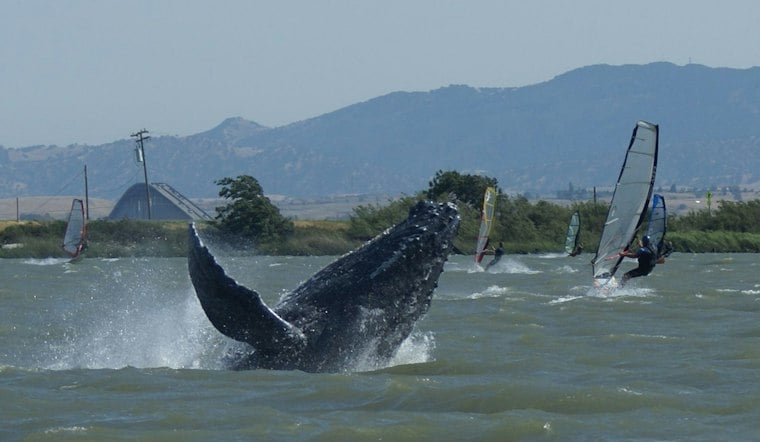
A humpback whale was spotted swimming in the Sacramento River near the Rio Vista Bridge Wednesday, coming in close to shore as anglers and witnesses looked on in surprise. The sighting, first reported around noon by anglers near the bridge, immediately drew comparisons to one of Northern California's strangest and most beloved wildlife stories: Humphrey the Humpback.
Whale Spotted Close to Shore Near the Bridge
According to ABC7 Bay Area, witnesses saw the humpback swimming near the shoreline in the Delta close to the Rio Vista Bridge, with the animal coming pretty close to shore at times. The station noted that how long the whale might stick around the area remains unclear. For a small Solano County town of roughly 10,000 residents, even a brief visit from a humpback is enough to turn heads along the waterfront.
It's not the first time a wayward humpback has found its way into these waters. Rio Vista holds a unique place in Northern California lore due to Humphrey the Humpback's 1985 freshwater foray, as detailed by KALW. The same station's reporting connects this week's sighting to a decades-long ecological narrative playing out in the Sacramento-San Joaquin River Delta, one that long predates this week's visitor.
The Legend of Humphrey Still Looms Large
In October 1985, a 40-foot humpback nicknamed Humphrey swam 69 miles inland up the Sacramento River to Shag Slough near Rio Vista, according to SFGate. He spent nearly a month trapped in shallow freshwater sloughs before rescuers guided him back to open water. The rescue itself became the stuff of legend: bio-acoustician Bernie Krause played underwater recordings of humpback feeding calls supplied by the University of Hawaii to lure the 40-ton whale back toward the Pacific, per the same reporting.
Humphrey wasn't done making headlines. Five years later, in October 1990, he turned up again, this time entering San Francisco Bay and running aground on a mudflat near Candlestick Park before rescuers freed him. Media coverage of that second misadventure humorously dubbed him “Dumphrey” before he was guided free, SFGate reports, and he was last documented near the Farallon Islands in 1991.
Rio Vista's Waterfront Feels the Draw
Rio Vista's waterfront draws visitors through Delta recreation, marina activity, and tourism, and sudden marine events have historically triggered large influxes of visitors and sightseers to the small town, as Hoodline has previously reported. Past whale sightings drew crowds of up to 10,000 visitors a day to Rio Vista's riverbanks, a scale of interest the town's Delta Marina district knows well from its long relationship with waterfront tourism.
Rio Vista made that connection to its history official in 1986, when the city dedicated a permanent granite memorial marker along its Main Street waterfront to commemorate Humphrey's 1985 Delta journey, according to the Historical Marker Database. At DH White Elementary School, Humphrey's story reportedly remains part of lessons, a sign of how deeply that 1985 visit shaped the town's identity.
A Pattern of Wayward Whales in the Delta
Humphrey wasn't the only humpback to wander unusually far inland. In May 2007, a mother and calf pair named Delta and Dawn traveled roughly 90 nautical miles up the Sacramento River to the Port of Sacramento, according to Wikipedia's account of the incident, going 20 miles farther than Humphrey had two decades earlier. During that rescue, veterinarians from The Marine Mammal Center administered antibiotics via dart to the free-swimming whales for the first time in history, treating severe skin deterioration and propeller-strike wounds.
Prolonged exposure to freshwater can be dangerous for ocean-dwelling whales. Humpbacks that stray into rivers can suffer skin deterioration and lesions. KQED has reported that humpbacks have been feeding on anchovies and krill in San Francisco Bay and adjacent estuaries.
What Federal Rules Say About Approaching the Whale
The Endangered Species Act and Marine Mammal Protection Act prohibit harassment and other harmful conduct, per NOAA Fisheries. The same agency's guidelines advise boaters to stay at least 100 yards away from humpback whales and to slow down to avoid dangerous strikes; the federal 100-yard vessel requirement specifically applies to humpback whales in Hawaii and Alaska waters.
For now, it remains unclear how long this week's whale will linger in the Delta or whether it will find its own way back to the bay, much as Humphrey and Delta and Dawn eventually did. The sighting has already reignited a familiar mix of excitement and concern in a town that has watched this story unfold before.



