

























































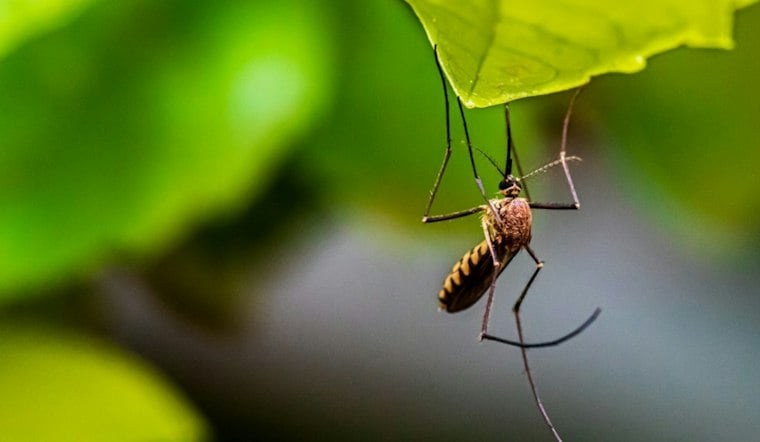
A mosquito species never before documented in Portland has turned up in a trap near Kelley Point Park, and Multnomah County officials say it belongs to a group they consider of primary concern. The insect, identified as Aedes notoscriptus, was trapped at the Bybee Lake Pumphouse in North Portland on Aug. 25, according to the county.
Multnomah County confirmed the identification and said the species may carry West Nile virus and chikungunya virus, as reported by KOIN. A county vector ecologist made the first visual identification of the mosquito, which has distinctive markings on its head that set it apart from native species. Multnomah County has not found additional specimens of the species since the initial trapping, and the county noted it had been more than a decade since an invasive mosquito discovery here led to an endemic population taking hold locally.
A Species With No Prior Portland Record
Aedes notoscriptus is native to Australia, and its arrival at Bybee Lake marks the first time it has ever been found in Portland, per the same account from KOIN. The species was first detected in the United States in Los Angeles County back in 2014, and it has since established permanent populations across Southern California, according to entomological research published by Oxford Academic. Laboratory tests have found the mosquito susceptible to Zika virus, though public health agencies report it has not yet been implicated in disease transmission to humans within the United States, according to the American Mosquito Control Association. In Australia, the species is considered a competent vector for Barmah Forest and Ross River viruses.
Oregon has already seen a related invasive mosquito species expand north in recent years. In July 2024, the Jackson County Vector Control District detected the state's first-ever Aedes aegypti, or yellow fever mosquito, in Talent, and the species turned up again in Ashland in August 2025, according to the Jackson County Vector Control District. That discovery triggered door-to-door outreach.
Why These Mosquitoes Behave Differently
Invasive Aedes mosquitoes differ from Oregon's native species in several important ways. They actively bite during daylight hours, target human ankles and feet, and breed in artificial containers holding tiny amounts of water, according to the California Department of Public Health. Mosquito activity can be especially high at dawn and dusk, and breeding sites can occur near rivers.
West Nile virus activity is monitored in Oregon. The Oregon Health Authority recorded the state's first West Nile virus-positive mosquito pool of the 2026 season from a sample collected on July 15 in Eagle Point, Jackson County, according to the Oregon Health Authority. State health officials monitor mosquito pools for West Nile virus.
County Mosquito Monitoring and Mosquitofish
Multnomah County conducts mosquito surveillance.
Multnomah County offers free mosquitofish to residents with ponds.
Illegal waste tire stockpiles have also drawn scrutiny as a major mosquito breeding hazard in the county. Hoodline reported in June on a six-foot-high tire dump discovered on a 1.2-acre parcel in Southeast Portland, the kind of site Oregon DEQ regulates because stagnant rainwater trapped inside discarded tires creates ideal breeding grounds. Multnomah County saw a record mosquito outbreak in 2022, with more than 20,000 mosquitoes trapped across 150 locations, according to Portland Monthly, with officials noting that warmer, wetter weather patterns intensify seasonal outbreaks.
Whether the single Aedes notoscriptus trapped at Bybee Lake represents an isolated hitchhiker or the start of an established local population remains an open question for vector ecologists. For now, Multnomah County has found no additional specimens since the August trapping, and officials continue to describe the species as one of primary concern as they watch for signs of it returning.





