

























































Jackson Health System says it could lose roughly $64 million a year in property-tax funding within two years if Florida voters approve Amendment 3 in November. The ballot measure would raise the homestead property-tax exemption on primary homes from $50,000 to $250,000 by 2028, reducing a revenue stream Jackson uses to care for uninsured and underinsured residents across Miami-Dade County.
Jackson Health CEO David Zambrana discussed the system's exposure during a Greater Miami Chamber of Commerce panel on Amendment 3 in Miami on Wednesday, the Miami Herald reported. Projections cited in that report show Jackson losing about $34.7 million in fiscal year 2027 and roughly $29 million more in fiscal year 2028, with the annual loss stabilizing near $64 million after that. The chamber also held a separate Amendment 3 panel at Jungle Island and plans to host town halls across Miami-Dade County about the measure's potential effects and the funding decisions it could require, according to remarks from the chamber's P.J. Campbell relayed by the Herald. The chamber says it is not advocating for how people should vote.
A Statewide Hit Concentrated in South Florida
Jackson's projected loss is part of a broader hit to Florida's public hospital infrastructure. A statewide analysis found that the state's 28 public hospital and healthcare taxing districts could collectively lose $323 million over three years if Amendment 3 passes, according to the Florida Policy Institute. Four South Florida systems — Jackson, North Broward Hospital District, South Broward Hospital District, and the Health Care District of Palm Beach County — would together absorb more than 70% of that statewide loss.
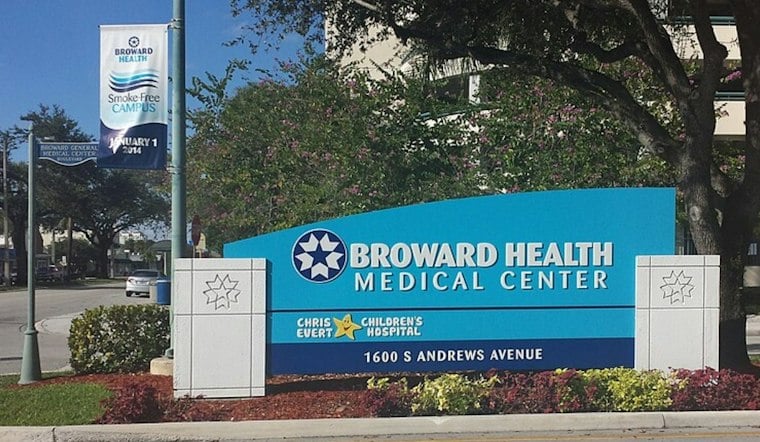
The North Broward Hospital District, which operates as Broward Health, faces the single largest hit of any Florida health system: a projected $100.4 million loss over fiscal years 2027 through 2029, per WLRN. Just south, Memorial Healthcare System in southern Broward is projected to lose a comparatively modest $2.2 million over the same period. In Palm Beach County, the Health Care District faces a $66.5 million three-year loss that would strain funding for the Trauma Hawk air ambulance service, school health programs, and Lakeside Medical Center — the county's only public hospital, serving the rural Glades region around Belle Glade.
Jackson's Public Structure and Funding Context
Miami-Dade County's FY 2026-27 proposed budget identifies the Public Health Trust that governs Jackson Health as an entity created by county ordinance in 1973 to operate, govern, and maintain designated health facilities, according to the Miami-Dade County FY 2026-27 proposed budget. That county-government structure helps explain why a change in local property-tax collections could affect Jackson, although the projected $64 million figure is the system's estimate of the specific Amendment 3 exposure. The potential loss also follows a history of concentrated public-hospital financing in South Florida. A 2015 study prepared for the Florida Agency for Health Care Administration found that Miami-Dade County, the North Broward Hospital District, and the South Broward Hospital District accounted for 82% of Florida's intergovernmental-transfer funds collected in state fiscal year 2012-13. The finding provides historical context for why changes to local hospital funding can have effects well beyond a single system.
What's Actually on the Line at Jackson
Jackson Health provides care regardless of insurance status or ability to pay. The system operates hospitals, nursing homes, a transplant center, urgent-care sites, doctors' offices, and clinics across Miami-Dade, with services including behavioral health, labor and delivery, emergency care at the Ryder Trauma Center, and organ transplantation. It also partners with the University of Miami Miller School of Medicine.
Zambrana told the Herald that Jackson's quality of care and service will not change, and he said residents who need Jackson should not hesitate to come. Still, the system acknowledges it does not yet know whether Amendment 3 would force service cuts, rollbacks, or staff layoffs — only that it plans to spread any cuts across affected services rather than concentrate them in one area. Jackson has said the tax cuts would require examining virtually every corner of its operations for potential savings.
Squeezed From Multiple Directions
Jackson is already navigating financial pressure well beyond the ballot measure. The system faces physician and nurse shortages, rising costs paired with lower reimbursement rates, a growing wave of cybersecurity threats, and higher demand tied to an aging Miami-Dade population. It carries roughly $3.1 billion in operating expenses and reported net income ranging from $7.9 million to $41.4 million in the prior year, according to the Herald's reporting. About 42% of Jackson's patients pay through sources other than Medicare and Medicaid, per Miami Herald news partner WLRN — revenue the system says it relies on to help fund care for patients who cannot afford treatment.
Jackson has already completed cost-cutting efforts that reduced its bills by $350 million, and it now plans to expand outpatient services and grow the number of paying patients it serves, in hopes of offsetting some of the coming shortfall. The Jackson Health Foundation raises money separately for patients who cannot afford treatment and for major capital projects. The system employs more than 15,000 full-time workers.
Capital Plans Move Forward Despite Uncertainty
Even as the tax fight plays out, Jackson's governing board has recommended a $251.5 million capital plan for fiscal year 2027 to fund medical equipment, diagnostic technology, facilities, and IT upgrades, according to Citizen Portal. Miami-Dade County's proposed budget for fiscal year 2026-2027 also includes a dedicated debt millage rate of 0.0895 mills specifically to service general obligation bonds tied to Jackson Health facilities, funding voters approved back in 2013 to modernize the system's infrastructure. Jackson recently opened one of the largest ERs in the nation, a 178,000-square-foot emergency department expansion that cost an estimated $300 million.
The Path to the Ballot
Amendment 3 was placed on the ballot by the Florida Legislature through House Joint Resolution 1-F and needs at least 60% voter approval on November 3 to amend the state constitution starting January 1, 2027. Beyond the homestead exemption increase, the measure would also lower the annual assessment increase cap for non-homestead properties like commercial real estate and rental housing from 10% to 5%, according to Ballotpedia. Legislative fiscal staff project the amendment would cut local government property tax revenues statewide by $4.6 billion in fiscal year 2027-2028 and $8.4 billion the following year.
The debate over Amendment 3 has already rippled through South Florida governments well beyond hospitals. Broward mayors have warned the cuts could jeopardize public safety budgets, and municipal leaders across the state have raised similar alarms about strained local finances heading into the vote.



