

























































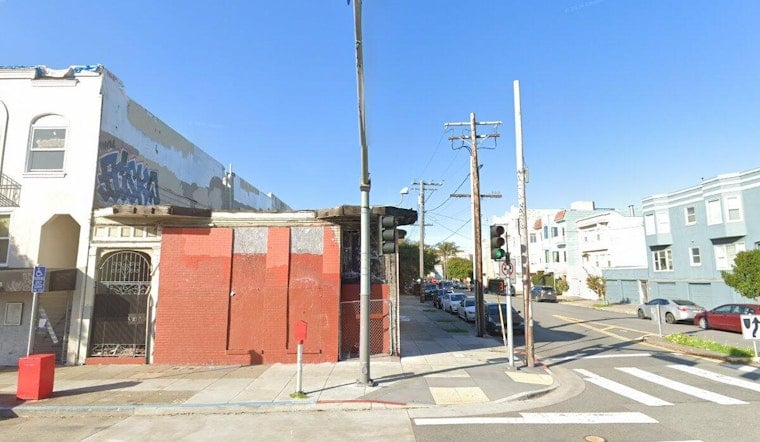
A proposed 89-unit condominium project at the site of the old Hong Kong Lounge II on Geary Boulevard could win city approval in as little as six months. Two blocks away, a similar residential project at the Coronet Theater took six years to clear San Francisco's permitting process. The gap between those two timelines captures just how much has changed in how the city handles housing applications along one of its busiest commercial corridors.
The 3300 Geary Boulevard project, filed by property owner Five Stars Investment LLC, would rise eight stories and 84 feet tall on the former Hong Kong Lounge II site in Jordan Park, according to San Francisco Chronicle reporter J.K. Dineen. Updated filings reviewed by SF YIMBY show the design, from Elevation Architects, calling for 89 for-sale condos, 13 deed-restricted affordable units, 1,400 square feet of retail space, and 53 parking spaces using stackers. The San Francisco Planning Department now has six months to approve the development once the application is deemed complete, per the Chronicle's reporting. According to the San Francisco Planning Department's housing delivery assessment, the department now accepts all land-use entitlement applications and referrals online, allowing electronic submittals.
That timeline stands in sharp contrast to the Coronet Theater project two blocks away, where the Goldman Center on Aging has spent six years trying to build a 120-unit senior housing complex alongside partner Bridge Housing. Goldman bought the Coronet, a 1,300-seat theater, back in 2000; the Goldman Center on Aging later converted its site into the Coronet senior housing campus, which opened in 2011. The project's environmental review alone took nearly two years after the Planning Commission certified the study in 2006. The Board of Supervisors rejected an appeal of that certification by a 9-1 vote that same year, but the project also faced a short-lived legal challenge and opposition from Jordan Park neighbors over traffic, parking, shadows, and blocked views, some of whom pushed to have the theater landmarked, according to the Chronicle's account. The delays drove up project costs, and Goldman has said it would extend the Coronet's lease by six months while it keeps seeking approval.
Why the 3300 Geary Site Sat Vacant for Years
The Geary Boulevard corner has been an eyesore since February 2019, when a Kilford Engineering excavation crew ruptured a marked PG&E natural gas line at Geary Boulevard and Parker Avenue. The rupture triggered a three-alarm fire that burned for more than two hours and damaged five structures, according to CBS San Francisco, which reported that the National Transportation Safety Board later cited the contractor's excavation practices for the rupture. The blaze destroyed Hong Kong Lounge II, a popular dim sum restaurant that also contained a six-bedroom apartment above it. Owner Annie Ho eventually reopened the business four years later, in February 2023, as HK Lounge Bistro in SoMa, as Hoodline previously reported.
The 3300 Geary project's client acquired the former Hong Kong Lounge property adjacent to an existing office building and has cycled through two earlier development proposals before landing on the current plan. The first called for 41 units, the second grew to 62, and the project now sits at 89 units after growing through multiple iterations, per the Chronicle. Architect Jonathan Pearlman said the project went through many iterations, and noted that community meetings are no longer required because of the city's new streamlining rules.
Family Zoning Rewrote the Math
Much of that growth traces back to San Francisco's Family Zoning Plan, signed into law in December 2025 and enacted in January 2026, which increased density and eased some height and density limits to create capacity for an estimated 36,000 new housing units, according to San Francisco Planning. The rezoning also eliminated common space requirements and reduced the 3300 Geary project's affordable housing requirement from 15% to 5%, changes the Chronicle reports made the project economically feasible. Developers delayed their application specifically to take advantage of Family Zoning and the reduced affordable housing threshold, using the city's Housing Choice — San Francisco program, which the Chronicle identifies as part of Mayor Daniel Lurie's Family Zoning Plan.
The pressure behind that policy shift traces back to the state level. Under California's 6th Cycle Regional Housing Needs Allocation covering 2023 to 2030, state housing officials mandated that San Francisco plan for 82,069 new housing units, including roughly 46,000 designated as affordable — more than triple the city's previous allocation, per San Francisco Planning. State housing laws include provisions addressing review timelines and limits on local hearings, with some 60- and 90-day periods identified in the relevant rules. According to a MayorSF.gov report dated May 24, 2023, Bill 35 grants ministerial approval for 100% affordable housing projects, and permitting is no longer a primary cause of delay for those projects.
A Wave of Projects Along Geary Boulevard
The 3300 Geary proposal is one of six new housing projects now in the pipeline along Geary Boulevard, together totaling about 300 units, per the Chronicle's reporting. At 2800 Geary Boulevard, developer Sean Sullivan is planning a 49-unit, six-story condominium project on the former Firestone Tires site, invoking the Housing Choice — San Francisco program under Family Zoning, according to SF YIMBY. Further out in the Richmond District, Kieran Woods Construction plans an eight-story, 42-unit complex at 5420 Geary Boulevard on a 0.16-acre lot between 18th and 19th avenues, next to the historic, vacant Alexandria Theater — a unit count that exceeds what the old rules would have allowed by more than two times. According to SF OpenData, the San Francisco Development Pipeline provides a snapshot as of the end of 2025 Q4 and tracks both construction and entitlement activity citywide.
Not everyone along the corridor is cheering unreservedly. David Heller, president of the Geary Boulevard Merchants Association, said new westside housing developments have lacked retail, pointing to three new complexes built with no ground-floor commercial space at all. Brian Quan, who is active with Grow the Richmond, offered a different view, saying affordability matters more than neighborhood character, architecture, or density, and that more neighbors would mean more clientele for struggling businesses. Quan also pointed to the former Ross Dress for Less and Blockbuster site as another potential location for future Geary Boulevard housing, and said he looks forward to seeing the burned-out Hong Kong Lounge site put back to use.
The broader transformation of the corridor extends beyond Geary Boulevard itself. Two blocks east, developers at 3333 California Street filed initial building permits in February 2026 for 152 residential units, the first phase of a planned 744-home redevelopment of the former UCSF Laurel Heights campus, according to SF YIMBY. Even with entitlements moving faster than ever, though, financial execution remains uncertain: developers are leaning on density bonuses to make projects like 3300 Geary pencil out.


