

























































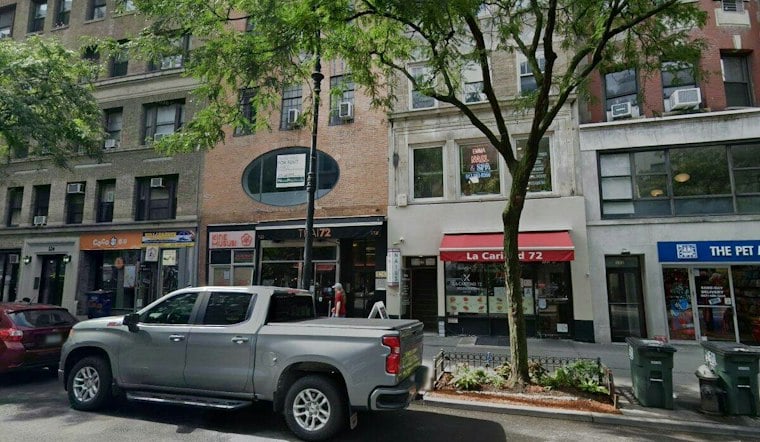
Kine Musubi opened its first brick-and-mortar shop this week at 128 West 72nd Street, bringing house-made Hawaiian-style musubi to a stretch of the Upper West Side between Amsterdam and Columbus Avenues. The shop, which makes its rice balls fresh with house-made teriyaki sauce, jasmine rice, and nori, follows more than a year and a half of the founders selling musubi as a weekly pop-up before landing this permanent space.
From Pop-Up to Permanent Storefront
The opening, which happened on September 24, caps a winding path for co-founders Chi Ian Chan and his wife Lizzy Han, according to iLovetheUpperWestSide.com. Before the storefront, Kine Musubi sold its musubi at a Sunday pop-up hosted inside Sushi Nonaka, a run that lasted from August 2023 to March 2025, per the Kine Musubi website. That pop-up era included a musubi take on a bacon, egg, and cheese, a detail Eater covered when it profiled the project in April 2025.
Once Sushi Nonaka's doors closed, Kine Musubi had aimed for an August 2025 opening on the Upper West Side, but the timeline stretched well past that target. According to West Side Rag, the 128 West 72nd Street storefront previously housed a smoke shop and, before that, Box Kite Coffee.
A Menu Rooted in Childhood Memory
Chan grew up in Hawaii after his family moved there when he was five, and he was raised in Honolulu's Chinatown, while Han grew up in Kona on the Big Island. Chan told Hawaii Public Radio that he started making his own musubi after relocating to New York in 2022, missing the snack his mother used to prepare for elementary school field trips back home. He has said that getting the ratio of Spam to rice right is the key to a good musubi, and he and Han call their from-scratch teriyaki recipe the Liquid Shaka Sauce.
The shop's menu centers on the Local Musubi, described as a Hawaii classic, alongside the Spam Lakika, which includes Spam, takuan, red chili flakes, and gochujang, and the Ebi Opae, made with crispy shrimp katsu and teriyaki mayo. Individual musubi run $6 to $8, and a mix-and-match box of five costs $30. There's also a vegan section featuring the Musu-V, built on a soy-based Spam alternative, plus furikake rice and fried garlic rice as base options. Drinks include UCC Hawaii Kona coffee and Hapa Co. Hawaiian plantation iced tea, and the shop's opening-day post featured its Spam Lakika served over fried garlic rice.
Musubi's Deeper Roots in Hawaii
The dish Kine Musubi is built around has a long history that predates any New York storefront. Spam became a fixture of Hawaiian cuisine during World War II, when wartime rationing and restrictions on commercial fishing pushed island residents toward shelf-stable canned pork as a primary protein source, according to Matador Network. The modern Spam musubi format traces to the early 1980s, when Japanese American nutritionist Barbara Funamura on Kauai began combining grilled Spam and rice wrapped in nori, as detailed by Food Republic.
That legacy still shows up in the numbers. Hawaii residents consume roughly 7 million cans of Spam annually, about 5 cans per person each year, making the state the highest per-capita Spam consumer in the country, according to Hormel Foods data reported by Hawaiʻi Public Radio. Convenience chain 7-Eleven, which introduced Spam musubi to its Hawaii shelves in 1994, now sells about 70,000 of them every week across its island locations, per HAWAIʻI Magazine.
Joining a Small but Growing NYC Scene
Kine Musubi markets itself as New York City's first dedicated Hawaiian-style musubi specialty storefront, a distinction separate from restaurants that simply serve musubi as a side dish. Manhattan diners have had access to elevated versions before, however — East Village restaurant Noreetuh, which opened in 2015 and earned Michelin Guide recognition, popularized spicy Spam and galbi short rib musubi on its menu years earlier. Kine Musubi's storefront gives the dish its own dedicated home on the Upper West Side, with pre-ordering and a planned Kine Mart section both listed as coming soon on the shop's website.




