

























































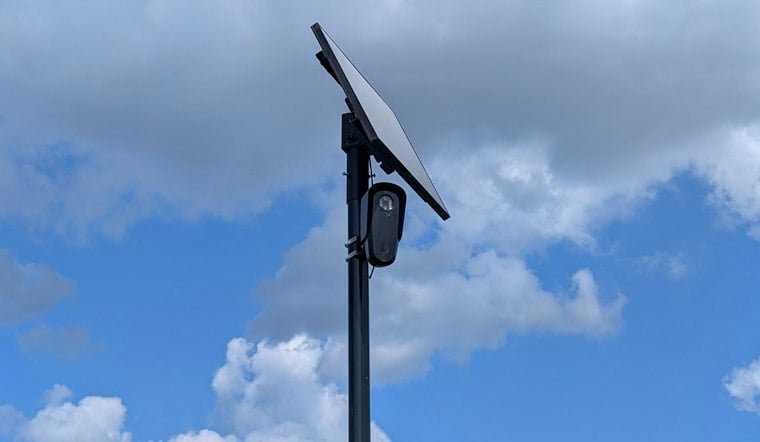
Lee's Summit police will no longer let any outside law enforcement agency simply log into its Flock Safety license plate camera network. Starting about a week before September 15, 2026, agencies seeking access to the city's 55 cameras must first sign a memorandum of understanding guaranteeing they will protect the data the same way Lee's Summit does.
The new requirement, confirmed by Lee's Summit Police in comments to KCUR, comes after residents raised alarms about how far the city's driving data could travel once it entered Flock's interconnected system. Flock's platform allows officers from across the country to search camera data from other jurisdictions, and Lee's Summit officials say they can no longer share locally collected data with agencies that cannot guarantee the same level of protection.
Police official Chris Depue told the station that Lee's Summit may be a pioneer in Flock data protection, and that the department felt obligated to act once the community identified a problem. Between January 1 and July 1, 2026, Flock recorded almost 2,700 searches of Lee's Summit camera data, according to the same report — most tied to theft investigations, with fugitives and drug cases coming up secondarily. During that six-month stretch, three Lee's Summit officers alone conducted about a quarter of all searches, though the report notes it remains unclear exactly how many outside agencies queried the city's license plate information.
A Patchwork Fix for a Nationwide Network
The mechanics of enforcing the new rule are messy. The memorandum is meant to cover every law enforcement agency anywhere that might want to query Lee's Summit's cameras, but Depue acknowledged the department is using boilerplate language whether the requesting agency is next door or six states away — a practical hurdle in communicating the requirement to agencies nationwide.
That tension over enforceability is compounded by the scale of Flock's business. The vendor operates cameras across thousands of law enforcement agencies in 49 states, according to Police1, and on August 13 the company announced it would shrink its default data retention window from 30 days to seven and require officers to enter a case code before running searches, changes set to take effect by the end of 2026. Lee's Summit itself uses Flock cameras, according to the City of Lee's Summit.
Federal Scrutiny and a Regional Backlash
The local move lands amid a broader reckoning. U.S. Sen. Josh Hawley, chairman of the Senate Judiciary Subcommittee on Crime and Counterterrorism, opened a federal investigation on August 26 into Flock's network of more than 120,000 cameras nationwide, citing concerns that the system effectively functions as an unauthorized national surveillance dragnet, according to the subcommittee's announcement. The networked system can track a person across the country, according to the report.
Those warnings are not abstract in the Kansas City metro. Gardner, Kansas, turned off its four Flock cameras in August 2026 after a resident discovered that more than 1,200 outside agencies and vendors had potential access to local driving data, according to the Johnson County Post; Gardner police physically covered the cameras during the contract termination. Weston, Missouri, canceled its Flock contract after residents revolted, and Parkville, Missouri, shut off its entire 15-camera network on September 11 following consecutive contentious town halls, as Hoodline reported in its coverage of Parkville's suspension.
Misuse Cases Fuel the Debate
Criminal misconduct cases have sharpened the stakes. A former Joplin, Missouri, police officer was charged on September 4 with four counts of misuse of official information after state investigators determined he made 22 law-enforcement-sensitive database checks between November 2024 and December 2025 to track two girlfriends and one girlfriend's current boyfriend, according to Hoodline's earlier reporting on the ex-Joplin officer charged in that investigation, which the Missouri State Highway Patrol handled.
Complicating matters further, the Missouri General Assembly considered House Bill 3192, aimed at setting statewide rules for ALPR data retention and access, according to Missouri General Assembly records cited by Cass County DeFlock. Missouri still lacks a single statewide ALPR statute, leaving individual cities like Lee's Summit to write their own rules, and departments to set their own interagency sharing terms.
Reports of officer misuse have contributed to scrutiny of Flock cameras and automated license plate readers in communities nationwide. Lee's Summit's MOU requirement represents an attempt to keep its 55 cameras running while setting its own access standard, in contrast to Gardner and Parkville, which stopped their programs outright. Whether one city's paperwork requirement can realistically bind thousands of outside agencies on a shared national platform remains an open question the department itself has yet to fully answer.



