

























































Lee Jankins had just recarpeted his house, so the family's keepsakes, tools, and his two young daughters' toys were sitting in the garage out back when overnight storms rolled through Madison Heights this past week. By morning, all of it was gone, burned along with his father's ashes in a fire he never saw coming.
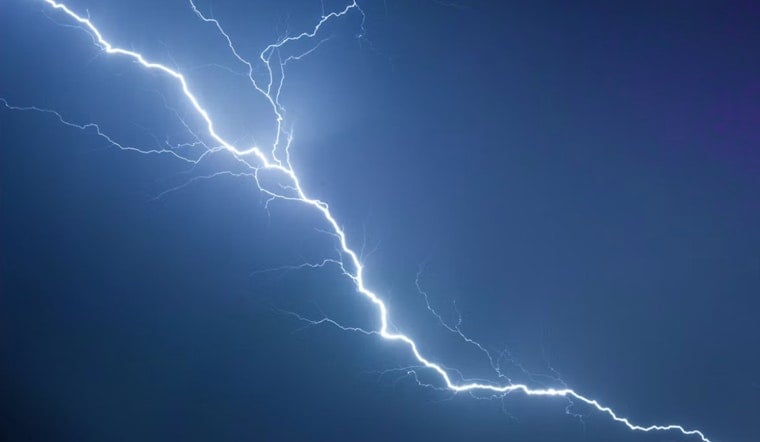
The blaze broke out near East University Avenue and Groveland Street after lightning struck a power line and transformer during the overnight storms on September 3, according to 7 News Detroit. The burning transformer collapsed directly onto Jankins's detached garage, according to the same report, in a neighborhood near 11 Mile and John R roads where another home also suffered storm damage. As FOX 2 Detroit reports, Jankins currently lives at his sister's house in Madison Heights, and it was in that garage where he and his daughters used to spend time together.
Jankins lost far more than a structure. His daughters' aerial swing, their bikes and ride-on toys, and a large TV were all stored in the garage, the outlet notes, alongside tools he had accumulated over years of work and other irreplaceable family items. Perhaps hardest to bear, his father's ashes were also destroyed in the fire.
Part of a Region-Wide Storm Disaster
Jankins's loss unfolded amid one of the most damaging weather events Metro Detroit has seen this year. The overnight storms knocked out power to more than 260,000 DTE Energy customers across Southeast Michigan, brought wind gusts up to 70 mph, and spawned a tornado on Detroit's east side, per a report from CBS Detroit. Oakland and Wayne counties were among the hardest-hit jurisdictions, the station's report adds.
The scale of the outage exceeded even the summer's other major disruptions, including a July 3 storm that had already left more than 168,000 customers without power, according to the same CBS Detroit account. To respond, DTE Energy deployed a storm force of more than 2,600 workers, including 800 out-of-state utility linemen, with a goal of restoring 90 percent of impacted customers by the end of that week, the report states.
The National Weather Service found that extreme atmospheric instability drove the outbreak, recording MUCAPE values exceeding 4,000 J/kg over Southeast Michigan during the September 2-3 storms. Storm cells raced across the region at speeds of 50 mph, the agency's assessment notes, conditions capable of producing the kind of rapid, violent development that triggered the lightning strike behind Jankins's fire.
A Community Responds
Madison Heights, an inner-ring Detroit suburb in southern Oakland County roughly 12 miles north of downtown, is home to about 28,468 residents across some 7 square miles, according to U.S. Census Bureau figures. It's the kind of tight-knit community where a family's loss doesn't go unnoticed, and neighbors have already begun rallying behind Jankins and his two girls.
A GoFundMe campaign titled “More Than a Garage for Lee and His Girls” was started to help replace some of the lost items, FOX 2 Detroit reports. The fundraiser is aimed at helping Jankins rebuild what the fire took, from his daughters' toys to the tools he relied on for years of work.
Resources for Storm-Affected Families
Families across Metro Detroit dealing with spoiled groceries from extended outages have a narrow window to seek help. Under Michigan Department of Health and Human Services rules, SNAP recipients who lose food due to storm-related power outages lasting four or more hours must submit replacement requests within 10 days of the outage, according to a report from CBS Detroit. Applicants are required to submit an affidavit along with proof of the outage.
Garage fires like the one that destroyed Jankins's belongings are more common than many realize. An estimated 6,600 residential garage fires occur annually across the United States, resulting in roughly 30 deaths, 400 injuries, and more than $457 million in property loss, according to the National Fire Protection Association, with electrical failures and heating equipment ranking among the top causes. Electrical malfunctions alone account for 13 percent of all U.S. home structure fires and cause the single largest share of direct property damage among residential fire categories, per the Electrical Safety Foundation International, with electrical arcing serving as the primary heat source in nearly 60 percent of such blazes.


