

























































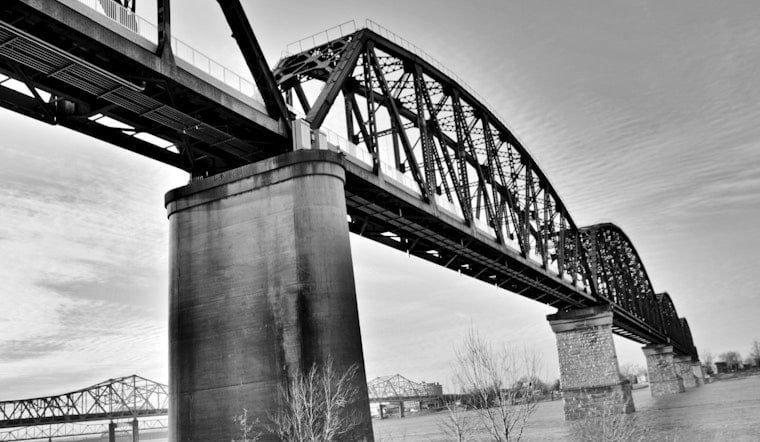
A Louisville Metro Police officer spent nearly an hour talking with a man who was considering jumping from the Big Four Bridge, patiently building trust until the man stepped back to safety. Police did not release the body camera footage of that encounter until this week, months after it happened.
According to the Louisville Metro Police Department, Officer McKinley responded to the Big Four Bridge for reports of a person in a mental health crisis who was considering jumping. As reported by LEX 18 News, Officer McKinley sat with the individual for nearly an hour, offering support through what LMPD described as patience, empathy, and determination. In the footage, McKinley is heard telling the man, “I may have only met you just a few minutes ago, but I do care about you.”
LMPD said that trust-building ultimately helped the man make what the department called the courageous decision to step back from the edge. The department later shared the bodycam video publicly, framing it as an example of de-escalation work carried out by its officers. Separate reporting from WHAS11 clarified that the encounter itself happened on March 21, 2026 — meaning the footage sat unreleased for close to six months before police shared it on social media this week.
Why the Bridge Draws These Calls
The Big Four Bridge is a converted former railroad truss bridge stretching 2,525 feet across the Ohio River, linking Louisville's Waterfront Park to downtown Jeffersonville, Indiana. Once known as the “Bridge That Goes Nowhere” during its decades of disuse, the span was converted into a pedestrian and bicycle walkway in 2013 and now sees an average of 1.5 million crossings a year, according to Midstory. Its height, high foot traffic, and open sightlines over the river have also made it a recurring site for crisis calls; prolonged negotiations there have previously forced emergency agencies in both Louisville and Jeffersonville to close pedestrian access ramps on both sides of the river, cutting off cross-river foot and bike traffic during the response, according to accounts shared on Reddit.
How Louisville Routes Mental Health Calls
Not every crisis call in Louisville goes to a uniformed officer. Louisville Metro Government expanded its Crisis Call Diversion Program, known as Deflection, to operate 24 hours a day across all eight police divisions starting in July 2024, in partnership with Seven Counties Services and MetroSafe 911. But that civilian response has limits: under Seven Counties Services and MetroSafe dispatch protocols, non-police Deflection teams do not respond when someone possesses a weapon, poses an immediate threat of self-harm, or is behaving violently, which requires a direct law enforcement response instead. That protocol is why an LMPD officer, rather than a civilian crisis worker, was the one standing on the bridge with the man in March. LMPD officers who respond to these calls are trained through the department's Crisis Intervention Team program, which teaches uniformed patrol officers psychiatric de-escalation techniques and connects them with community mental health resources as an alternative to arrest.
A State Reckoning With Suicide Rates
The bridge encounter also lands against a backdrop of troubling state statistics. Kentucky recorded a suicide death rate of 17.9 per 100,000 residents in 2024, well above the national age-adjusted rate of 13.7 per 100,000 reported by the Centers for Disease Control and Prevention, according to Trust for America's Health. The toll extends to young people: the Kentucky Department of Education reported this year that suicide is the second leading cause of death among the state's youth, with 15 percent of high school students and 17.4 percent of middle school students saying they have seriously considered ending their lives.
State lawmakers have moved to widen the legal options available once someone is in crisis. Kentucky House Bill 485, which took effect this year, gave judges a third option in mental health cases by allowing them to mandate outpatient psychiatric care and medical follow-ups instead of choosing only between involuntary hospitalization or release — a gap Hoodline detailed in our earlier coverage of the law.
LMPD and other outlets covering the bodycam release pointed readers toward the 988 Suicide & Crisis Lifeline, which people struggling with their mental health are encouraged to contact by phone or text. Nationally, the line received more than 19 million calls, texts, and chats between its July 2022 launch and October 2025, according to a KFF health analysis, connecting callers to more than 200 local crisis response centers across the country. LMPD has not detailed what happened to the man after he stepped back from the bridge in March, and it remains unclear what led the department to release the footage nearly six months after the encounter.





