

























































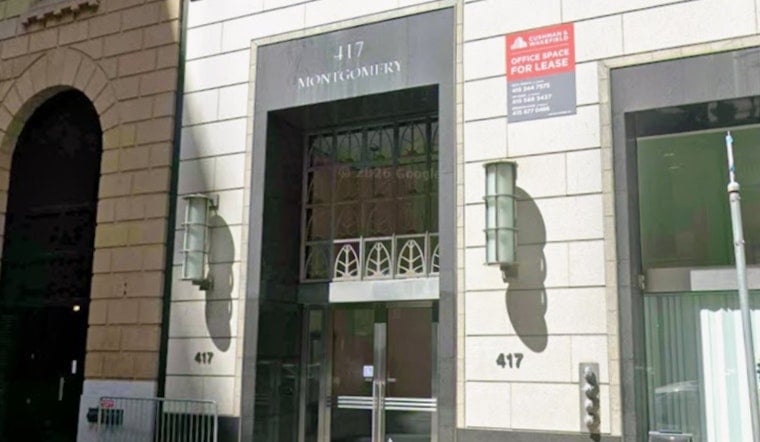
A 10-story office tower at 417 Montgomery Street in San Francisco's Financial District has changed hands for $25.2 million, with a partnership of Menlo Park-based real estate firms betting that artificial intelligence startups will succeed where a Planet Fitness gym recently failed. The building, known as the Lurie Building, was roughly 70 percent vacant at the time of sale, and its former fitness tenant was ordered to vacate in August after falling more than $500,000 behind on rent.
The deal closed on August 31, according to The Real Deal, with a newly formed entity called 417 Montgomery LLC purchasing the roughly 96,000-square-foot building from a group of sellers that included DCN LLC, DCN 2012 LLC, Cushman Neal Family LLC, Entrex Holdings LP, CGIT Enterprises LLC, and San Francisco Assets LLC. The buyer is a partnership between Kenson Ventures Real Estate, led by principal John Fong, and Wheatley Properties, whose principal is Christian Hansen. Cushman & Wakefield brokered the sale, and Fong and Hansen also signed documents for a $28.5 million loan from East West Bank tied to the property.
The purchase marks the first full entry into San Francisco's market for both Fong and Hansen, according to the same report. Kenson Ventures brings more than 30 years of Peninsula commercial, life science, and mixed-use development experience, per a Thesis Driven profile of the firm, though the 417 Montgomery deal represents its first full-ownership office acquisition in the city. Hansen is also a passive investor in 550 California, a 14-story Class A office building nearby.
A Gym's Rent Trouble Opens the Door for AI Tenants
Planet Fitness was ordered to vacate 417 Montgomery in August after falling behind on rent by more than $500,000, the report notes. The new owners now plan to overhaul the building's first floor, replacing it with a lobby and amenity center, and to convert the property from a Class B building into Class A office space aimed squarely at the artificial intelligence boom reshaping downtown leasing.
“AI companies are growing rapidly in San Francisco,” Hansen said, according to the same account, adding that the city's appeal to AI talent and companies has increased sharply. He said he plans to target AI, technology, and venture capital firms as tenants going forward. The building already counts a law firm, the design studio Revel Architecture & Design, and artificial intelligence companies among its current tenants.
Building's Physical Condition Made It Market-Ready
Marketing materials from when the building hit the market in March showed it had already received more than $4 million — roughly $40 per square foot — in capital improvements since 2023, including modernized elevators, new HVAC systems, a new roof, and exterior facade restoration, according to The Registry. Those same materials indicated that roughly 45 percent of the existing office buildouts were immediately reusable for new tenants, and the building was listed at 27 percent occupancy with boutique floor plates averaging about 8,700 square feet and four sides of window lines on its upper floors.
Those floor plates line up with how San Francisco's office market is actually leasing right now. Commercial leasing data from 2025 shows that 74 percent of all office leases signed across the city were for spaces under 10,000 square feet, according to the same Registry report — a pattern that lets mid-sized AI and tech companies lease entire dedicated floors rather than fractions of larger ones. Citywide, San Francisco's office vacancy rate stood at around 30 percent by the end of the second quarter.
Discount Pricing Reflects Broader Downtown Valuation Gap
The $25.2 million sale price works out to a little more than $260 per square foot, a steep discount compared to other recent downtown transactions. The Real Deal notes that 401 Kearny Street sold for nearly $720 per square foot in August, while 800 Market Street sold for $342 per square foot in October 2025 — pricing gaps that reflect how modernized Class A headquarters buildings still command far more than older Class B stock even after renovation.
The sale also generated more than $1.5 million in transfer tax, per public records, thanks to San Francisco's Proposition I, approved by voters in November 2020, which set a 6.0 percent transfer tax rate on property transactions valued at $25 million or more. That tax burden sits inside an ongoing local political fight: Mayor Daniel Lurie and Supervisor Bilal Mahmood introduced the BUILD Act in February to cut the transfer tax on $25 million-plus deals to 3.0 percent, but paused that initiative in June in favor of a measure targeting commercial foreclosures, according to Greenberg Traurig.
Notably, the new owners are choosing to keep 417 Montgomery as commercial office space rather than pursue a residential conversion, even though San Francisco voters approved Proposition C in March 2024 to exempt commercial-to-residential office conversions from local transfer taxes — an incentive Hoodline previously covered in the context of other underutilized downtown buildings. Instead, Fong and Hansen are wagering that AI-driven office demand will fill the tower faster than housing conversion would.
A Depression-Era Landmark With Deep San Francisco Roots
The Lurie Building was constructed in 1936, and marketing materials reportedly described it as the first major U.S. structure built after the start of the Great Depression. It was designed by architect Wilbur D. Peugh, who had previously designed the Title Insurance Company Building at 130 Montgomery Street in 1930 and later designed 120 Montgomery Street and 600 California Street, according to Art and Architecture SF. The building's namesake, Louis R. Lurie, built nearly 300 office buildings during his career.
The site's history stretches back even further. In 1877, the location housed Morse's Gallery, where photographer Eadweard Muybridge created his famous 360-degree panoramic views of San Francisco, according to the Getty Museum, a milestone that remains a touchstone of 19th-century American photography nearly a century and a half before the building's newest owners set their sights on the AI economy.


