

























































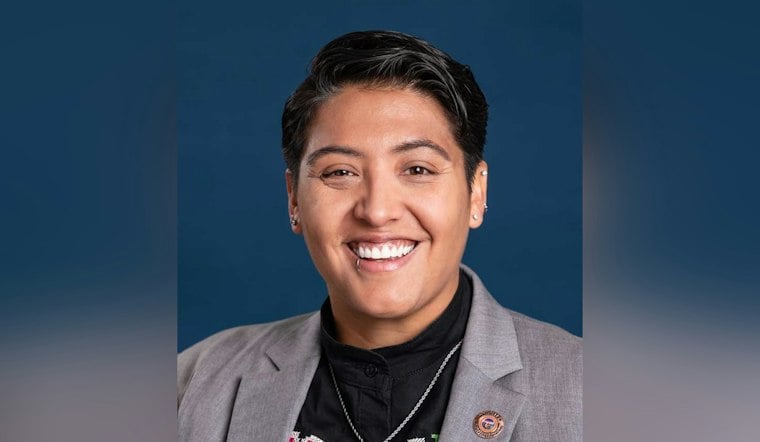
Arizona state Representative Lorena Austin says they were nowhere near downtown Mesa when Turning Point Action activists began circulating AI-generated photos claiming to show the West Mesa Democrat planting a Democratas Por Biggs campaign sign. Austin, who represents District 9, says the images are fake, and now everything is on the table regarding possible legal action.
The deepfake images depicted Austin placing a sign supporting Republican gubernatorial candidate Andy Biggs in downtown Mesa, according to Phoenix New Times. Austin was out of town when the images began circulating, and told the outlet the photos simply were not of them. Captions accompanying the posts suggested Austin had joined Turning Point's push for Biggs, even though Austin has publicly supported Governor Katie Hobbs' reelection campaign.
Turning Point activist Matt Whitmire posted one of the fabricated photos, and Turning Point Action Chase the Vote manager Mary Ann Mendoza posted a second image of Austin near a campaign sign. Mendoza ran unsuccessfully against Austin twice, including in the 2022 general election for House District 9 that made Austin the state's first openly nonbinary and Chicana state legislator, according to Wikipedia. Activist Mindy Little also posted a Grok-created video using the same deepfake photo, though the video depicted people speaking Spanish while the deepfaked Austin image was notably absent from that clip.
Tattoos, Watches and Telltale AI Artifacts
The fabrication wasn't subtle once examined closely. The deepfake photos contained inconsistent placement of Austin's eagle tattoo and watch, and the campaign signs in the images carried inconsistent wording between versions. Automated forensic analysis using Deepfake Detector evaluated Whitmire's image and assigned it a 100% AI score, according to reporting by KJZZ reporter Wayne Schutsky, citing severe visual artifacts including misplaced tattoos and unnatural hands, per KJZZ.
None of the posts disclosed that the Austin image was AI-generated, a detail with legal significance in Arizona. Turning Point activists later deleted the deepfake posts, and Turning Point USA did not respond to Phoenix New Times' request for comment. Turning Point Action never contacted Austin about supporting Biggs' campaign, and the Biggs campaign itself did not contact Austin either.
A Campaign Disavowal Amid Friction
Biggs campaign spokesperson Drew Sexton wrote that the post was not from or connected to the Andy Biggs campaign, distancing the official operation from the activists' online conduct. Democratic strategist Michael Beyer called the output ai-generated fantasies, while political consultant Chuck Coughlin called the post disgusting and misleading. Democratic strategist Tony Cani said the posts were unethical even if intended as a joke, and Republican consultant Barrett Marson suggested the post might reflect the state of the election for team Biggs. Communications consultant Jeremy Helfgot said Austin's nonbinary identity may have contributed to why they were targeted.
Arizona's Untested Deepfake Statutes
The episode is emerging as one of the first practical tests of Arizona's 2024 AI campaign laws. The Arizona State Legislature passed two bills that year targeting deceptive AI campaign content, and Governor Hobbs signed HB 2394 and SB 1359 into law, establishing civil protections against digital candidate impersonations and requiring disclaimers on AI-generated political media distributed within 90 days of an election, according to KAWC. Notably, Republican Representative Alexander Kolodin, who authored HB 2394, said in June 2024 that he used ChatGPT to help draft the bill's definition of deepfake, an approach legislative trackers cited as a first for AI-assisted state lawmaking, per KJZZ.
Under ARS 16-1023, a candidate can seek preliminary and permanent relief against the payee of a digital impersonation when the image is not identified as inauthentic and would not be obvious as an impersonation to a reasonable person. The statute gives targeted candidates a two-year window from the date of discovery to file an expedited Superior Court action for declaratory and injunctive relief, according to the League of Arizona Cities and Towns. A companion law, ARS 16-1024, requires clear identification that covered synthetic media was made by artificial intelligence, prohibits distributing a known fraudulent deepfake of a ballot candidate within 90 days of an election, and sets a $10 fine per day for undisclosed distributed content.
A Prior Case Fizzled Before Trial
The statutes have already been tested once, and not successfully. Former Republican state Representative Joseph Chaplik filed a lawsuit in July 2026 against Virginia-based super PAC Conservatives for Effective Government, citing the AI statutes after the group aired ads showing an AI-generated image of Chaplik wearing a shirt bearing a black fist. That case was the first to cite Arizona's deepfake statutes, but attorney Dennis Wilenchik said the Chaplik case was not ongoing. Chaplik lost the Congressional District 1 Republican primary to Jay Feely shortly after filing, according to Phoenix New Times.
Arizona's laws sit within a fast-growing national patchwork. As of June 2026, 29 U.S. states had enacted election-related AI deepfake regulations, while federal standards remained stalled in Congress. Turning Point USA formed a dedicated Arizona PAC in December 2025 specifically to challenge Hobbs and support Biggs, part of a broader push that Hoodline has tracked as the group directs resources toward statewide and local contests. Public polling in September 2026 showed Hobbs holding a lead over Biggs, buoyed by support from moderate independent voters and a fraction of moderate Republicans, per KJZZ.
For now, Austin says the matter remains under consideration. Everything is on the table regarding legal action, Austin told Phoenix New Times, leaving open whether the West Mesa lawmaker will become the next Arizona candidate to test the state's still-largely-untried deepfake statutes in court.




