

























































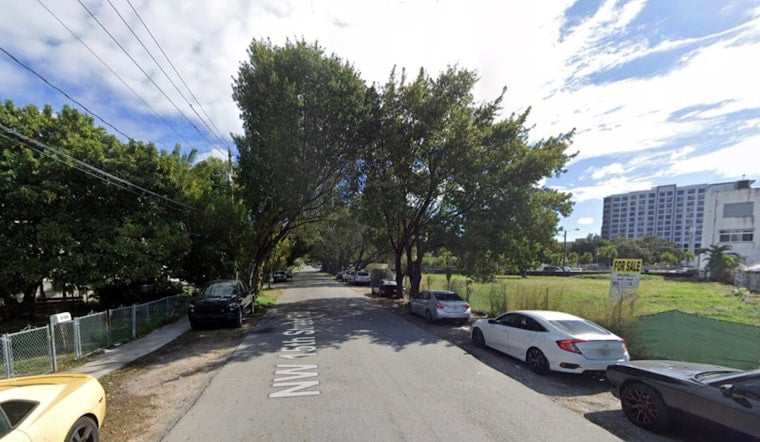
A vacant parcel just steps from Jackson Memorial Hospital is now home to construction crews building The Triangle, an eight-story, 112-unit apartment tower aimed at the tens of thousands of workers who staff Miami's Health District every day. The project, backed financially by developer Daniel Dias, sits at 1750 NW 15th Street Road on a 0.7-acre site that a Dias-led entity picked up for $1.7 million, and it's being built entirely under Florida's Live Local Act.
According to The Real Deal, the $35 million project is the latest ground-up build from DFRE, the five-year-old, Miami-based firm founded by Dias in 2021 and now led alongside architect-by-training Laura Weinstein-Berman, who joined the company shortly after it launched. The Triangle will offer studios of about 450 square feet to tenants earning up to 120 percent of the area median income, the threshold set under the state's workforce housing law. Per ODP Architects, which designed the building, the 131,000-square-foot tower will also include ground-floor retail, a 3,500-square-foot gym at street level, a 10,000-square-foot pool terrace on the fifth floor, and 72 parking spaces spread across four levels of structured parking.
A Health District Built for Its Own Workforce
The site sits inside the 153-acre Miami Health District, also called the Civic Center, which ranks as the nation's second-largest medical district and includes Jackson Memorial Hospital, the University of Miami Health System, and the Miami VA Healthcare System — institutions that together employ roughly 46,000 workers, according to Highland Park Miami. That concentration of hospital staff, students, and administrators gives a project like The Triangle a built-in pool of potential tenants within walking distance of work.
The Real Deal's report notes The Triangle is expected to be finished in early 2028, adding another data point to what remains a fairly short list of ground-up Live Local Act construction. Developers have filed a wave of Live Local applications over the past three years, but the same reporting from The Real Deal, written by Lidia Dinkova, describes actual groundbreakings as relatively rare — with many projects instead converting completed market-rate buildings into workforce housing or targeting office-to-residential redevelopment rather than building from scratch.
DFRE's Track Record Around Miami
DFRE has built a portfolio that reaches beyond the Health District into industrial, retail, hospitality, and workforce housing, and the firm says it holds onto and manages its own buildings for the long term rather than flipping them. Its résumé includes El Jardin, an adaptive reuse project in Little Havana that's now open, and 1536 Health District, a 40-unit workforce project built on a 5,400-square-foot lot that's also open today. The company additionally operates Gold Lake Industrial in Medley and brought Peach on 14th, a live-work project in Overtown with three units, into its portfolio.
Weinstein-Berman spent five years working on Peach on 14th, which reserves units for households earning no more than 50 percent of area median income and drew financing from both the Omni Community Redevelopment Agency and the Florida Community Loan Fund. She told The Real Deal that DFRE personally investigates neighborhoods before picking development sites, explaining that the surrounding area itself signals what kind of project it can support. Looking ahead, DFRE has additional plans on the boards, including a 143-unit workforce project called 1620 Little Havana and a 2-acre retail development in Fort Lauderdale.
The Legal Framework Making It Possible
Florida lawmakers passed the Live Local Act in 2023, and the law lets developers build larger buildings and skip public hearings, rezoning votes, and comprehensive-plan amendments as long as at least 40 percent of units go to households earning up to 120 percent of area median income for 30 years, according to Bilzin Sumberg. The law also grants tax breaks to qualifying landlords. This July, House Bill 1389 took effect as the fourth major statutory update to the act, expanding which commercial and industrial parcels qualify while explicitly barring cities from using setback or stepback rules to shrink state-authorized building heights, per Holland & Knight.
The financial math shifted too. In May, the Florida Housing Finance Corporation raised income and rent limit standards by 9 percent across most of the state, according to Bilzin Sumberg, pushing up the allowable rent caps that make these workforce projects pencil out financially even as borrowing costs stay elevated.
Part of a Bigger Regional Push — and Fight
Miami-Dade County's affordable housing shortfall tops 90,000 units, a gap that has pushed both public and private responses, including Mayor Daniella Levine Cava's $86 million HOMES initiative, according to the Greater Miami Housing Alliance. Other developers have leaned on Live Local incentives across the region this year: a joint venture between Ascentris and ZOM Living landed a $92.3 million construction loan in April to tear down an office building in Doral and build the 380-unit Hazel Doral, while Affiliated Development closed a $74 million loan in July for The Cove, an eight-story, 376-unit Live Local project in Fort Lauderdale. Separately, developer Daniel Abreu secured a Live Local Act construction loan in 2024 for an 80-unit building near North Miami.
Not every municipality has welcomed the state's preemption of local zoning power. A Broward County court sided with the City of Hollywood in March against a developer's proposed 17-story beachfront Live Local tower, and Florida Attorney General James Uthmeier filed an amicus brief in April backing a roughly 240-unit Live Local project at Bal Harbour Shops over objections from the wealthy village. Just west of Wynwood in Allapattah, developers have also unveiled plans for a 20-story, 280-unit Live Local tower, underscoring how the same state law is reshaping neighborhoods across Miami-Dade at very different scales.





