

























































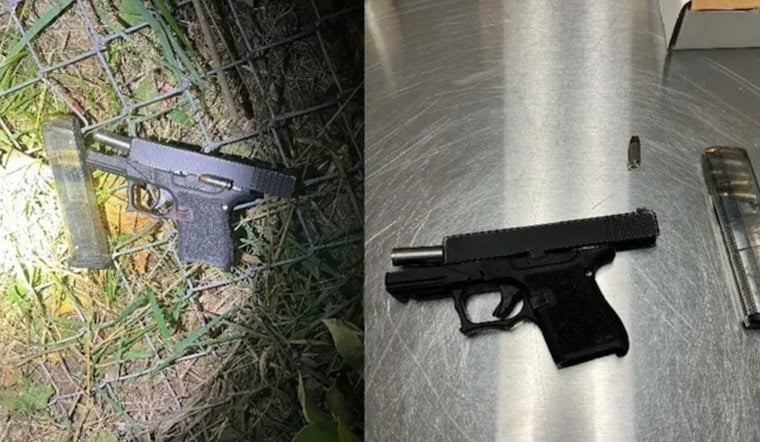
A 36-year-old Minneapolis man will spend the next 20 years in federal prison after a late-night traffic stop in New Hope turned into a high-speed chase that ended with his SUV spinning out in a Minneapolis yard and a loaded, unserialized handgun turning up near a knocked-over fence. Esau Chucky Sago was sentenced to 240 months in federal prison on September 3, 2026, after a jury convicted him of illegally possessing ammunition as a repeat violent offender.
U.S. District Judge Nancy E. Brasel handed down the sentence, which followed a two-day jury trial that ended with Sago's conviction on November 18, 2025. According to FOX 9, prior felony convictions had already barred Sago from possessing any ammunition or firearm, making his ninth felony conviction the trigger for a lengthy federal sentence rather than a state case.
The case began at approximately 12:45 a.m. on October 10, 2024, when New Hope police department officers spotted a white SUV with obstructed or missing license plates and what appeared to be a rushed paint job intended to make it look white, according to an announcement from U.S. Attorney Daniel N. Rosen's office. Officers attempted to stop the SUV, but Sago sped away from New Hope police, driving through residential areas at speeds exceeding 70 mph for several miles.
Chase Ends With a Fence Down and a Gun in the Grass
The pursuit pulled in officers from New Hope, Crystal, and Robbinsdale police departments before a Crystal police department officer used a PIT maneuver to end it. Sago's SUV knocked over a fence and ultimately spun out and landed in a Minneapolis yard, per the same Justice Department account. Sago was the only person in the vehicle.
After the SUV was towed, an officer found a loaded handgun with no serial number resting on the fence — the kind of untraceable firearm commonly referred to as a ghost gun. The Minnesota Bureau of Criminal Apprehension forensic laboratory later found Sago's DNA on the pistol grip, the magazine base, a magazine round, and the chambered round.
Nine Felonies and a Federal Career-Criminal Label
Sago's record includes two convictions for domestic assault and one for domestic assault by strangulation, along with prior convictions for fleeing police in a motor vehicle, making threats of violence with reckless disregard for others, and vehicle theft. Those qualifying offenses led prosecutors to classify him as an armed career criminal, a designation under the federal Armed Career Criminal Act that carries a mandatory minimum sentence of 15 years in prison, according to Eisner Gorin LLP. Under 18 U.S.C. § 924(e), a defendant convicted of unlawful firearm or ammunition possession with at least three prior violent felony or serious drug convictions faces that mandatory floor with no chance of federal parole.
U.S. Sentencing Commission data show that more than 38% of federal offenders who qualify under the Armed Career Criminal Act receive sentences of 20 years or longer, according to the commission's 2021 analysis — putting Sago's 240-month term in line with typical outcomes for repeat violent offenders facing the same statute.
Sago was indicted on February 26, 2025, months after the October 2024 chase, and a jury ultimately found him guilty of illegally possessing ammunition despite his felon status. Rosen said the defendant is a danger to the community and placed law enforcement officers' lives at risk, adding that the sentence protects public safety and holds Sago accountable. ATF St. Paul Field Division Acting Special Agent in Charge Matthew Olson publicly commended the joint work of the Minnesota Bureau of Criminal Apprehension and local police departments, saying Sago's history of violence before the pursuit showed he posed an ongoing threat to public safety.
A Broader Fight Over Untraceable Guns
Sago's case lands amid a wider legal and legislative reckoning in Minnesota over ghost guns. In August 2025, the Minnesota Supreme Court ruled that state law did not explicitly ban untraceable firearms unless federal standards required it, a gap that prompted state lawmakers this year to advance legislation, HF 3407 and SF 3661, aimed at closing the loophole, according to the Minnesota Attorney General's Office. Hoodline has previously reported on the state Senate's push toward a ghost gun crackdown as well as Minneapolis police operations that have turned up unserialized weapons in local neighborhoods.
Federal prosecutors have targeted ghost gun activity in Minnesota before. In September 2022, the U.S. Attorney's Office charged a Minneapolis resident accused of using 3D printers to manufacture untraceable machinegun parts, and in April 2023 a federal court sentenced a Sauk Rapids man to five years in prison for manufacturing and selling untraceable ghost guns and kit assembly tools out of his home. Sago's own contact with Minnesota's justice system over firearms goes back further still — a January 2012 arrest in St. Paul for felon in possession of a firearm led to state appellate litigation that eventually reached a U.S. Supreme Court petition in 2014.
The U.S. Attorney's Office for the District of Minnesota relies on its Project Safe Neighborhoods initiative to coordinate joint operations between suburban police departments and federal prosecutors, channeling federal resources toward repeat violent offenders carrying illegal weapons or ammunition. Federal ammunition possession charges under 18 U.S.C. § 922(g) have become a go-to tool for prosecutors in the state; a September 2024 case using the same statute resulted in more than seven years' imprisonment for another repeat felon. Along with the 240-month prison term, Sago was also sentenced to five years of supervised release.





