

























































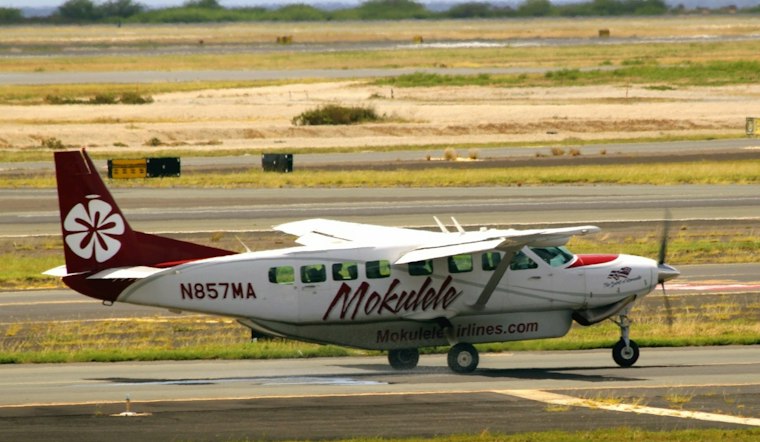
Mokulele Airlines has been awarded a $19.4 million federal contract to keep flying between Lanai, Honolulu and Kahului for the next four years, locking in essential air service for the island through August 2030. The deal, announced in a Monday news release from parent company Surf Air Mobility, doubles the length of Mokulele's previous two-year agreement and comes as the carrier tries to shake off a rocky recent history of delays and groundings that have frustrated neighbor island residents.
According to Maui News, Mokulele was selected through a competitive process after the U.S. Department of Transportation cited the airline's existing infrastructure in Hawaii, its history of serving Lanai, and its connections with other airlines. Under the new Essential Air Service contract, Mokulele will operate 63 round trips each week to Lanai — 42 weekly round trips between Lanai and Honolulu, and 21 between Lanai and Kahului — totaling 126 flights a week. Louis Saint-Cyr, president of airline operations at Surf Air Mobility, called the award an honor. “It is an honor to have been selected by the DOT to continue operating the Lanai EAS contract,” Saint-Cyr said, according to the same report, adding that Mokulele provides safe, reliable and profitable air service in Hawaii.
How the New Deal Compares to the Original 2024 Contract
The USDOT's initial EAS award to Mokulele for Lanai in August 2024 provided a total subsidy of roughly $8 million across two years. Federally subsidized air service on Lanai only began in 2024 after Mokulele filed a 90-day termination notice with the USDOT in December 2023, citing rising operating costs that made unsubsidized routes unprofitable, as reported by Hawaii Public Radio. Lanai and Molokai were actually designated as EAS-eligible airports back in 1983, but the islands operated without subsidies for four decades until that 2024 shift.
Mokulele's win wasn't uncontested. Pacific Air Charters and Massachusetts-based Cape Air also submitted proposals for the 2026 Lanai contract, with Pacific Air Charters requesting between $6.5 million and $7 million over two years, per the same Hawaii Public Radio account. The competitive process highlighted growing interest from rival carriers in interisland commuter routes that were once considered too thin to sustain multiple operators.
A Lifeline for an Island Largely Owned by One Billionaire
Lanai's dependence on air travel is sharpened by an unusual fact: over 98% of the island's land is owned by billionaire Larry Ellison, leaving residents reliant on daily flights to Honolulu and Maui for specialized healthcare, professional services and government appointments, per Hawaii Public Radio's reporting. Lanai Air flights are expensive, making the federal subsidy an important source of air service for islanders.
That necessity has collided with real frustration. The USDOT required Mokulele to submit monthly flight timeliness reports during its 2024 contract — defining an on-time arrival as one arriving within 15 minutes of the scheduled arrival time — after widespread resident complaints about delays and cancellations, Hawaii Public Radio reported. Mokulele also saw significant service disruptions in August 2024 following FAA maintenance inspections, and it temporarily suspended fleet operations again in early 2025 for further safety checks, according to The Molokai Dispatch. Those groundings prompted state transportation officials to explore backup emergency charter options for residents needing medical transport.
Fleet Upgrades and an Eye Toward Electric Flight
Mokulele has spent the past year trying to rebuild trust with upgraded ground and passenger facilities and the addition of Cessna Caravan aircraft to its fleet, according to Maui News. The carrier currently operates about 112 daily departures across five Hawaii islands. Those investments follow a $22.4 million plan Surf Air Mobility announced in January to modernize Mokulele's fleet, airport lounges and operating software across its Hawaii network, as detailed by Business Wire.
Hoodline previously reported on Mokulele's three new planes and reopened terminal, which detailed the same fleet expansion and 2024 contract history now central to this larger, longer-term award. Throughout 2025, Mokulele operated approximately 36,000 scheduled departures and carried 224,000 passengers across its network, maintaining an average stage length of 51 miles across nine served airports, figures that underscore just how much of Hawaii's interisland travel runs through the carrier's schedule.
Surf Air Mobility is also positioning Mokulele as a testbed for electric aviation. In March, the company placed a firm order for 25 five-passenger BETA ALIA electric aircraft, with options for 75 more, naming Mokulele as the launch operator for commercial interisland electric service once FAA certification is achieved — something Aviation International News reports BETA is targeting for early 2027. This past summer, BETA Technologies and Surf Air completed a demonstration campaign in Hawaii, according to Hawaii Public Radio's coverage of the trials. Surf Air has framed the effort as part of a broader push to operate the first commercial passenger electric flights in the country, even as it works to prove its existing propeller fleet can reliably serve the very communities it now hopes will fly electric.





