

























































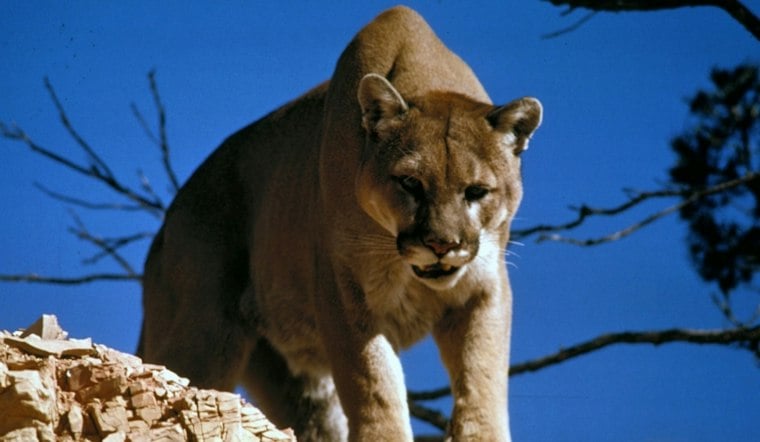
Conservation officials have alerted the public to confirmed mountain lion sightings in southwestern Illinois, with the same animal believed to have been spotted multiple times across Union and Jackson counties near Shawnee National Forest. Wildlife authorities say encounters like this remain exceedingly rare in the Prairie State, making the sightings notable even as they fit a familiar pattern of wandering young males passing through rather than settling down.
According to the Illinois Department of Natural Resources, the mountain lion sightings in Union and Jackson counties are believed to involve a single animal moving through the area near Shawnee National Forest. Illinois has recorded just 12 confirmed mountain lions in the last 25 years, according to the report, underscoring how uncommon it is for the state's wildlife agency to verify a cougar's presence at all.
Male mountain lions can grow five to eight feet long, weigh between 110 and 160 pounds, and stand roughly 30 inches tall at the shoulder, per the same report, while females tend to run slightly smaller. DNA analysis on previous Illinois mountain lions has traced their origins back to Nebraska and the Dakotas, the outlet notes, with the animals traveling across multiple states before reaching Illinois. Mountain lions have also been observed in the Chicago area in recent years, including one shot and killed in the Rogers Park neighborhood and another struck and killed by a vehicle on Interstate 88 in DeKalb County in 2022.
Why a Single Cat Can Show Up in Multiple Counties
Wildlife biologists say a lone disperser can easily generate several sightings across neighboring counties in a short window. Dispersing male mountain lions require a minimum home range of approximately 70 square miles and wander large distances, according to University of Illinois Extension research, as young males wander hundreds of miles eastward from western states in search of territory of their own.
That research also found that Illinois lacks the sort of sufficient contiguous forested habitat needed to support a permanent, breeding mountain lion population, despite the state's high white-tailed deer numbers. Mountain lions were historically among the top native predators in Midwestern ecosystems, but Wildlife Illinois notes they were extirpated from the state prior to 1870, as European settlers converted native forests and prairies into farmland. That history helps explain why today's confirmed sightings, however striking, don't signal that cougars have returned to stay near Shawnee National Forest.
A History Shaped by Past Encounters
Between 2002 and 2013, state wildlife records documented four sub-adult male mountain lion mortalities in Illinois, including a cat killed by a train in Randolph County in 2002 and a cat shot by police in Chicago's Roscoe Village in 2008, according to Wildlife Illinois. Public reaction to those police shootings helped push state lawmakers to act. In August 2014, Governor Pat Quinn signed Senate Bill 3049 into law, amending the Illinois Wildlife Code to protect mountain lions, black bears, and gray wolves effective January 1, 2015, per reporting from the Illinois Sierra Club at the time.
That shift moved state policy away from lethal eradication and toward protection and passive surveillance, even as tension persists between safeguarding wide-ranging predators and addressing public safety concerns in suburban or rural communities. Illinois law now prohibits killing or harassing a mountain lion unless it poses an imminent threat to a person or property, and it protects the animals from hunting altogether.
Trail Cameras Are Catching More Cats
Modern trail camera technology has made these detections far easier than in decades past. In April 2025, trail camera footage in Pike County captured a young male mountain lion passing through an area a turkey hunter had occupied just hours earlier, according to footage reviewed by KHQA. IDNR partners with the University of Illinois Extension and the USDA to run a dedicated online portal on WildlifeIllinois.org, where residents can submit citizen reports, trail camera photos, and location coordinates for large carnivores — though officials note most submitted reports ultimately turn out to be bobcats or feral domestic animals.
The state has also handled tracked cougars directly when they wander near populated areas. In October 2022, IDNR tranquilized a young male mountain lion on the western edge of Springfield and relocated it to an Indiana sanctuary, after following its movements via a GPS collar that Nebraska researchers had fitted in late 2021; that animal had crossed Nebraska and Iowa before entering central Illinois. Highway crossings remain a persistent hazard for these wide-ranging animals, and the 2021 Bipartisan Infrastructure Law authorized $350 million for a federal Wildlife Crossings Pilot Program to build overpasses and underpasses meant to reduce vehicle collisions with migrating wildlife, according to Barn Raiser.
What to Do If You Encounter One
Anyone who spots a mountain lion is urged to report the sighting to the Illinois Department of Natural Resources, leave the animal alone, and avoid direct contact. Experts advise that people should never run, since a fleeing person can trigger a mountain lion's predator response and prompt it to give chase.
Instead, residents encountering a mountain lion should make noise so the animal is aware of their presence, give it as much space as possible, and avoid playing dead. Mountain lions are more likely to attack when they feel trapped or provoked, and anyone who is approached or attacked should fight back rather than go passive. Landowners dealing with non-immediate cougar conflicts also have an administrative option: under the Illinois Wildlife Code, they can apply to IDNR for a nuisance permit to legally capture or remove an animal without running afoul of the state's harassment bans, according to the City of Highland Park.





