

























































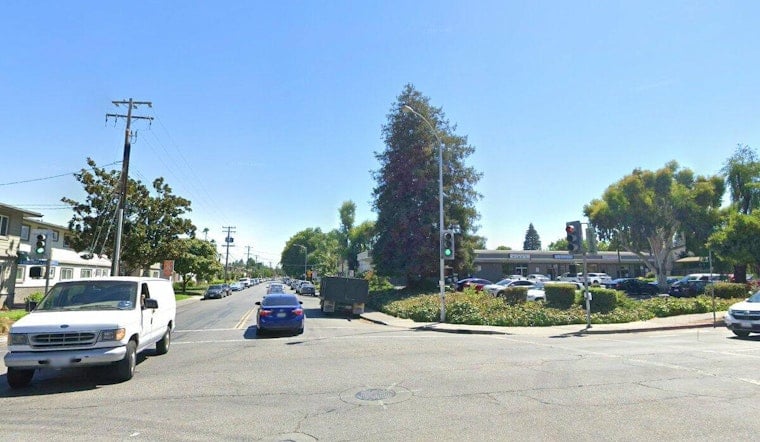
Mountain View's Council Transportation Committee is steering the redesign of Rengstorff Avenue toward keeping all four existing vehicle lanes intact, even though the 1.7-mile corridor sits on the city's High Injury Network and has a history of severe collisions. About two dozen community members showed up to weigh in at a recent committee meeting, with many urging the city to add protected bike lanes and improve sidewalks and crosswalks along the busy street.
The corridor runs from El Camino Real to Leghorn Street, passing just south of U.S. Highway 101, and currently carries two vehicle lanes in each direction, on-street bike lanes, and roughly 250 parking spots, according to a city staff report cited by the Mountain View Voice. Rengstorff also serves as a Safe Routes to School corridor for Monta Loma Elementary, Crittenden Middle School and Los Altos High School, and it carries VTA bus lines that rely on its vehicle lanes to stay in service. Street parking is concentrated particularly north of Central Expressway, while sidewalks along the route range from four to six feet wide and the posted speed limit sits at 35 mph.
Three Alternatives, Three Different Tradeoffs
City staff presented the committee with three design alternatives, each carrying different consequences for parking and bike infrastructure. Alternative A serves as a baseline option focused on improving intersections and safety at key crossings — including trouble spots near Wyandotte Street, Junction Avenue and the Waldorf school — while retaining all existing on-street parking, per the Voice's report.
Alternative B builds on that baseline by adding protected bike lanes, but the report notes it would require removing about 64% of street parking along the corridor. Alternative C instead adds wider sidewalks and green elements on top of Alternative A, requiring removal of about 48% of parking. Transportation Manager Lauren Ledbetter told the committee the city could not combine every element of all three alternatives without accepting tradeoffs somewhere, and she identified reducing vehicle lanes as one possible option the city considered.
Committee Members Split Over Priorities
Council members expressed clear concerns about removing street parking even as they voiced support for improving safety for bicyclists and pedestrians. John McAlister argued that removing street parking would harm the wider community and said vehicle accessibility is critical to keeping public transit running, adding that “people need to take cars.” He said he preferred better markings for the existing bike lanes rather than new protected lanes, and he opposed adding protected bike lanes to the corridor.
Ellen Kamei struck a different tone, saying the community has repeatedly asked for a more walkable and bikeable city and emphasizing the importance of corridor safety for students who use Rengstorff to get to school. She said she favored a combination of Alternatives B and C. Alison Hicks suggested reducing the medians to free up space for protected bike lanes and street parking, calling widened sidewalks a lower priority and saying some parking would probably need to be eliminated carefully.
A citywide traffic analysis found that removing driving lanes would cause significant and unacceptable impacts at multiple intersections, a finding that appears to be steering the city away from any reduction in vehicle capacity. Some community members at the meeting favored reducing driving lanes anyway, but the committee ultimately asked city staff to clarify the tradeoffs further before moving forward, according to the Voice.
A High-Priority Corridor With State Backing
The stakes behind the redesign trace back to state funding. Caltrans awarded Mountain View $352,000 for the Rengstorff Avenue Complete Streets Study, according to Caltrans. The corridor sits on the city's High Injury Network and was identified as the highest-priority corridor in the city's Comprehensive Modal Plan. The designation reflects the corridor's history of severe collisions.
The corridor has already seen targeted safety upgrades ahead of the broader redesign. In December, the city completed a $1.16 million traffic signal and safety overhaul at Rengstorff Avenue and Latham Street, adding protected left-turn signals, green bike lane markings and an artificial intelligence video detection system to monitor traffic in real time, as reported by San José Spotlight. That intersection had previously lacked dedicated left-turn phases, creating conflicts between turning vehicles and crossing pedestrians.
How Rengstorff Compares to Other Corridors
The reluctance to touch vehicle lanes on Rengstorff stands out against Mountain View's own recent track record. The city approved a road diet for El Monte Avenue in 2023, cutting travel lanes from four to three to improve pedestrian safety, and it launched construction on a similar four-to-three-lane pilot along California Street in 2025, complete with protected bike lanes. Both projects show the city has been willing to trade car capacity for safety elsewhere, even as staff and committee members balk at doing the same on Rengstorff, where traffic models predict significant intersection backups.
Part of the difference may come down to what else is happening on the corridor. Rengstorff is simultaneously the site of Caltrain's Rengstorff Avenue Grade Separation Project, which includes a new pedestrian overcrossing, according to Caltrain. The Santa Clara Valley Transportation Authority and Caltrans are also planning interchange upgrades at Rengstorff Avenue and Charleston Road, along with San Antonio Road, to improve freeway access at the corridor's northern end near U.S. 101. The Mountain View Police Department has also relied on Rengstorff as an event traffic detour, directing westbound egress from Shoreline Amphitheatre onto the avenue during Fourth of July celebrations.
Staffing Shortfalls Loom Over Bike Projects Citywide
The Rengstorff debate follows a pattern Hoodline previously reported on Terra Bella Avenue, where the City Council shelved a planned bike lane feasibility study after staff revealed the transportation division was operating with only two of five positions filled. That staffing gap adds context to why city staff may be cautious about committing to more ambitious multimodal redesigns even on a corridor identified as a top safety priority.
Public input on Rengstorff has included a February 27 event at the Mountain View Community Center. A community survey covering the different road design options remains open through September 11. City staff plan to narrow the options down to a single preferred design by early 2027, one that will incorporate feedback from the Council Transportation Committee, community members and the Bicycle and Pedestrian Advisory Committee. According to the staff report, the final redesign proposal is expected to go before the full City Council in April 2027.




