

























































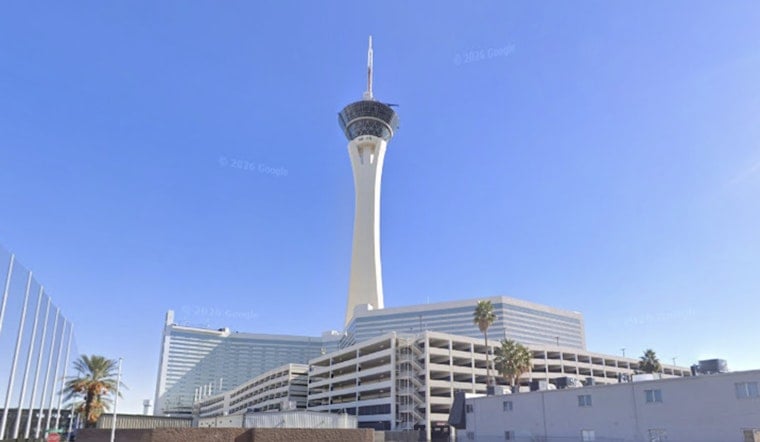
For more than a month as of late August, the Naked City neighborhood tucked behind The STRAT recorded zero violent crime — a stunning milestone for a pocket of Las Vegas that spent decades as shorthand for drug use and gang activity. Calls for service in the surrounding Gateway District have fallen from 6,352 in 2022 to a projected 4,000 this year, and a wave of new restaurants, renovated apartments, and a from-the-ground-up housing project are moving into a neighborhood that hadn't seen new residential construction in over 65 years.
A Neighborhood Built for Casino Workers, Then Left Behind
Naked City sits north of the Strip, just behind The STRAT hotel-casino, stretching from West Sahara Avenue north to East Charleston Boulevard near Interstate 15, according to the Las Vegas Review-Journal. The area was platted in the 1920s as the Meadows Addition and originally provided centrally located housing for casino workers on the northern Strip, according to the Las Vegas Review-Journal. Local legend has long credited the Naked City nickname to showgirls sunbathing nude on apartment rooftops in the 1950s and 1960s, per the Review-Journal's original reporting, though local news media and police logs officially attached the moniker during an early 1980s surge in gang activity. Whatever its origin, the name stuck as the neighborhood became, in later decades, a haven for drug use and crime.
That history had real consequences for the neighborhood's biggest neighbor. The STRAT, which opened in 1996 as the 1,149-foot Stratosphere Tower under casino pioneer Bob Stupak, filed for Chapter 11 bankruptcy in 1997 partly because of depressed visitor foot traffic tied to the adjacent high-crime area, before financier Carl Icahn purchased the property in 1998. Golden Entertainment later bought the tower and rebranded it as The STRAT in 2019. Today, the Review-Journal reports, The STRAT partners with other business leaders and property owners on safety and cleanliness discussions in the district.
Police Credit a Model Built in West Las Vegas
The turnaround has coincided with the Las Vegas Metropolitan Police Department's 2022 expansion of its Safe Village Initiative into the Gateway District — a community-policing strategy designed to reduce violent crime by addressing its root causes, per the Review-Journal. LVMPD first launched the framework in West Las Vegas back in 2007, earning the department the International Association of Chiefs of Police's Webber Seavey Award for Quality in Law Enforcement in 2011. Metro now dedicates two full-time officers to Naked City specifically. Metro Sgt. Miles Peshlakai reported that crime was down month over month in the neighborhood, and told the Review-Journal that Naked City had gone more than a month without a single violent crime as of late August.
The agency deploying that strategy, LVMPD, was itself formed in July 1973 through a state legislative merger of the Las Vegas Police Department and the Clark County Sheriff's Office, consolidating regional policing under one roof. The Gateway District's monthly community meeting now brings together developers, business owners, community leaders and residents — a forum the Review-Journal describes as central to sustaining the drop in calls for service.
New Housing Breaks a 65-Year Drought
Developer David Raanan secured entitlements for an 87-unit residential project at 215 Philadelphia Avenue, known as The Philly at 215, which will include 81 studio apartments and six one-bedroom units. The project, per the Review-Journal, would be one of the first significant ground-up residential developments in Naked City in decades. Raanan moved to the nearby Allure Condos — a 41-story luxury tower on West Sahara Avenue near Las Vegas Boulevard — in 2019, and has discussed using low-income housing tax credits to make the new construction financially feasible.
Raanan and his business partner, Glenn Plantone, also renovated a 24-unit property at 1922 Fairfield Avenue, adding modern interiors, stainless-steel appliances, two-tone finishes, walk-in showers, quartz countertops and exterior art, and received a $75,000 grant from the City of Las Vegas for their work. The City of Las Vegas later gave Raanan a Compassionate City Award for his efforts in Naked City, and in September, Las Vegas Mayor Pro Tem and Ward 3 Councilwoman Olivia Díaz named him the city's Citizen of the Month for his community organizing, Safe Village Initiative participation, and residential renovations. Díaz, whose ward encompasses the entire Gateway District, said public safety improvements require residents, businesses and community partners in addition to law enforcement, per the Review-Journal.
Businesses Follow the Falling Crime Numbers
Roughly 37 new businesses opened in the Gateway District in 2025, and 13 more are slated to open this year, according to the Review-Journal's reporting. Newcomers include Meraki Mediterranean Grill, Able Baker, and Mae Daly's Fine Steaks and Whiskeys. The district also has 36 EV charging spaces planned off Las Vegas Boulevard. Longtime motels the Star Motel and the Aztec Inn have undergone significant renovations, and the neighborhood's business community pushed to permanently close a local 7-Eleven convenience store, while also installing more lighting and organizing vacant-lot cleanups, per the Review-Journal.
Those smaller storefront additions sit alongside much larger commercial bets nearby. Atomic Golf, which opened adjacent to The STRAT in spring 2024, represents a $75 million private investment across 99,000 square feet and four stories, with 103 tech-driven hitting bays, eight projection-mapped putting bays, six bars and two kitchens. Hoodline previously reported on a major police lockdown at the venue in April, a reminder that the district's public-safety story is still being written even as investment accelerates. Nearby, the Golden Steer Steakhouse at 308 West Sahara Avenue — Las Vegas's oldest operating steakhouse, open since 1962 — remains a legacy anchor known for red leather booths once reserved for regulars including Frank Sinatra, Marilyn Monroe and Elvis Presley, and it too partners with area business leaders and property owners on safety and cleanliness discussions.
Density and Disrepair Still Shape the Neighborhood
The pace of change runs up against the physical reality of the neighborhood's housing stock. Naked City's housing is roughly 62% multi-family apartment buildings and 35% single-family ranch-style homes, most built between the 1950s and 1980s without homeowners association oversight, in one of the city's most densely populated sectors at nearly 228,860 residents per square mile. Many of those apartment complexes fell into disrepair following regional economic shifts in the late 20th century, which is part of why multifamily renovations like Raanan's have become central to the neighborhood's stabilization efforts.
Longtime property owner Nate K., who has owned multiple multifamily buildings in the area and been part of the Naked City community since 2009, and nonprofit Casa de Luz have both contributed to neighborhood improvements, per the Review-Journal. The City of Las Vegas has also spearheaded multiple public-art mural projects in the area. Public infrastructure investment predates the current private building boom: the city opened the $7.5 million, 34,183-square-foot Stupak Community Center and Stupak Park in 2010, replacing a smaller facility that had served the area since 1992 and honoring former Stratosphere developer Bob Stupak.
Raanan told the Review-Journal that crime and open drug activity have declined significantly in the neighborhood he has spent years working to reshape. With a new apartment building rising for the first time in over six decades, dozens of new storefronts opening, and police reporting a full month without a violent crime as of late August, Naked City's next chapter is still being written — one that residents, city officials and developers alike are watching closely for signs of who ultimately benefits.




