

























































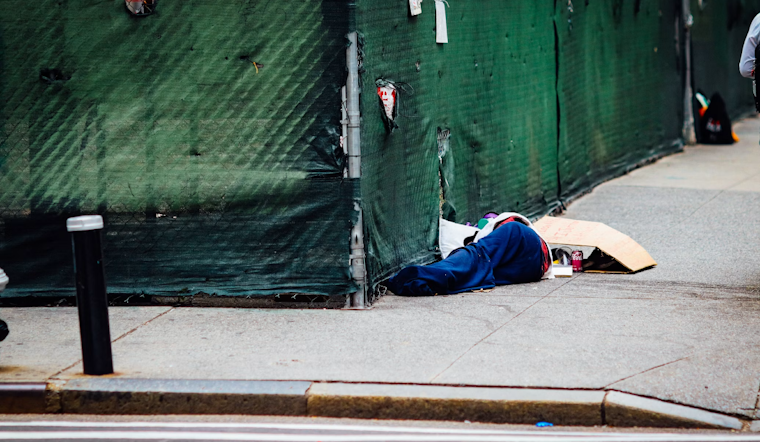
Nearly 6,000 unhoused people are living within a mile of Los Angeles County's proposed 2028 Olympic and Paralympic venues, according to a new academic study — a figure more than three times higher than the county's own working estimate as officials scramble to plan for security perimeters that haven't even been finalized yet.
The research, known as Home 2028, comes from a team of USC and UCLA researchers who calculated that 5,975 unsheltered people live within a one-mile radius of the venues, according to LAist. The researchers, led by UCLA data analyst Jessie Chien alongside professors Benjamin Henwood and Randall Kuhn, arrived at the number by adjusting 2026 Point-in-Time homeless count figures at the census-tract level to account for potential overlap with security perimeters, factoring in walkable streets and major roadways near each site. Roughly 2,200 of those unhoused residents — about 5% of the county's unsheltered population — live within just a half-mile of venues, the tighter of the two radii the team modeled.
A Massive Gap Between County and Academic Estimates
The county's own count is dramatically smaller. L.A. County's Department of Housing and Homelessness has estimated that around 1,600 unsheltered people could be affected by Olympic security zones, according to Carter Hewgley, the department's chief strategy officer. That number underpins the county's application for $93 million in state funding submitted this year to address homelessness ahead of the Games, with plans to direct that funding toward services for more than 4,000 unhoused people overall.
Hewgley told LAist his office was directed to plan for security perimeters as wide as one mile, even though the boundaries themselves are not yet set — those will ultimately be established by the Secret Service. He said he is reviewing the Home 2028 team's methodology to understand the gap between the two figures. Randall Kuhn, one of the study's authors, said the county's estimate seemed obviously low, per the same report.
Researchers Warn the True Number May Be Even Higher
The 5,975-person estimate doesn't even capture the full picture. The Home 2028 team's figures exclude Pasadena and Long Beach, both major host cities for 2028 venues, meaning researchers say the true regional total is likely higher once those areas are factored in. Los Angeles County has an estimated 49,000 unsheltered people overall, so even the higher academic estimate represents a fraction of the county's total unhoused population — but a fraction concentrated in areas where security restrictions are expected to limit access to competition spaces.
Benjamin Henwood, one of the study's authors, expressed concern about what he described as brute-force criminalization of unhoused people as security plans move forward, according to LAist. Researchers with the Home 2028 project, a website devoted to studies and public discussion tied to the Games, say they're worried that people could simply be pushed out of Olympic zones into other neighborhoods rather than connected to housing or services, with unhoused residents inside the perimeters potentially forced to move regardless of whether shelter is available.
Local Officials Weigh Housing-First Promises Against Security Demands
Local officials have said they want to prioritize offering shelter to people living near Olympic venues rather than simply clearing them out. That framing echoes Mayor Karen Bass's broader housing-first approach ahead of both the 2026 FIFA World Cup and the 2028 Games, which has centered on modular tiny homes on city land instead of forced busing or sweep-and-clear tactics, as Hoodline has previously reported. Her Inside Safe program has moved thousands of unhoused Angelenos into interim motel beds since she took office.
But the gap between stated intentions and enforced reality remains a live concern for advocates, who often point back to the 1984 Los Angeles Olympics, when LAPD Captain Billy Wedgeworth told reporters police were trying to “sanitize the area,” a phrase that preceded sweeps scattering unhoused residents away from Downtown tourism zones, according to the Washington Post. Advocates have also cited the 2024 Paris Olympics as a cautionary example, noting that despite heavy spending on police operations to disperse unhoused populations there, only 256 people were placed into stable housing through a relationship-based program.
Council Fights and Funding Gaps Loom Over Planning
The financial and political stakes of Olympic preparation are already playing out at Los Angeles City Hall. Earlier this month, the City Council voted 10-4 to approve the Enhanced City Resources Master Agreement with LA28 covering municipal service reimbursements, a deal finalized nearly ten months behind schedule amid disputes over security and public safety cost controls, according to the Los Angeles Times. Dissenting council members warned that city taxpayers remain the financial backstop if cost overruns exceed $540 million in combined city and state contingency funds.
Council President Marqueece Harris-Dawson has also introduced a motion directing city departments to report on how to humanely resolve homeless encampments around Olympic venues while identifying funding to cover the costs, a measure referred to the ad-hoc Olympic committee and housing committee as officials debated who would actually pay for outreach and relocation. That unresolved question — over which agency holds jurisdiction and budget responsibility once the Secret Service sets its security perimeters — sits at the center of the current standoff, since no single entity currently owns the problem of homelessness inside those zones.
Host Cities Are Already Testing Their Own Approaches
Individual host cities have started moving on their own timelines. Long Beach installed a $790,000 perimeter fence around its Billie Jean King Main Library this year to prevent encampments from forming, a move Hoodline reported cut nearby encampments even as the city's advisory committee on homelessness argued the money should have gone toward direct housing instead. Meanwhile, L.A. County's Pathway Home model — which master-leases motels and deploys strike teams to clear encampments — is expected to anchor the county's approach around venues if the $93 million state funding request comes through, moving shelter residents into permanent housing to free up bed capacity for people displaced from encampment zones.
Downtown business interests have also been preparing independently, with the DTLA Alliance's Path of Progress campaign working to clean and secure high-visibility corridors like 7th and Hill streets ahead of both the World Cup and the Olympics. And human rights advocates have separately pressed LA28 to publicly release its draft Human Rights Strategy covering homelessness and civil rights protections, a document completed at the end of 2025 that coalition members say should come with dedicated funding for implementation and independent audits. With the Secret Service still expected to set formal security boundaries and no agency yet holding clear responsibility for what happens to people inside them, the distance between the county's 1,600-person estimate and the researchers' nearly 6,000-person figure remains one of the more consequential open questions heading into 2028.





