

























































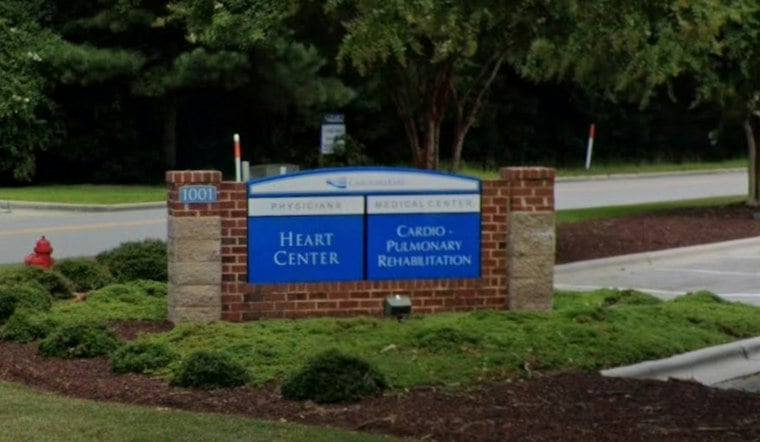
Jensen Hawkins and his wife were driving through New Bern in June when they came upon a car that had slammed into a light pole and burst into flames, the driver still trapped inside. Hawkins, an echocardiography technician at CarolinaEast Heart Center, stopped, grabbed the detachable trailer hitch from his own vehicle, and used it to smash open the burning car's window. He pulled the driver free just before the vehicle exploded — twice.
CarolinaEast Health System has now named Hawkins its 2026 Scott Whitford Unsung Hero of the Year, according to WCTI 12. The health system described Hawkins as someone who routinely goes beyond what's expected for patients and community members, the station reported. Hawkins, who has worked at CarolinaEast for nearly six years, was treated for his own injuries at the CarolinaEast emergency department following the rescue.
Hawkins said he was thankful that God had placed him there to help, per the station's report. He works within CarolinaEast's Heart Center, part of a multispecialty physician network spanning more than 150 providers across 19 coastal North Carolina locations, according to CarolinaEast Health System. Echo technicians like Hawkins specialize in cardiac ultrasound imaging used to evaluate heart function, the health system notes.
Why the Rescue Mattered Before Fire Crews Could Arrive
The danger Hawkins faced reflects a broader pattern in vehicle fires nationwide. Collision or overturn impacts cause three out of every five civilian fatalities in road vehicle fires, according to National Fire Protection Association research, since structural damage from crashes often traps occupants inside fast-burning cars. In 2024, highway vehicle fires caused an estimated 510 civilian deaths, 1,070 injuries, and 211,500 total fire incidents across the U.S., per the same organization's more recent data — vehicle fires account for roughly 13 percent of all U.S. civilian fire deaths.
North Carolina law offers some protection to bystanders who step into these dangerous situations. Under North Carolina General Statutes § 20-166(d), anyone who renders first aid or emergency assistance at the scene of a motor vehicle crash on a street or highway is shielded from civil liability unless their conduct amounts to wanton behavior or intentional wrongdoing, according to the North Carolina General Assembly. The law is designed to encourage bystanders to assist crash victims without fear of being sued.
An Award Rooted in Sacrifice
The Scott Whitford Unsung Hero of the Year Award carries deep weight at CarolinaEast. Scott Derrick Whitford was a 56-year-old Navy veteran and CarolinaEast facility services carpenter who died on June 17, 2017, while trying to save a 15-year-old girl and her mother from a rip current off Atlantic Beach, according to the Carnegie Hero Fund Commission. Whitford had worked at CarolinaEast for seven years before his death. In June 2018, the Carnegie Hero Fund Commission posthumously awarded him the Carnegie Medal, a national honor recognizing civilians who perform extraordinary acts of lifesaving bravery, with the medal formally presented to his family in Atlantic Beach in 2019.
CarolinaEast established the award in Whitford's name following his death, previously honoring staff members including pavilion manager Shawna Knight in 2019 and materials operator Carole Gann in 2022. During 2020, amid the COVID-19 pandemic, the health system shared the award collectively among all roughly 2,700 staff members rather than naming a single recipient.
A Major Local Employer With a Busy Emergency Room
CarolinaEast operates a 350-bed flagship acute care hospital in New Bern and stands as one of Craven County's largest employers, with approximately 2,700 workers, according to Business North Carolina. The health system originally opened in 1963 as Craven County Hospital. Its emergency department, where Hawkins was treated after pulling the driver to safety, treats more than 75,000 patients annually and works alongside an emergency medical services transport team serving Craven County.




