

























































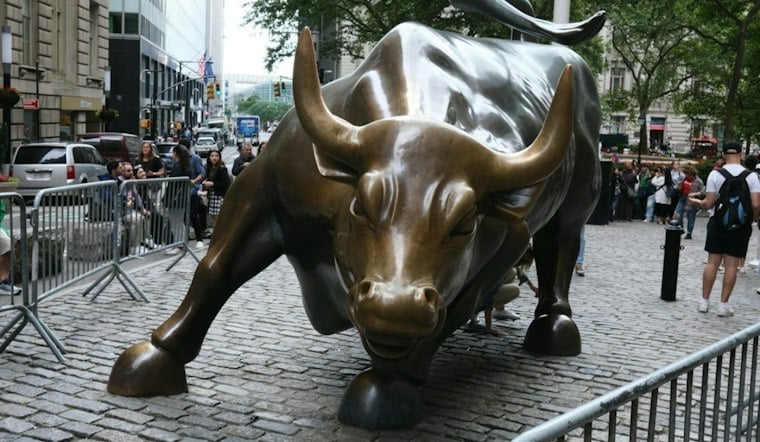
Charging Bull’s long-running legal ambiguity is not just a question of who holds the deed. The sculpture’s physical ownership, reproduction rights, permission to remain at Bowling Green and day-to-day care are separate issues, and the available accounts do not resolve them all. The 7,100-pound bronze bull has stood in Manhattan for nearly four decades, becoming a prominent piece of public art even as its legal status remains unclear.
The mystery traces back to sculptor Arturo Di Modica, who built the bull independently and, as reported by the New York Post, placed it outside the New York Stock Exchange without a permit in December 1989. City officials had it hauled away to an impound lot in Queens, with the New York Stock Exchange paying for its removal, according to the Post's reporting. Then-Mayor Ed Koch and Parks Commissioner Henry Stern arranged for its return — this time to Bowling Green, a few blocks away — and Di Modica paid to relocate it from storage. Arthur Piccolo, chairman of the Bowling Green Association, is credited by the Post with convincing Di Modica to consider that spot in the first place.
Di Modica spent between $320,000 and $360,000 of his own money to fabricate the piece, casting it at the Bedi-Makky Art Foundry in Greenpoint, Brooklyn, according to the The Business Standard. He created the sculpture, weighing 7,100 pounds and stretching 16 feet long, as a gift meant to celebrate American resilience after the 1987 stock market crash. Four years later, needing to recoup his costs, he tried to sell it — but turned down a $300,000 offer from a Las Vegas hotel because the buyer would not agree to keep it in Lower Manhattan, per the same account.
A Reported Sale That Still Left Ownership Murky
The Post reports that Di Modica sold Charging Bull to British billionaire investor Joe Lewis in 2004, on the condition that the statue never be moved. But the reported arrangement does not settle who owns the sculpture installed at Bowling Green: the Post says the Lewis family has the original cast and reproduction rights, while not owning the statue itself. The city also does not own it, according to the Post, and the Parks Department does not consider Charging Bull part of its permanent public art collection or take responsibility for its upkeep.
Care for the bull is another matter distinct from ownership. The Downtown Alliance, the business improvement district that cleans it, has no formal maintenance agreement and does not own it, the Post reports. The city maintained the statue with Di Modica’s permission in 1999 and again in 2004, and J&R Music World once supported its upkeep through a charitable donation. Those episodes do not establish legal title; Charging Bull also has no official landmark designation.
A Different Model for Public Art
Central Park offers a contrast in how a public sculpture can be given and cared for: the Central Park Conservancy says philanthropist George Delacorte gave Alice in Wonderland to the City’s children, and 11 of the Delacortes’ grandchildren unveiled it at a dedication ceremony in May 1959. The Conservancy says it restores, preserves and maintains historic structures like the sculpture. Charging Bull’s history, by contrast, is marked by an informal arrangement for its placement and no settled account of its ownership or upkeep.
The uncertainty persisted after Di Modica died in 2021. His estate attorney, Gaetano G. D'Antona, told the Post that even he does not know who now owns the bull. Attorney Steven Hyman told the paper he believed Di Modica held the copyright and had an informal arrangement with the city allowing the statue to remain at Bowling Green, but that the arrangement was never formalized into ownership. Di Modica copyrighted Charging Bull as an unpublished work in March 1998, a registration confirmed by The Patry Copyright Blog. Copyright gave him control over commercial use of the bull’s image; it did not, by itself, resolve ownership of the physical sculpture.
An Artist Who Went to Court Over His Own Bull
Di Modica did not hesitate to sue when he felt his work was being exploited. In September 2006, he filed a federal copyright lawsuit in Manhattan against major corporations including Wal-Mart and North Fork Bank over unauthorized commercial images and replicas of the sculpture, according to the Los Angeles Times. He also sued Random House in 2009 over a book cover depicting the bull, per the Post's reporting. And in April 2017, Di Modica — working with civil rights attorney Norman Siegel — challenged the installation of the Fearless Girl statue facing his bull, arguing under the Visual Artists Rights Act that the placement distorted his original composition, as reported by Hyperallergic.
Then-Mayor Bill de Blasio pushed back publicly, telling WNYC radio that same month that Charging Bull was “a celebration of unfettered capitalism” while defending Fearless Girl's presence, per Hyperallergic's reporting. The clash over the two statues previewed a larger fight two years later, when de Blasio's administration announced plans in November 2019 to relocate Charging Bull closer to the New York Stock Exchange, citing pedestrian safety and counter-terrorism concerns following a 2017 vehicle attack in Lower Manhattan, according to Business Insider. The city worried that tourist crowds spilling onto Broadway created a vulnerability to vehicular attacks.
That relocation plan collapsed in June 2020, when the city's Public Design Commission rejected it following community board opposition, according to Tribeca Trib Online. Opponents argued the City Charter forbids moving public artwork the city does not own — and pointed out that the New York Stock Exchange, not the city, was funding the proposed move, an arrangement they characterized as an extralegal end-run around charter rules. Under Parks Department guidelines, temporary art permits are generally capped at one year, yet Charging Bull has remained at Bowling Green under a temporary authorization dating back to its December 1989 installation, per the Business Standard — never formally acquired by the city, never approved by the Public Design Commission.
Graffiti, Fake Blood, and a Broken Horn
The unresolved ownership hasn't stopped the bull from taking a beating over the years. It has faced numerous graffiti attacks, according to the Post, and in 2019 climate activists poured fake blood over it and climbed on top of it. The bull has also had its horn damaged at one point, which Di Modica himself repaired, the Post reports. During the 2011 Occupy Wall Street movement, police surrounded the statue with continuous security barricades as it became a central symbolic site for anti-corporate protests, according to Business Insider.
The unresolved legal questions have not diminished the bull’s draw for visitors. The Post describes steady tourist traffic and reports a belief among some visitors that touching the sculpture brings good luck or money.
Bowling Green sits just steps from where a car erupted in flames near the statue earlier this year, underscoring how central the bull remains to the daily life and security concerns of the neighborhood even as its legal status stays undefined. The statue was valued at more than $300,000 at one point, according to the Post's reporting, a figure that seems almost beside the point when no one can agree who is entitled to collect it.





