

























































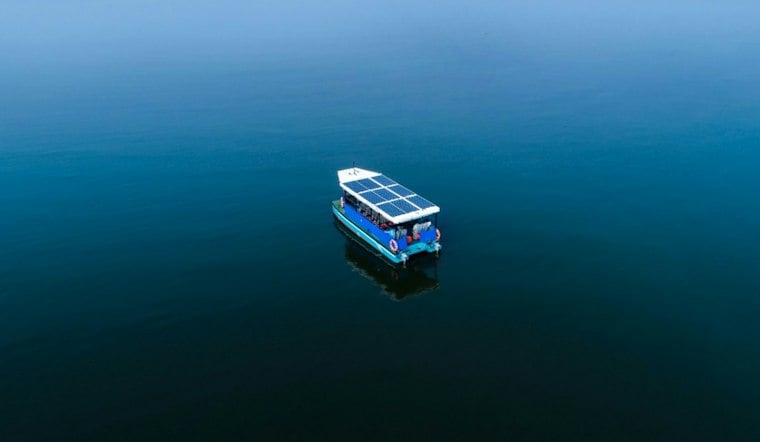
A North Andover inventor who spent four decades building electric cars and solar inverters is now betting his engineering career on boats. James Worden, founder of Worden Marine, has been showing off a solar-electric vessel that runs on sunlight alone, cutting the fuel odors, engine noise, and vibration that come standard with traditional boats.
Worden demonstrated a 20-foot catamaran-style vessel on Boston's Charles River, and according to Boston 25 News, he said the boat was running on pure solar power despite cloudy skies that day. That prototype is named Anita, honoring Worden's late wife and longtime engineering collaborator Anita Rajan Worden, an MIT graduate who co-founded Solectria Corporation with him, according to the MIT Edgerton Center.
Worden's résumé in clean-energy mobility stretches back to 1985, when he founded the MIT Solar Electric Vehicle Team as an undergraduate, later winning the inaugural American Solar Cup in 1988 with his Solectria 5 solar car, per MIT News. He went on to found Solectria in 1989, per Boston 25 News, a company that became one of the nation's early electric vehicle manufacturers before Worden pivoted to solar inverters. That later venture, Solectria Renewables LLC, was acquired in July 2014 by global industrial automation leader Yaskawa Electric Corporation, according to a statement from Yaskawa Electric.
From Prototype to a 40-Foot Commercial Vessel
The company just took a major step beyond prototype testing. On September 9, Worden Marine officially opened the Worden Marine Innovation Center on the historic KITCO family farm in North Andover, bringing marine operators, shipbuilders, and policymakers together to view its 40-foot solar-electric vessel, the TRUSOLAR40, according to a release distributed via GlobeNewswire. Worden Marine bases its design and marketing operations in North Andover, per Boston 25 News, while producing resin molds in Rhode Island.
Final assembly happens further north. Worden Marine fabricates its composite hulls and decks at Safe Harbor Front Street Shipyard in Belfast, Maine, using carbon-fiber infusion, according to Maine Boats, Homes & Harbors. Front Street Shipyard is a major Maine facility capable of servicing vessels up to 200 feet, the outlet notes. The company also uses 3D printing in its boat production, per Boston 25 News.
Bifacial Solar Panels and a Floating Power Plant
To squeeze out every possible watt, the vessels use dual-sided bifacial solar panels mounted on a flat canopy roof, capturing not just direct sunlight but ambient light reflected off the water surface, according to a Boston 25 News report carried by MassLive. That design lets the boats reach speeds of approximately 6 knots, with an occasional top speed of 10 knots, on pure solar power, per the same report. Worden has said solar panels can still produce useful power even on cloudy days.
Worden envisions these boats doing more than just moving people. He has said an idle solar-powered boat can function as a floating power plant, generating electricity and even putting power into the grid, letting owners take money off their electric bills. Onboard battery systems keep the boats from becoming stranded and allow continued operation when sunlight is limited, according to Boston 25 News.
Engineering Team Talks Tradeoffs
John Lagasse, Worden Marine's engineering manager, has pointed to the practical upside of ditching combustion engines altogether. He said electric propulsion eliminates the need to worry about gas lines and avoids the startup odors of traditional marine engines, per Boston 25 News. Newer Worden Marine boats also include joystick docking technology, allowing more precise maneuvering near docks.
Those advantages come at a price. Solar-powered vessels cost more upfront than traditional boats, though owners can save money over time through lower fuel and maintenance costs, according to the outlet's reporting. Worden Marine has also brought on retired U.S. Coast Guard Captain Peter Boynton — a former White House National Security Council director and Captain of the Port — as an advisor to help navigate Coast Guard regulatory compliance and commercial vessel safety, according to the company's own team page.
A Global Idea Meets New England Waterways
Worden has said he was inspired to enter the solar boating sector after studying Aditya, India's pioneer solar-powered ferry launched in Kerala, believing modern carbon fiber composites could drastically improve hull efficiency, per Maine Boats, Homes & Harbors. That outlet notes Aditya proved solar passenger ferries could operate cost-effectively in commercial service. In the U.S., the first fully solar-powered passenger vessel to gain Coast Guard operational approval was the 44-foot tour boat Solaris, which launched on the Hudson River in 2019, as Hoodline previously reported in coverage of a separate Maine-built solar catamaran.
Worden Marine's 20-foot prototype has already found real-world work locally, serving as the official VIP and media vessel for Community Boating Inc.'s 80th anniversary Sail-a-thon on Boston's Charles River in June, according to Community Boating Inc., which operates the nation's oldest public sailing program. Worden believes solar-powered boats could become common on waterways throughout the region and beyond, with potential uses spanning rivers, lakes, bays, and intracoastal waterways. He has floated ideas ranging from commuter ferries and corporate transportation vessels to shuttle services for destinations such as Boston's casino, according to Boston 25 News.





