

























































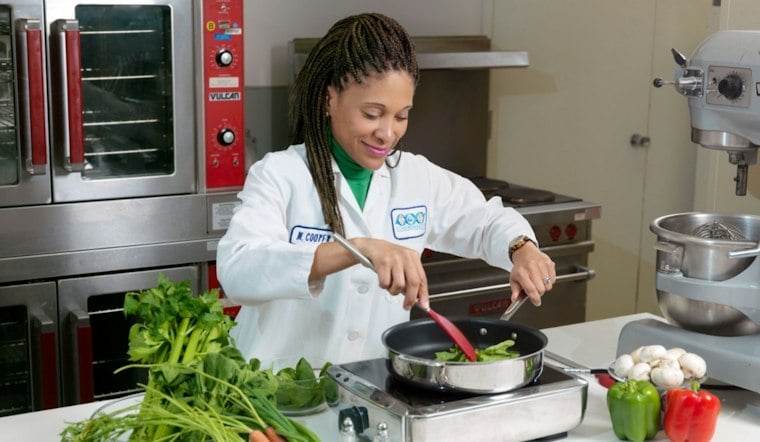
A 25-year-old designer from Northeast Philadelphia just won $300,000 from NASA for a concept addressing how astronauts might eat fresh food on Mars. Chinyere “Chichi” Ukeje, a native of Bowie, Maryland, took first place in NASA's Deep Space Food Challenge: Mars to Table, submitting a concept she named after Ani, the Igbo Earth goddess of harvest and fertility.
Ukeje was among the U.S. winners to receive a cash prize, according to The Philadelphia Inquirer. Her winning submission, called the Adaptive Nourishment Infrastructure, combines controlled-environment agriculture, fermentation, fungi cultivation, and closed-loop nutrient-recycling bioreactors designed to produce half of a Mars crew's meals, with the other half shipped from Earth, according to NASA. As reported by AL.com, her modular food ecosystem is designed to cook fresh meals daily and keep working through shortages of power, water, equipment, or crew time.
A Nationwide Contest With One Big Local Winner
NASA's competition drew 113 entries from 33 countries, per AL.com, with a food plan built around feeding a 15-person astronaut crew for 500 Martian sols. A Martian sol runs roughly 24 hours, 39 minutes, and 35 seconds, meaning the mission window works out to about 513 Earth days. Ukeje's $300,000 first-place prize came out of an advertised $750,000 purse, but NASA only distributed $650,000 total after judges declined to select a third-place winner, leaving $100,000 unspent, the Inquirer reports.
Second- through fifth-place winners shared $350,000 in prize money, according to AL.com. Among them, Rosemead, California-based Cislune took second place and $200,000 for its Fresh, Ferment, Reserve system, which relies on crop modeling, culture cassettes, and a protected Earth-loaded backup reserve to guard against crop failures and utility cutbacks, per NASA. Three additional $50,000 specialty prizes went to Ohā Kanu of Hilo, Hawaii, for an ahupuaʻa-inspired framework; Orbital Health Systems Inc. of Evansville, Indiana, for mission simulation design; and Autonomic Resilience Collective of Bentonville, Arkansas, for human-centered design, NASA notes. Belgium's Astrofood was recognized as the international winner.
Why NASA Wants Mars Crews Growing Their Own Food
The push toward homegrown Mars meals reflects the challenge of keeping food shelf-stable on long missions, according to research from NASA Johnson Space Center. Today's International Space Station meals are developed and packaged at NASA's Space Food Systems Laboratory in Houston, per the Kennedy Space Center Visitor Complex, which discusses long shelf-life needs for missions that may last up to five years. That system works for missions resupplied from Earth, but it cannot support astronauts who would be months or years away from a grocery run.
Teams submitted a design layout, meal plan, concept of operations, and walkthrough video, the Inquirer reports. Ukeje's design remains a concept that would need to be developed before it could feed a real crew.
Building on Years of Space Food Research
Mars to Table is a follow-on to NASA's Deep Space Food Challenge, according to NASA. The competition falls under NASA's Centennial Challenges program, run out of Marshall Space Flight Center in Huntsville, Alabama, which has spent more than two decades engaging the public to advance space robotics, additive manufacturing, power and energy, textiles, chemistry, and biology.
Jennifer Edmunson, program manager for Centennial Challenges at Marshall Space Flight Center, said the challenge is helping NASA advance the future of space food systems, according to AL.com. For Ukeje, the win marks a striking milestone for a Philadelphia-based designer whose concept took first place in the competition.





