

























































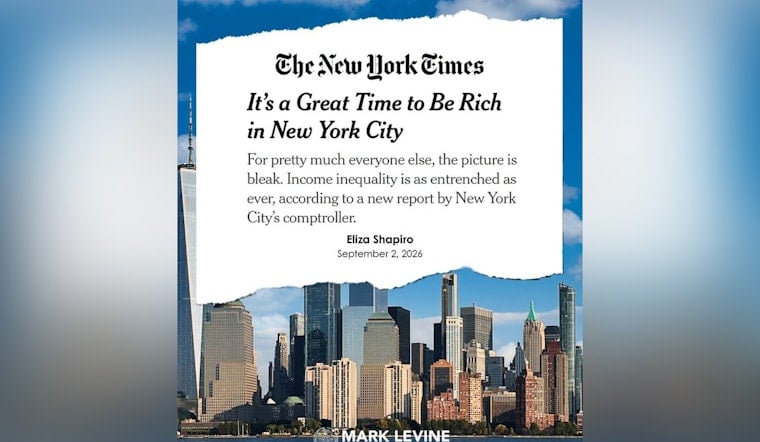
New York City's richest residents are pulling further away from everyone else, according to a new report from the Office of New York City Comptroller Mark Levine, which found that the top 0.1% of city households — roughly 5,000 of them — accounted for more than half of the city's total real income growth between 2019 and 2024. Meanwhile, the real median income for the bottom 90% of earners fell 3.2% over that same five-year stretch, even as those households' average income stayed essentially flat.
The findings, posted Tuesday by the Office of New York City Comptroller Mark Levine, paint a picture of a city where most residents are, in the office's words, treading water while a tiny sliver of ultra-wealthy households sees its fortunes multiply. Nearly two-thirds of all real income growth in the city between 2019 and 2024 flowed to the top 1% of tax units, the report found, a concentration the comptroller's office says is even more extreme than the national trend, where the top 1% nationally captured 39% of real income growth over the same period.
The numbers behind that gap are striking. By 2024, the top 0.1% of New York City households were pulling in 22% of all income generated in the city — roughly double the share that group holds nationally — while the broader top 1% took in 37% of all city income, compared with 22% of all income nationally, per the comptroller's office. The full report, published by the NYC Comptroller's Office, also breaks the divide down by income decile: only the top 20% of earners saw meaningful real income gains between 2019 and 2024, while real average income declined or stayed flat for the remaining 80% of city households, with the steepest proportional drops hitting the lowest earners.
Investment Gains, Not Paychecks, Drove the Divide
The report is careful to note that the widening gap wasn't primarily about salaries. Non-wage income — capital gains, interest, dividends, and business profits — was the real engine of top-tier growth, rising from 64% of total income for the top 1% in 2019 to 69% in 2024, according to the comptroller's office. In fact, wage growth in lower-paying job fields actually outpaced wage growth in higher-paying occupations between 2019 and 2025, but booming stock market returns for the wealthy erased any relative gains those workers might have otherwise seen.
For most New Yorkers, the math simply didn't work in their favor. Consumer prices in the metro area rose 20.1% between 2019 and 2024, outpacing the 16.3% nominal increase in median income and leaving local tax filers with a net 3.2% real income loss, the comptroller's office found. That inflation ate through the same categories most New Yorkers can't avoid — housing, food, and transportation — which the report says most city households are now struggling to afford.
Mid-income jobs are disappearing at the same time, according to the comptroller's office, adding another layer of pressure on households already squeezed by rising costs. The office also framed the local trend against a half-century of national history, citing tax research from economists Thomas Piketty and Emmanuel Saez showing the share of U.S. household income captured by the top 10% nationally climbed from under 35% in the 1970s to 50% in 2019 and nearly 52% in 2024 — with the national top 1% share rising from below 10% in the 1970s to 22% in 2024.
A City Budget Feeling the Same Squeeze
The inequality data lands alongside warnings about the city's own finances, which face a similar boom-and-bust tension. New York City is projected to face an $8.8 billion budget gap in fiscal year 2028 once one-time budget fixes expire and recurring costs continue to outrun revenue, according to a fiscal analysis the comptroller's office released in June 2026, as reported by Public Technologies.
Strong Wall Street earnings briefly padded city coffers, but fiscal watchdogs reported in August that the city made no deposit into its Revenue Stabilization Fund during fiscal year 2026, missing a chance to save between $1.4 billion and $1.7 billion under recommended reserve formulas even as Wall Street tax revenue hit record levels. The city instead used its entire $1.96 billion fiscal 2026 surplus to prepay fiscal 2027 debt service rather than build reserves for a downturn.
Levine had already flagged the risk of leaving the rainy-day fund untouched. Back in April, the comptroller's office proposed a 40-page reform package pushing City Hall to adopt mandatory annual deposit formulas and strict withdrawal triggers for the fund, a response to a draft budget plan that would have pulled nearly half of the city's $1.97 billion reserve to cover midyear operating deficits.
AI Adds a New Layer of Uncertainty
Layered on top of the inequality and budget pressures is a workforce risk the comptroller's office flagged back in May: a report from Levine's office estimated a 50% chance that rapid artificial intelligence adoption could hurt the city's economy, warning that up to 250,000 local jobs could be displaced, as reported by City & State New York. Entry-level analytical and administrative roles face particular exposure, even as Wall Street firms profit from financing the same AI technology.
Taken together, the report's findings describe a city where booming markets have enriched a small circle of households while inflation, disappearing mid-income jobs, and automation risk squeeze everyone else. The comptroller's office has made similar warnings before, including in its earlier response to bond market jitters, but Tuesday's report ties the city's income divide directly to national data showing New York's concentration of wealth outpacing the rest of the country.





