

























































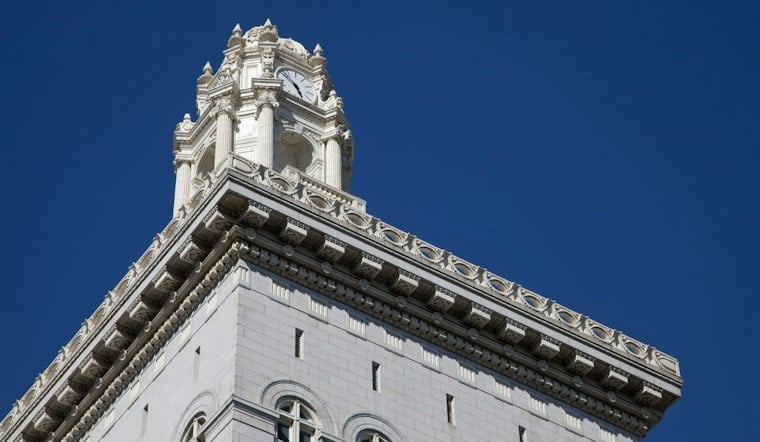
Oakland officials are considering a 45-day pause on land-use approvals and entitlements for new data centers as opposition grows to Behring Companies' proposal to convert part of an office building at 415 20th Street into an artificial-intelligence computing facility. Councilmember Carroll Fife introduced the urgency legislation on September 11, while opponents are organizing ahead of a September 15 meeting even though the project had not yet reached the full City Council.
The proposal, described by The Oaklandside, would convert roughly 20,000 square feet into a specialized data center serving AI companies, according to the seed reporting. Behring Companies has described the site as one of four properties in a planned 1.3-million-square-foot innovation campus, and CEO Colin Behring has said the building formerly housed a Department of Energy supercomputer. KQED reported that the site has up to 20 megawatts of computing capacity. The National Energy Research Scientific Computing Center says Berkeley Lab's Oakland Scientific Facility at 415 20th Street housed NERSC high-performance computing and data-storage systems.
A Discount Deal Fuels the Debate
Behring Companies acquired the 83,000-square-foot building in December 2025 for $6.8 million — a steep discount from the $36 million to $63 million previous owner Hines paid in 2019, per Industry Insider reporting. Hines had secured Oakland Planning Commission approval in May 2021 for an office-tower proposal at the site, according to San Francisco YIMBY; demolition permits were filed in August 2022 before those plans were abandoned in 2023 amid the post-pandemic commercial real estate downturn. Behring Companies has said future use, tenants, building systems, cooling, and mechanical design for the property have not been finalized, approved, or submitted for approval, according to the seed reporting.
Behring's ambitions stretch beyond that single building. The company is planning a roughly 1.3-million-square-foot, four-property innovation campus assembled around the 19th Street BART station, with the 415 20th Street site reported to support up to 20 megawatts of computing capacity, according to KQED. The proposal is described as an AI computing project.
Activists Rally at the Black Panther Party Museum
Opposition has been building for weeks. No Data Center in Oakland activists held a press conference at the Black Panther Party Museum on Broadway, addressing around 50 volunteers and several reporters, per the seed reporting. Volunteer Renee Coe has been canvassing downtown Oakland and other neighborhoods to build support against the project, while fellow volunteer Eisa Al-Shamma argued that real estate developers are trying to raise Oakland prices and profit at the expense of working people.
“Developers are trying to jack up prices and get rich at the expense of working people in Oakland,” Al-Shamma said, according to the seed reporting. Aditi Varshneya, an organizer with the Party for Socialism and Liberation, framed the fight in broader terms, saying the movement concerns who has the right to determine Oakland's future. The Party for Socialism and Liberation has organized anti-data-center events, meetings, and a signature-gathering campaign that has collected over 7,000 petition signatures through No Data Center in Oakland, per the same reporting.
Labor and Community Voices Join the Pushback
The opposition isn't limited to activist groups. Mullissa Willette, president of SEIU Local 521 — which represents thousands of child care workers in Northern California — said major economic shifts like data-center and AI booms have too often failed to benefit everyone equally. Some Oakland businesses have also signed up to distribute opposition campaign materials, and the seed reporting notes that businesses more broadly were skeptical of the data center proposal.
Dohee Kim, a campaign organizer with the Local Clean Energy Alliance, has questioned whether the proposal received robust zoning review and adequate public notice. Xavier Buck, executive director of the Dr. Huey P. Newton Foundation and co-founder of the Black Panther Party Museum, called for AI data centers to go through the same zoning and permitting processes as any other city project, arguing they should follow ordinary city rules rather than a separate track.
Oakland's Legislative Response Takes Shape
City Councilmember Carroll Fife, who represents District 3 — encompassing both West Oakland and the Behring properties — introduced urgency legislation on September 11 seeking an immediate 45-day moratorium on city land-use approvals and entitlements for new data centers, according to The Oaklandside. The measure is scheduled for a hearing before the Life Enrichment Committee on September 22, and organizers want city officials to prepare both the emergency moratorium and a permanent amendment to Oakland Planning Code Title 17. The pause, backers say, would give the city time to develop comprehensive operational, environmental, and public safety regulations for the industry.
That proposal is separate from an earlier Oakland City Council action. At-Large Councilmember Rowena Brown introduced legislation last year creating Responsible AI Activation Zones at Laney College, Mills College at Northeastern University, and the Unity Tech Hub in Fruitvale, according to Oakland North. A $1 million package was administered through a grant to the Oakland Fund for Public Innovation, according to Oakland North. Brown has said that legislation was designed for AI literacy and workforce development, and did not approve, regulate, or incentivize individual data centers or private lease agreements — a distinction organizers and city officials alike have stressed as the two policy tracks move forward separately.
West Oakland's Bigger AI Footprint
The Behring proposal lands amid a broader wave of physical-AI real estate activity in Oakland. Tesla is reportedly leasing a large industrial warehouse space in West Oakland for an AI-related project, and Jeff Bezos's Prometheus is doing the same, according to the seed reporting. The Real Deal has reported that Project Prometheus signed a 100,000-square-foot lease at the American Steel Blocks complex at 1960 Mandela Parkway, with Tesla leasing 40,000 square feet at the same campus.
That expansion is running up against real physical limits, including the electrical capacity required by high-density computing, a constraint that can push developers toward legacy industrial sites like those in Oakland.
State Lawmakers Weigh In on Power Costs
The fight over who pays for AI's electricity demands has also reached Sacramento. On August 31, the California Legislature passed Senate Bill 886 and Assembly Bill 2383, sending the bills to Governor Gavin Newsom with provisions requiring the California Public Utilities Commission to create special tariffs making data centers cover their own grid upgrades and power generation costs, according to Nossaman LLP. Those new tariffs and electric rules must be fully adopted by January 1, 2028.
A March 2026 report from California's Little Hoover Commission, cited by CalMatters, recommended that tech companies pay the full cost of grid integration rather than passing it on to everyday ratepayers. Data center opponents in Oakland view the AI expansion the same way — as a threat to affordability — even as proponents argue projects like the Behring facility could boost the local economy.
What the State and City Records Show
The California Energy Commission says California has more than 200 active data centers and is one of the nation's leading states for data-center development. The commission began incorporating projected data-center growth into its statewide electricity-demand forecast in 2024, using information from applications submitted to utilities, according to the California Energy Commission. Separately, the state bills described above would require special tariffs intended to make data centers cover grid-upgrade and power-generation costs, although those rules are not due to be fully adopted until January 1, 2028. Oakland's zoning framework is also being developed against a changing downtown landscape. A June 2024 City of Oakland Planning Commission document proposed adding a new Chapter 17.101K for Downtown District Zones to the Planning Code, including separate provisions for use requirements and development standards. That planning record provides context for the current dispute over how a technology-intensive facility and an office conversion near the 19th Street BART station should be reviewed, while the proposed moratorium would give the city time to consider more specific operational, environmental, and public-safety rules.
A Regional Pattern Emerges
Oakland isn't alone in weighing a pause. San Francisco Supervisor Shamann Walton announced plans on September 11 to introduce his own 45-day moratorium on new data center construction, aiming eventually for a permanent citywide ban amid neighborhood opposition in Bayview, as Hoodline previously reported. San Francisco currently hosts roughly a dozen data centers, concentrated mostly in District 10.
With the Oakland City Council set to weigh in on Tuesday and the Life Enrichment Committee hearing scheduled for September 22, the question of whether Behring's innovation campus moves forward — or gets paused alongside similar projects statewide — remains unresolved. For now, both sides are making their case in public, from press conferences at the Black Panther Party Museum to legislation moving through City Hall.





