

























































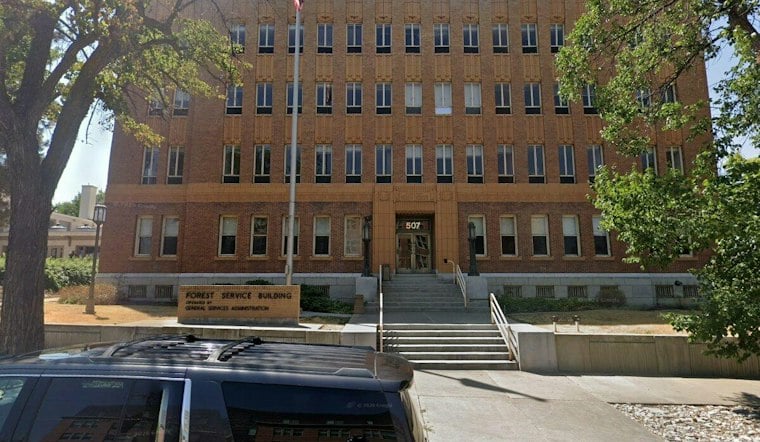
Ogden's Redevelopment Agency board voted unanimously to approve a land-transfer and development agreement with GIV Group for the historic U.S. Forest Service Building, setting in motion a plan to combine Weber State University creative space with affordable apartments in the 53,000-square-foot Art Deco landmark at 507 25th Street. The building, declared surplus by the federal government in 2023, sits in Ogden's Nine Rails Creative District and has anchored the city's East Central neighborhood since the early 1930s.
Under the agreement, GIV Group will lease the building while pursuing federal Low-Income Housing Tax Credit financing, according to Building Salt Lake. If the developer secures those credits, it has a previously approved option to buy the property for $2.8 million, per the same report. The project is also expected to generate roughly $3 million in additional tax increment, which Ogden intends to use alongside other project revenues to repay bonds issued for the building once it returns to use.
The city bought the building from the General Services Administration for $3.6 million, a deal the Ogden Redevelopment Agency board approved on a 5-2 vote on December 10, 2024. Two members dissented over acquisition costs and financial risk, according to the Standard-Examiner. The offer included $600,000 earmarked for earnest money and initial maintenance. Ogden closed on the acquisition in early April 2025, transferring title from the federal government to the city, per the Construction Owners Club.
The financing still carries public risk
Ogden City Council staff identified a maximum bond amount of $4.4 million for financing tied to the Forest Service Building, according to a city financing report. The report discusses the bond structure and a tax-increment backstop. Because GIV Group's purchase option depends on securing Low-Income Housing Tax Credits, the financing plan remains subject to both the credit award and the broader financing structure.
A New Deal Landmark Gets New Life
The building was designed by architects Leslie Hodgson and Myrl McClenahan in the early 1930s, and Ogden Mayor Ben Nadolski said the city recognizes the value and heritage of their work, per Building Salt Lake's reporting. The National Park Service's National Register nomination identifies it as a four-story, 52,625-square-foot federal office building with a basement, constructed in 1933-34. It was among the earliest Utah projects funded by Depression-era public works appropriations, according to the U.S. General Services Administration. The agency selected Ogden over Salt Lake City as its Intermountain Region headquarters in 1908, citing favorable railroad freight rates and a strong local business community.
The building was recognized as part of Ogden's Art Deco Buildings thematic nomination in the 1980s before earning individual listing on the National Register of Historic Places in 2006, the GSA notes. Preservation Utah holds an existing easement protecting the building's Art Deco facade, hallways, and other common areas. Ogden's report from Building Salt Lake lists the property alongside Ogden High School, the Ogden Municipal Building, and the Union Stock Exchange Building — which Fisher Regan Enterprises is separately renovating as the future headquarters of aerospace and defense firm GMRE — as part of the city's collection of Art Deco landmarks.
Mixing Studios, Offices, and Affordable Homes
GIV Group's plan calls for a mixed-use project combining creative studios, offices, and community space, with Weber State University expected to occupy several floors for creative space and artist studios. The remaining floors would hold affordable housing at an expected 60 percent of area median income, though the exact unit count and square footage for each use are still being finalized, per Building Salt Lake's account. The building falls within the Adams Community Reinvestment Area, which expires in 2043.
Housing built under the plan would use the Tenant Wealth Initiative model through the Perpetual Housing Fund of Utah, the same developer notes. That model includes annual rent rebates, down payment assistance toward homeownership, and an emergency fund tenants can draw on after a catastrophe. It also gives resident families a share of profits from the building's management and, if the property is sold or refinanced after 15 years, a share of its equity growth — aligning with the 15-year initial compliance period built into the federal Low-Income Housing Tax Credit program.
The Perpetual Housing Fund's tenant-wealth approach already carries institutional backing beyond Ogden. In August 2023, the Salt Lake City Community Reinvestment Agency allocated $10 million in federal American Rescue Plan Act funds to partner with the fund on its tenant-wealth housing pilot, according to the Salt Lake City Community Reinvestment Agency. That model lets low-to-moderate-income renters build equity through rent rebates and profit sharing.
A Developer With Local Track Record
GIV Group is not new to adapting historic or vacant buildings for affordable housing. The company previously converted a vacant University of Utah Health office tower in Salt Lake City into Arbor 515, a 96-unit affordable housing community that opened in late 2025 using the Perpetual Housing Fund model, according to CoStar. That project went on to win an adaptive reuse award from Preservation Utah.
GIV Group has also worked in Ogden's East Central neighborhood before, converting the former Weber College campus into Imagine Jefferson, an affordable housing complex. With this project, Ogden has now worked to preserve and thoughtfully reuse two historic buildings in the area, according to Building Salt Lake.
The Forest Service Building sits within the boundaries of Ogden's Nine Rails Creative District, an eight-block cultural zone the Ogden City Council unanimously established in 2018, stretching between 24th and 26th Streets from Grant to Madison Avenues. The district's name honors Ogden's history as a hub for nine separate rail lines during World War II, according to Ogden City Corporation. Building Salt Lake's report notes the district already includes the Forest Service Building alongside the Monarch and Dumke Arts Plaza.




