

























































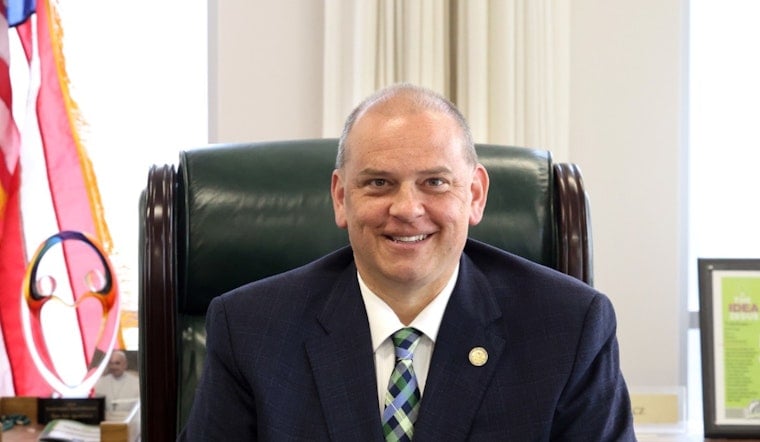
Ohio's biggest-city mayors are asking the state to hand over hundreds of millions of dollars they say Columbus took away starting more than a decade ago. The bipartisan Ohio Mayors Alliance has unveiled a proposal for a $1 billion Core Cities Transformation Fund, plus a separate request that the state cover 10% of municipal police and fire payroll costs, arguing the state broke a long-standing financial commitment to local governments during the Kasich administration.
The Core Cities Transformation Fund would provide grants and zero-interest loans for housing, downtown redevelopment, industrial sites, and infrastructure, according to reporting from Cleveland.com. Mayors want $100 million a year over a decade to fund it. The alliance says the plan would not raise a tax or redirect a penny; instead, it proposed reserving 20% of the annual growth in state sales and use tax revenues — assuming 3% yearly growth — to generate the money, according to the Statehouse News Bureau. The plan was unveiled in Columbus ahead of the 137th Ohio General Assembly and the 2027 gubernatorial transition.
A Decade-Old Grudge Over Police and Fire Costs
Separately, the Ohio Mayors Alliance wants the state to cover 10% of municipal police and fire payroll costs, a request that Cleveland.com columnist Laura Johnston calculated at about $320 million. Akron, Cincinnati, Cleveland, Columbus, Dayton, and Toledo have all negotiated double-digit wage increases in recent police union contracts to address recruitment shortages, per the alliance's own research. Ohio cities spent $3.2 billion on police and fire payrolls last year alone, according to the same Cleveland.com report.
The Ohio Mayors Alliance represents 31 of the state's largest cities and 3.2 million residents, whose metropolitan regions account for 76% of state jobs and nearly 90% of Ohio's $885 billion gross domestic product, per the organization's own materials cited in the dossier. Formed in 2016 to promote bipartisan advocacy for urban job centers, the group argues the state should invest in established cities that already have infrastructure and room for economic and population growth.
Tracing the Money Back to 2011
The mayors' argument centers on a specific historical grievance: that Gov. John Kasich cut the Local Government Fund in 2011, and that Kasich and the Ohio legislature broke a pact under which part of Ohio's income-tax revenue was supposed to support local governments. That understanding, according to the reporting, helped persuade voters to approve the state income tax in the first place.
The numbers tell part of that story. The Local Government Fund fell from $648 million in 2011 to $349 million by 2017, before rising to $546 million in the most recent fiscal year, per Cleveland.com's account. The fund's share of state General Revenue Fund tax collections was once 3.68%; current law allocates just 1.70%, according to the Ohio Municipal League. To close an $8 billion state budget gap in 2011, Kasich and the General Assembly passed House Bill 153, cutting Local Government Fund allocations by half and reducing state aid to local governments by $111 million in fiscal 2012 and $340 million in fiscal 2013.
Other tax changes also compounded the loss. Ohio repealed its state estate tax effective January 1, 2013, eliminating a revenue source that had historically sent 80% of its collections directly to local city general funds, according to Policy Matters Ohio. Ohio cities have spent 15 years trying to replace the support withdrawn by the state, and many have raised their own income taxes to make up the difference — municipal income taxes now generate roughly 70% of a typical Ohio city's general fund budget, according to the Ohio Municipal League. According to the Ohio Office of Budget and Management's The Jobs Budget, repeal of the tangible personal property tax resulted in $1.65 billion in lost property tax revenue to school districts and local governments. The Ohio Department of Taxation's 2009 annual report says the phase-out of tax revenue tied to the elimination of the tangible personal property tax ended in FY 2009.
Little Chance in a Republican Statehouse
Cleveland.com's Today in Ohio podcast, which first surfaced much of this reporting, frames the proposal bluntly. Laura Johnston said voters should know about the proposal, but also said plainly that it is not happening, and that changing leadership and representatives is necessary to restore state support. Fellow columnist Chris Quinn called the proposal a “pie in the sky fool's errand,” and said state leaders went against voters' will in reducing support for cities and weakening the state school board.
The Today in Ohio hosts noted the discussion could remind Ohioans who changed the bargain and what must change to restore it. That framing lands amid a broader pattern the hosts pointed to: Ohio voters placed the state school board in the Ohio constitution, yet state leaders have since reduced the board's authority, part of what Quinn and Johnston describe as a legislature that has weakened both cities and public schools. Ohio cities, which tend to vote Democratic, face a Republican-controlled, gerrymandered legislature that Cleveland.com's hosts say gives the mayors' proposal little realistic chance of passing.
A Bigger Political Play Than a Budget Line Item
Ohio's official demographic forecasts project that 74 of the state's 88 counties will lose population by 2050, a trend the Mayors Alliance points to in arguing that state economic policy must prioritize core urban centers, according to the Hicks Partners newsletter cited in the dossier. Ohio's congressional delegation has shrunk from 24 seats in the 1960s to 15 today as population growth has lagged, underscoring the stakes mayors say the state is ignoring.
The Ohio Mayors Alliance has clashed with state lawmakers before. In April, Hoodline reported on state gun-preemption lawsuits that the alliance opposed, and a separate Hoodline story detailed Senate Bill 63, which would cut off Local Government Fund distributions to cities that adopt ranked-choice voting. Given the current legislature's makeup, Cleveland.com's hosts view the transformation fund proposal as having virtually no chance of passing — but the effort still serves a broader purpose, establishing a unified platform for the state's 31 largest cities and pressuring the incoming 2027 state leadership to address municipal shortfalls that mayors say have gone unaddressed for 15 years.



