

























































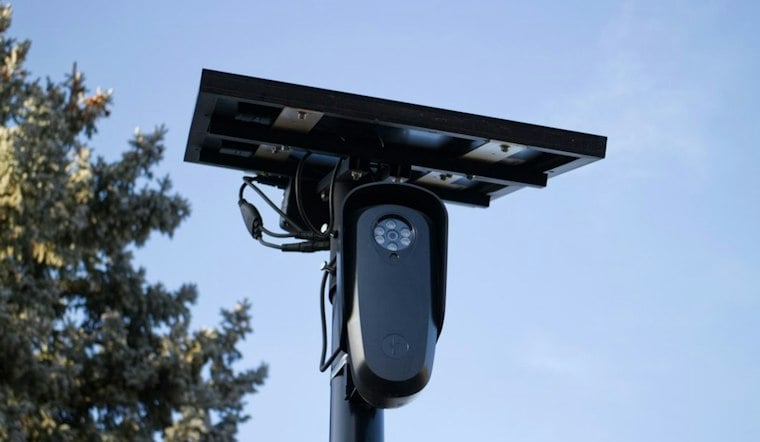
Strongsville police will keep using the city's 22 Flock license-plate cameras. Residents have raised privacy concerns, and the only fresh accountability officials have floated is a possible law requiring quarterly reports on how that data is used.
The account comes from an Oct. 5 meeting of City Council's Public Safety and Health Committee, reported Nov. 17 by Cleveland.com. Committee chairman Jim Kaminski said council may pass legislation requiring those reports. The cameras are staying either way. The paperwork is still a maybe.
A Lease, Not A Traffic Trap
Atlanta-based Flock Safety builds the readers to alert police when a plate is tied to a crime or an arrest warrant, and to help with vehicle thefts, kidnappings and searches for wanted people. Strongsville's 22 units are installed at intersections around town. Cleveland.com reported that they record license plate numbers only and have no facial-recognition capability. Police do not use them to catch speeding or other traffic violations.
The city pays Flock $79,000 a year to lease the system. Divided across 22 cameras, that lease works out to about $3,590 per camera a year. That is arithmetic on the reported total, not a published per-camera rate. Officers can see the data, and they are supposed to give a legitimate law-enforcement or investigatory reason before they do. The department regularly audits use so reads are not pulled for personal or improper reasons.
Kaminski and Thomas O'Deens briefed the committee and took questions. Kaminski said the cameras have the power to help solve serious crimes, that Strongsville police have solved very serious crimes with the system, and that he could not imagine going without plate readers in a missing-child case. Jim Carbone supported keeping the cameras and said they have helped solve major crimes.
Sharing That Runs One Way
Strongsville police own the data the city system collects. They erase it after 30 days unless particular information is tied to an ongoing investigation. They sometimes share it with other cities and with certain federal agencies. Cleveland.com reported that those shares do not include ICE, and that police do not turn their own Flock data over to businesses.
The other direction is open. Private companies that run their own Flock cameras share that data with Strongsville police. Residents cannot pull the city's file with a public-records request. Cleveland.com reported that the data is not treated as a public record.
That reported closure sits next to a narrower rule in state law. Ohio Revised Code Section 149.43 defines specific investigatory work product as information law enforcement assembles in connection with a probable or pending criminal or civil proceeding. Routine incident reports are excepted. That work product is not a public record until the statute's appeal or proceeding conditions are met. The section does not, on its own, declare every automated plate read exempt.
O'Deens told the committee police do not need a search warrant to look at Flock data. He said license-plate readers are not considered a search under the Fourth Amendment, and that there is no reasonable expectation of privacy in a plate on the outside of a vehicle. Those are his characterizations, offered at the same meeting where officials described a police-owned file, a 30-day delete, regular audits, and sharing with other cities and certain federal agencies.
What A Quarterly Count Would Have To Cover
If council writes Kaminski's idea into law, a quarterly report would be the regular public description of a system residents otherwise cannot inspect plate by plate. He said council may require reporting on how Flock data is used. The Nov. 17 account does not spell out whether that would mean searches, hits, outside shares, or audits that found a problem.
Local retention and the company's newer default are already out of step. Pew Research Center reported that Flock cut its default retention period from 30 days to seven in August 2026. Strongsville's described practice is still 30 days unless the read is part of an open investigation. Pew also counted 109,577 Flock automatic license-plate-reader nodes on OpenStreetMap as of Sept. 17, 2026, and cautioned that the crowdsourced tally is a lower-bound sample, not a complete census. Flock estimated its cameras helped with more than 1 million law-enforcement investigations in 2025.
Search volume is not an abstraction everywhere. The Times Union reported that police in Troy, New York, searched that city's Flock data more than 19,000 times between April 1, 2024, and April 30, 2026. That is Troy's count. It is the kind of figure a Strongsville quarterly report could put in front of residents, if council decides the reports should include searches at all.
Next Door, And One City Over
North Royalton has also decided to keep its cameras, with a calendar attached. Cleveland.com reported Oct. 27 that the contract covers 10 readers and runs through December 2028. The committee plans to wait until 2028, as the contract nears its end, to decide whether to renew with Flock Safety. North Royalton agreed to $2,500 per camera a year, $25,000 in all, plus a one-time $350 installation fee per camera.
Cleveland is already trying to change vendors. Signal Cleveland reported that the administration asked City Council to approve a contract with Flock competitor Axon to replace the readers. Council approved a six-month extension of the Flock contract on the condition that the city solicit proposals from other companies.
The Strongsville coverage also reported that Cleveland's Flock cameras have been used to help ICE locate immigrants, and that Cleveland officials said city policy prohibits using the cameras for immigration enforcement. Strongsville's stated line is different in form and similar in the claim that matters locally: police sometimes share with other cities and certain federal agencies, and Cleveland.com reported they do not share with ICE.
A Cancellation Wave This Suburb Is Sitting Out
NPR reported in February that at least 30 localities had deactivated Flock cameras or canceled contracts since the start of 2025, with immigration surveillance among the concerns. Flagstaff took a narrower path rather than a full exit. It removed city data from Flock's national and statewide lookup networks, limited sharing to two local agencies, and cut retention from 30 days to 14.
Strongsville is not making that move. The 22 cameras stay at the intersections. The $79,000 annual lease continues. The rules officials described on Oct. 5 remain the public ones: police ownership, a stated investigatory reason, regular audits, a 30-day delete unless a case is open, incoming reads from private companies' cameras, and no shares with ICE or businesses.
The concrete choice still in front of council is the one Kaminski described. Members may require a quarterly accounting of how the data is used. Until they do, the plates keep getting read under the practices the committee heard six weeks before the Nov. 17 report.



