

























































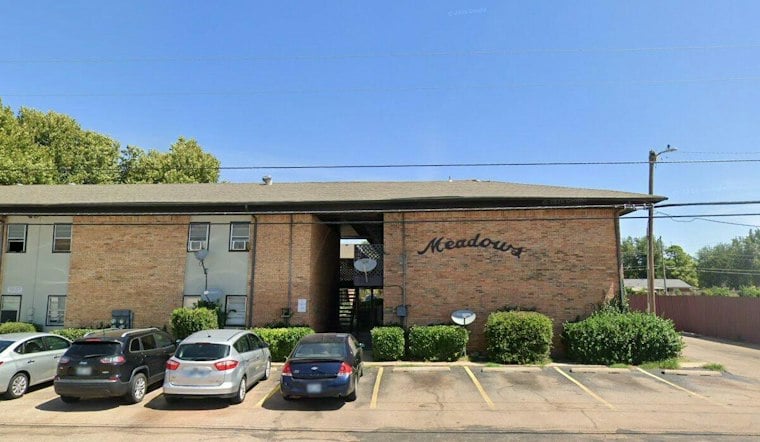
A fire tore through the Meadows Apartments complex near Northwest 10th Street and Rockwell Avenue in northwest Oklahoma City in late August, displacing roughly 50 residents — among them 17 people who had only recently moved off the streets and into apartments through a city-backed rehousing program. The blaze has forced Key to Home, the partnership responsible for placing those residents, to scramble for emergency solutions in a rental market that was already tight before the fire hit.
The 17 displaced residents had been transitioned into housing through Key to Home's Encampment Rehousing Initiative, according to Oklahoma City Free Press. Authorities have since taken one suspect into custody in connection with the fire, which is being treated as suspicious, KOCO reported. In an Oklahoma Chronicle segment, reporter Evan Onstot spoke with Jamie Caves of Key to Home about the program's response, as people who had only recently found stability were suddenly at risk of returning to the streets.
A Program Built to Move Fast, Now Moving Again
Key to Home's Encampment Rehousing Initiative was designed to move unsheltered residents from outdoor living into apartments, with housing and resource support available to participants. That rapid-placement model that got these 17 residents off the streets in the first place is now the tool case managers must lean on again, this time competing for scarce inventory in a rental market already stretched thin.
Jamie Caves, affiliated with Key to Home, described the fire as a new challenge for the partnership, according to the Oklahoma Chronicle segment. The Key to Home Partnership, launched in April 2023 as a city-led public-private collaboration involving nearly 50 organizations, was modeled after Houston's housing-first strategy, according to the City of Oklahoma City. The partnership has helped hundreds of people experiencing homelessness find homes since its launch, per the Oklahoma Chronicle report.
Momentum Built Over Years, Tested in a Single Night
The fire lands at a moment when Key to Home had reason for cautious optimism. Oklahoma City's 2026 Point-in-Time Count recorded 1,867 people experiencing homelessness on January 23, 2026, a 1% decrease from the prior year and the city's first overall decline since 2022, according to the City of Oklahoma City. That progress came just months before the Meadows fire threatened to undo it for at least 17 individuals.
But the citywide numbers mask uneven ground. Homelessness among families in Oklahoma City rose 5% in 2026 while unaccompanied youth homelessness grew 11%, reaching two-decade highs for both groups since federal tracking began in 2005, according to The Frontier. The outlet also cited National Low Income Housing Coalition data showing a minimum-wage worker in Oklahoma must work 116 hours a week to afford a standard two-bedroom apartment — a gap that helps explain why displaced residents can't simply find new housing on their own.
State and Local Funding Backing the Effort
Key to Home has drawn support from multiple layers of government in recent months. In March 2026, the State of Oklahoma signed an agreement allocating up to $800,000 to fund housing and case management for roughly 40 people cleared from highway encampments in Oklahoma City, according to Oklahoma City Free Press. The partnership also provides clinical mental health support, street outreach, and housing assistance to high-need individuals.
Most people cycling through Oklahoma City's homelessness system are not newcomers. Data from the 2025 Point-in-Time survey found that about 70% of people experiencing homelessness in Oklahoma City became unhoused while already living in Oklahoma City, according to the MetroFamily Magazine. That context underscores why the Meadows fire strikes close to home for the case managers now working to rehouse the same 17 residents a second time.



