

























































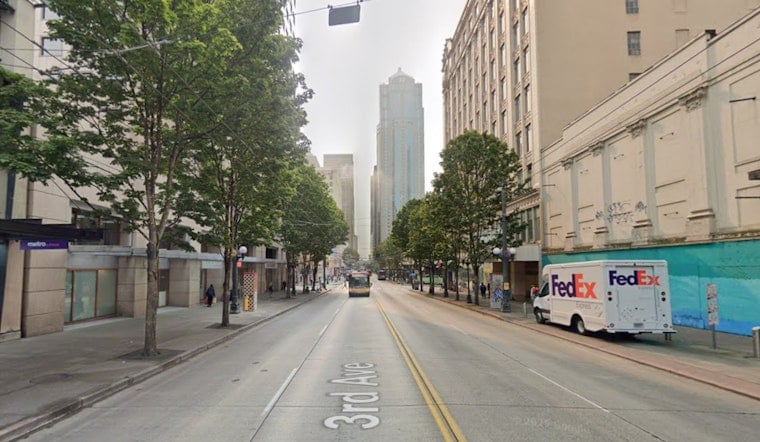
The old 7-Eleven at 1524 Third Avenue in downtown Seattle has reopened, but there is nothing behind the counter you would actually want to eat. The space quietly debuted August 28 as Inconvenience Store, an immersive art exhibition built by more than 70 mostly local artists that mimics a convenience store down to its checkout counter, refrigerator case and hot bar, only every item on the shelf is handmade art with a price tag between $1 and $10,000.
The soft opening happened during a downtown art walk, and the show's official launch is set for September 19 alongside the Walk Don't Run arts marathon, a 3-kilometer route running from Pioneer Square through the retail core into Belltown that organizers say draws inspiration from the historical NEPO 5K Don't Run event held from 2011 to 2015, according to Cascade PBS. Opening day hours run noon to 4 p.m., after which the exhibit settles into its regular schedule of Saturdays and Sundays from noon to 4 p.m., with admission free and the show slated to run through mid-2027, as reported by The Seattle Times.
A Store Stocked Entirely With Art
Inconvenience Store is curated by Lilia Deering and Mary Anne Carter, the same pair behind STÖR, a 2024 IKEA-spoof exhibit at Base Camp Studios 2 that pulled in more than 10,000 visitors and generated over $50,000 in art sales across 813 households during its three-month run, according to Mary Anne Carter's own site. Inconvenience Store is billed as the second installment in their immersive series aimed at reducing barriers to art, and Deering told the Times that traditional white-wall galleries can feel intimidating and often lack price transparency, a gap the mock-retail format is designed to close.
The merchandise, organized across 14 departments including food and pantry, health and beauty, and office supplies, leans into absurdist takes on ordinary goods. Shoppers will find artist-made beeswax egg votive candles, Nerds gummy clusters keychains, a walk-through refrigerator gallery featuring rotating wall-hung artwork, a sound sculpture built to resemble an ATM, and long candles shaped like yardsticks that melt away when lit. The hot bar serves up playful imitations of hot dogs and pizza slices, and visitors can trade coins for original prints and stickers rather than snacks.
The Artists Behind the Shelves
Seattle-based textile artist Shiloh Davies contributed oversized bobby pins, bread-slice throw pillows and snack-shaped keychains to the show, with soft sculpture keychains priced from $20 and large hair clips going for about $120, per the Times. Fellow artist Emma Kates-Shaw spends roughly an hour hand-encrusting each of her lighter cases with Apoxie Sculpt, rocks, shells, beads and pearls, pricing the finished pieces at about $65 apiece. Other items on the shelves include a deliberately pre-tangled USB cord and shoulder bags fashioned from Cheetos and Lay's wrappers, part of a broader effort by the artists to abstract familiar store goods into everyday inconveniences stripped of their practical use, Carter told the paper handmade production is inefficient and more expensive than mass manufacturing but that inefficiency is what creates something special.
Why a Former 7-Eleven, and Why Now
The exhibit sits on the ground floor of Parnassus, a building Base Camp Studios bought in April 2026 for artist housing and studio space. Nick Ferderer, who founded Base Camp Studios, invited Deering and Carter to activate the ground floor with art, and the space is expected to become a permanent gallery once construction on the upper levels wraps up, according to the Times' reporting.
That purchase fits a larger pattern for the nonprofit along Third Avenue. Base Camp Studios also bought the 116-year-old Gibraltar Tower at 1518 Third Avenue, just down the block, for $2.8 million in April 2026, with plans to convert its upper floors into as many as 16 affordable artist lofts and workspaces, Hoodline previously reported. That deal was made possible in part by Seattle's Office to Residential Conversion Program, which grants commercial building owners local tax deferrals if at least 10% of converted units are set aside as affordable housing for households earning up to 80% of the area median income, according to KNKX Public Radio.
The station's reporting also lays out why arts groups have become such active players on this stretch of downtown: the Third Avenue corridor suffered severe post-pandemic declines in foot traffic, persistent storefront vacancies, and open-air drug activity, pushing local leaders to lean on cultural activations as a tool for downtown safety and recovery. Mayor Bruce Harrell's Downtown Activation Plan, launched in June 2023, set out to fill empty storefronts with creative pop-ups while also easing environmental review hurdles for residential conversions and expanding safety ambassador programs, per KING 5 News.
Part of a Wider Downtown Arts Push
Base Camp Studios is not alone in betting that empty retail can become cultural infrastructure. The municipal Seattle Restored program, run by the city's Office of Economic Development, has activated more than 50 vacant commercial storefronts citywide by pairing small business pop-ups and artists with subsidized studio rents, according to The Urbanist. Down the same block, Cannonball Arts turned a vacant 66,000-square-foot former Bed Bath & Beyond into a multi-use contemporary arts center, the outlet notes, suggesting large-scale retail-to-arts conversions are gaining real momentum across downtown Seattle.
Whether that momentum holds once initial city subsidies expire remains an open question that The Urbanist's reporting does not resolve. For now, though, organizers say the goal is simpler: turning a corridor known for empty storefronts into somewhere people actually want to walk through, with Inconvenience Store meant to help downtown feel less like a place to pass by and more like a destination in its own right.





