

























































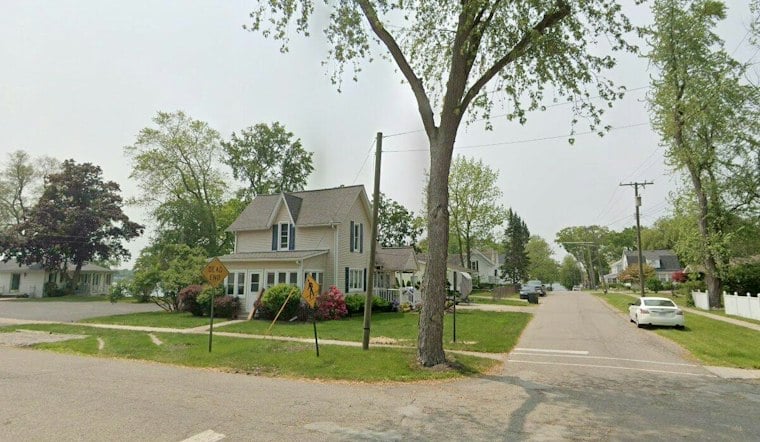
A weathered lakefront cottage on Ray Court in Orion Township, once the summer home of Teamsters boss Jimmy Hoffa, is emerging from a lengthy restoration that has kept its 1925 bones intact while turning it into a vacation rental. John and Susan Hagen, builders from Ortonville, Michigan, bought the 2,528-square-foot property along Square Lake in May 2025, after it had been listed at $275,000.
According to Lake Orion Review, the couple's project has drawn attention well beyond Orion Township because of who once called the house home. Hoffa made the Square Lake cottage a home for his wife and two children starting in 1947, according to FOX 2 Detroit, and he vanished during the summer of 1975 after receiving a call about a meeting scheduled for after lunch. The house sits on 0.6 acres with 175 feet of Square Lake waterfront and includes a detached garage with an upper-level apartment, per property records reviewed by Zillow.
Sagging Floors and a Basement Rebuild
The renovation was not a cosmetic job. Crews spent their first six months tackling structural repairs after discovering sagging floors throughout the interior and frame deficiencies serious enough to require adding a new support wall in the basement, the report notes. The house had sat largely vacant and unmaintained for decades before work began, leaving the Hagens with a heavier lift than a typical historic-home purchase.
Despite the extensive repairs, the Hagens preserved several period details that tie the house to its past. Original knotty pine wall and ceiling paneling remains, along with a restored living room fireplace and a retro home bar, and the exterior was repainted white to mirror its historical appearance, the same account states. The home was sold with much of its contents in 1985, leaving the surviving architectural features as a link to its past.
From Hoffa's Summer Home to The Hoffa House
Rebranded as The Hoffa House, the property is being converted into a three-bedroom vacation rental with en-suite bathrooms, according to the property's Airbnb listing. The Hagens also plan to offer public tours. The home is within walking distance of the Polly Ann Trail in northern Oakland County, positioning the rental as both a slice of true-crime history and an outdoor-recreation stop.
Following Hoffa's disappearance in 1975, the home and its remaining contents stayed in his family's hands until 1985, after which the house sat mostly untouched for nearly 40 years until last year's sale, the same report notes. Hoffa's disappearance remains unsolved.
The House's Final Documented Morning
The cottage's backyard holds a specific place in the Hoffa timeline. On the morning of July 30, 1975, Detroit Free Press photographer Tony Spina took what are believed to be the last known photos of Hoffa there, just hours before he disappeared, according to Michigan in Pictures. Spina had reportedly visited the cottage that day to update newspaper photo archives, unaware he was capturing Hoffa's final documented hours.
Hoffa disappeared after showing up for a meeting at the former Machus Red Fox restaurant in Bloomfield Township on July 30, 1975, per Oakland County Times. Hoffa had driven from the cottage that day to attend a meeting scheduled for after lunch, a detail that has anchored decades of speculation about his final hours.
Neighbors Remember a Different Side of Hoffa
Not every memory tied to the property is shadowed by intrigue. In a community retrospective produced by Orion Neighborhood Television, long-time Square Lake neighbors recalled Hoffa as an approachable and polite community member who regularly interacted with local residents, the same Oakland County Times report states. Those anecdotes, shared during local anniversary interviews, painted a picture of Hoffa as a familiar face on the lake rather than the notorious national figure he became in headlines.
For the Hagens, that dual identity, a family lake house and a fixture of one of the country's most enduring unsolved disappearances, appears central to the appeal of the restoration. With structural repairs largely behind them and period details intact, The Hoffa House is positioned to give visitors a rare, tangible connection to Hoffa's final days in Metro Detroit.



