

























































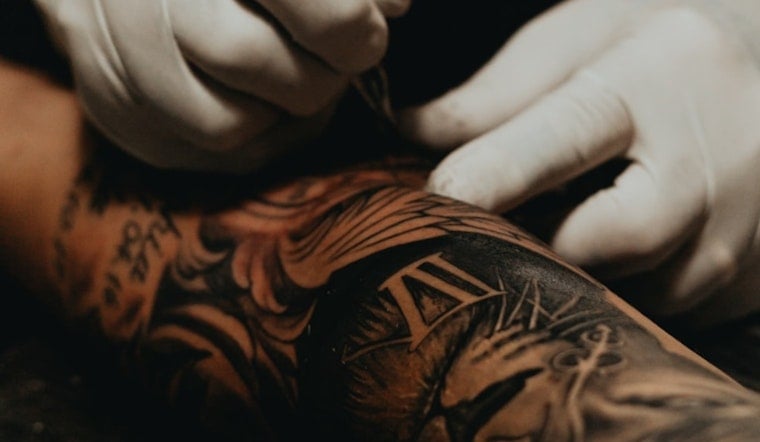
A Kansas farm girl turned circus performer named Maud Wagner became America's first female commercial tattoo artist more than a century ago, and now her story is headed to the stage in Overland Park. On Thursday, September 24, InterUrban ArtHouse will host a live edition of a Kansas City podcast built around Wagner's unlikely path from aerialist to tattoo pioneer, alongside 17 area artists reimagining what body art can be.
The event, called “A People's History of Kansas City LIVE! Moving the Needle: The Art of the Tattoo,” is a live version of KCUR's award-winning podcast, hosted by Mackenzie Martin, according to KCUR. The show focuses on Wagner's life and influence, tracing how tattoos expanded from Indigenous communities into circus sideshows and, eventually, art galleries. Participants include tattoo artist Ron Dolecek, artist Laryn Langford, and photographer Julie Denesha, the station reports.
Wagner was born in Emporia, Kansas, in 1877, and met tattoo artist Augustus “Gus” Wagner at the 1904 St. Louis World's Fair, where she was working as an aerialist and contortionist. According to Storyline Ink Tattoo Studio, Wagner agreed to a date with Gus in exchange for lessons in hand-poked tattooing — a trade that launched her into history as America's first female commercial tattoo artist. She went on to join the circus and become a tattooed carnival performer, per the same account, eventually influencing other female tattoo artists who followed.
A Marriage Built on Hand-Poked Ink
Even after electric tattoo machines were patented by Samuel O'Reilly in 1891, Maud and Gus Wagner shunned the automated equipment, remaining among the last American tattoo artists to work exclusively by hand, according to Stigma Rotary. Hand-poking meant manually pressing ink into skin dot by dot, a painstaking method that defined the couple's artistic identity for decades. Their daughter, Lotteva Wagner Davis, began tattooing at age nine and became a professional tattooist herself — yet she remained tattoo-free throughout her life, according to Vintage Everyday, because her mother forbade her father from tattooing her, and Lotteva maintained that if he couldn't do it, no one would.
Wagner died in 1961 and was buried alongside her husband, who died in 1941 after being struck by lightning, in Homestead Cemetery in Cedar Point, Kansas. Tattoo history enthusiasts replaced the couple's weathered headstones with new markers in 2016, as reported by Atlas Obscura. Some of the physical artifacts tied to that legacy resurfaced closer to the present day: a historic hand-painted sideshow banner depicting Wagner made its way to local tattoo artist Ron Dolecek after a customer brought it into his shop, following a break-in at an abandoned farmhouse outside Cedar Point, according to KCUR's reporting on the artifacts, which had been preserved in Kansas' Flint Hills region for decades. KCUR's live show facts note that these Maud Wagner artifacts were unearthed through that break-in at a Kansas farmhouse.
From Post Office to Community Art Hub
The evening's venue has its own local backstory. InterUrban ArtHouse was founded in 2011 by local artist Nicole Emanuel and, in 2017, purchased a 10,000-square-foot former U.S. Postal Service sorting facility in downtown Overland Park to serve as its permanent home, according to a 2016 report from KCUR. The organization takes its name from the historic Missouri/Kansas Interurban Railway trolley line, and today the building houses 19 studio spaces for more than 25 multidisciplinary artists, alongside programming like art therapy and youth music mentorship, per InterUrban ArtHouse's own materials describing itself as an affordable creative hub connecting Johnson County to the broader Kansas City arts scene.
The venue, located at 8001 Newton in Overland Park, is also currently showing “This Is Permanent,” an InterUrban ArtHouse exhibition recognizing tattoo artists' skill and tattoos as an art form. Among the works on display is a 2026 piece by Laryn Langford made with acrylic and tattoo ink on paper. Tickets for the September 24 event are $10 for KCUR and InterUrban ArtHouse members and $15 for non-members, with non-member purchases including a year of KCUR membership. A happy hour show has doors opening at 5:30 p.m. with the program running 6-7 p.m., while a late show follows with doors at 7:30 p.m. and a program from 8-9 p.m. Accessibility accommodations are available by contacting [email protected].
Tattoos Go Mainstream, Especially Among Young Women
Wagner's story lands at a moment when tattooing has moved far beyond sideshow curiosity into the cultural mainstream. A 2023 Pew Research Center survey found that 32% of American adults have at least one tattoo, including 38% of women compared to 27% of men, with 22% of adults reporting multiple tattoos. More recent analysis from the Survey Center on American Life, published in 2026, found that 56% of young American women aged 18 to 29 now report having a tattoo — a sharp rise from earlier 2010 surveys, when young women were far less likely to be inked.
Today's tattoo industry also operates under a regulatory framework that didn't exist in Wagner's era. In Kansas, tattooing is legally regulated by the Kansas Board of Cosmetology, which requires practitioners to complete a formal apprenticeship, undergo infection control training, pass state exams, and work only within licensed facilities, according to the Body Art Training Group. State rules under Kansas Administrative Regulations Article 69-15 also mandate client recordkeeping and health disclosures. According to the Kansas Board of Cosmetology, the agency protects consumers' health and safety by licensing and overseeing the state's cosmetology, body-art and tanning professions. As the KCUR event's framing puts it, tattoos have long served as tools for self-expression, personal and cultural identity, rites of passage, belonging, beauty, and rebellion — themes that connect Wagner's circus-era hand-poking to the shop-based artistry celebrated at InterUrban ArtHouse today.
Hoodline previously toured Kansas City tattoo shops in its coverage of the Willow Creek neighborhood. The upcoming live show at InterUrban ArtHouse offers another lens on the region's relationship with the art form — this time tracing it back to a Kansas-born performer who helped invent the profession itself.





