

























































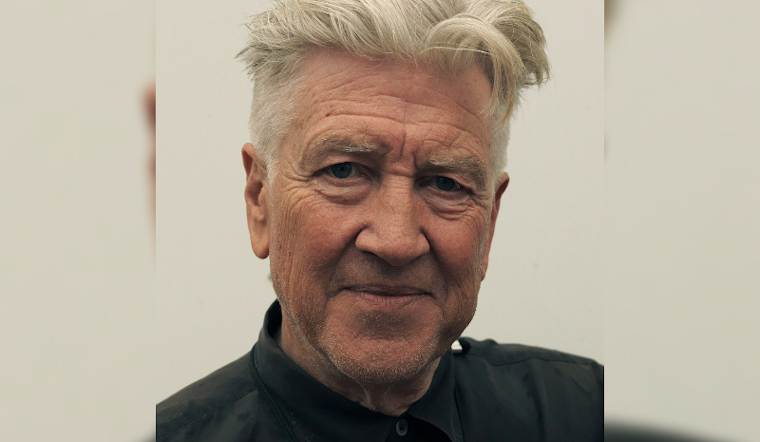
David Lynch spent more than half a century in Los Angeles, and starting Sept. 19, the city he photographed for decades gets its first exhibition devoted entirely to that work since his death in January 2025. Pace Gallery's La Brea Avenue flagship will present David Lynch: L.A., a survey of 35 black-and-white and color photo-based works pulled from five series made between 1979 and 2008.
The show is billed as the first exhibition devoted solely to Lynch's photography practice in Los Angeles, according to the Los Angeles Times, whose reporter Tara Anne Dalbow detailed the exhibition ahead of its opening. One series focuses squarely on the city itself, while four others capture its atmosphere more obliquely — the neon-scarred storefronts, alleys and stairwells that populate the frames Lynch composed across nearly three decades.
Born in Missoula, Montana, in 1946, Lynch studied painting at the Pennsylvania Academy of the Fine Arts before receiving an American Film Institute fellowship in 1970. He arrived in Los Angeles after dark, driving in on San Vicente Boulevard, and stayed for more than half a century. Bill Griffin, managing partner of Pace's Los Angeles gallery, said Lynch chose to settle there for its architecture, film noir, cinema, color, mystery and mood — the same qualities that would define his photographs.
A Bee Board and a Ghostly Couch
Among the works on view is Bee Board, made around 1986-87, which depicts bees pinned to a specimen board and named for Lynch's friends and acquaintances. Another piece, Couch Series #1 from 2008, layers negatives to produce a ghostly double exposure — one of three series Lynch created centered on women's bodies. A 1979 photograph titled Untitled (Los Angeles) shows a skyscraper chandelier casting white light across a coffered ceiling, while another 1979 image captured the fire-burnished remains of the Thrifty sign above a Westwood drugstore.
Lynch approached these outings with a self-imposed goal of shooting 10 photos in five hours, according to the Times report. His son, filmmaker Riley Sweeney Lynch, described the excursions as a treasure hunt, a phrase that captures the improvisational way his father moved through the city's overlooked corners.
Decades of Collaboration Behind the Show
Griffin and Pace senior director Genevieve Day organized David Lynch: L.A., drawing on a working relationship with Lynch that dates back to 2009. Lynch's family advised the pair on how to present the five bodies of work, the Times reported. Arne Glimcher, founder of Pace Gallery, called photography a lesser-known dimension of Lynch's practice and predicted many viewers will be surprised by the intensity of the work on display.
Britt Salvesen, a curator at the Los Angeles County Museum of Art, said photography allowed Lynch to linger on a single image in a way his other mediums did not. Lynch used the camera as a way to find ideas, a habit that ran alongside a career spanning painting, design, music and film — a body of work that began publicly with his 1968 short The Alphabet and continued through his 1977 debut feature Eraserhead, shot partly at Greystone Mansion in Beverly Hills.
A Museum Retrospective Still Taking Shape
Salvesen also confirmed that LACMA is preparing a retrospective of Lynch's career and is currently in discussions with other museums about it, though no timing or scope has been finalized. The Pace exhibition arrives as something of a local precursor to that larger institutional reassessment, giving Angelenos their first dedicated look at Lynch's photography in the city that shaped it.
Pace's La Brea Avenue building, a 15,000-square-foot space with permanent architectural lighting designed by James Turrell, opened in April 2022 following the gallery's merger with local dealer Kayne Griffin. The venue previously hosted a Berlin-focused Lynch exhibition at Pace's German location earlier this year, running from Jan. 29 to March 29, 2026, which featured paintings, sculptures, watercolors and photographs Lynch shot in Berlin in 1999. Lynch's fine art first drew comprehensive international museum attention in 2007, when the Fondation Cartier pour l'art contemporain in Paris mounted The Air Is on Fire, a 40-year retrospective covering his paintings, drawings, photography and soundscapes. A later survey, David Lynch: The Factory Photographs, opened at London's The Photographers' Gallery in 2014, focused entirely on his black-and-white images of decaying factories across Germany, Poland, England and the United States.
Lynch's commercial gallery relationships extended beyond Pace as well. In late 2022 he held concurrent solo shows in New York at Pace and at Sperone Westwater, which had exhibited his paintings and mixed-media works since 2019. His five-decade career also included an Honorary Academy Award in 2019, three Best Director Oscar nominations for The Elephant Man, Blue Velvet and Mulholland Drive, and the Cannes Film Festival's Best Director award in 2001. Mulholland Drive, released in 2001 and still regarded as one of the definitive Los Angeles films of its era, remains part of a wave of continued interest in Lynch's L.A.-set work, including a screening of The Elephant Man planned at the Aero Theatre as part of Mel Brooks' handpicked film series.





