

























































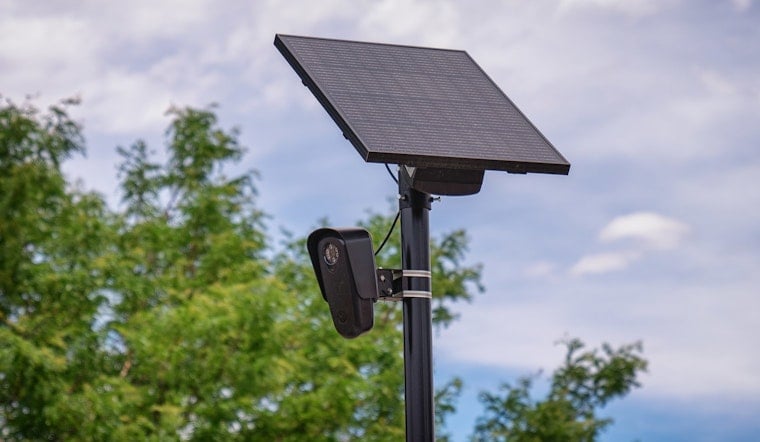
Palm Beach County commissioners voted 7-0 to pause new permits for automated Flock Safety license plate cameras on county roads, while also demanding that the Palm Beach County Sheriff's Office answer pointed questions about how long the data is kept and who can see it. The move comes as the Sheriff's Office operates 83 license plate readers across the county, according to county records.
The vote, first reported by WLRN, reflects a broader reckoning playing out statewide over Flock Safety, the surveillance technology company whose cameras record license plate numbers and other characteristics of passing vehicles every day. Flock operates a nationwide network accessible to thousands of law enforcement agencies across 49 states, and law enforcement agencies can search and share that data across jurisdictions once it is collected.
Commissioner Gregg K. Weiss questioned who owns the data generated by the cameras and who has access to it, warning that without proper oversight, the systems could track innocent drivers. Joel Flores, a critic who spoke to the point, called the network an intrusive form of mass surveillance, arguing that the cameras photograph everyone who drives past them regardless of suspicion. Other critics have gone further, describing the technology as unconstitutional warrantless mass surveillance.
A Different View From a Camera's Beneficiary
Not every commissioner sees the cameras as a threat. Maria Sachs pointed to the significant public safety benefits of the technology, drawing on her own experience after a Flock camera helped recover her stolen truck. Law enforcement more broadly has credited Flock technology with helping track suspects in violent crimes and locate missing people, arguments that have kept the devices popular even as scrutiny mounts.
Flores, for his part, argued that public safety and privacy do not have to be at odds, suggesting the county can find a middle path rather than treating the debate as all-or-nothing. Palm Beach County plans to hold a public workshop on these surveillance questions in the coming weeks, giving residents and officials another forum to hash out the tension between the two camps.
State Order Adds Pressure From Above
The county's pause lands just after the Florida Department of Transportation decided to remove automated Flock cameras from state rights-of-way altogether, citing rapid expansion of the technology and data privacy concerns. That state-level shift followed Governor Ron DeSantis publicly calling Florida's Flock network “out of control” and urging lawmakers to consider an overhaul, a stance Hoodline detailed in late August.
The FDOT order does not touch every camera, however. It applies specifically to state highway rights-of-way, meaning county roads, city streets, police vehicles, and non-highway camera networks remain under local control regardless of what the state decides. That jurisdictional line has become a source of confusion even as more Florida communities take action; Manatee County recently banned Flock cameras from parks and public facilities, a step Hoodline covered when it happened.
West Palm Beach's Alternative: Anonymized Street Sensors
While the Sheriff's Office faces questions about its Flock cameras, the city of West Palm Beach has partnered with the Center for Smart Streetscapes, a National Science Foundation-funded research group led by Columbia University and Florida Atlantic University, on a project that takes a markedly different approach to street-level data. Known as CS3, the initiative has deployed 55 AI-powered sensors along Clematis Street to track pedestrian flow, crosswalk safety, and urban heat.
Unlike Flock's cameras, CS3 sensors do not record or save raw street video of real people. Instead, they convert captured activity into anonymized digital avatars or silhouettes, and according to experts involved in the project, the resulting data contains no personally identifiable information. A city representative said all data collected through the mobility intelligence project is publicly available, and CS3 provided a project update on the effort back in January.
The contrast between the two systems underscores what commissioners are wrestling with: a technology built explicitly to identify vehicles and drivers versus one designed to strip identity out of the data entirely. Whether that distinction satisfies residents worried about being tracked is likely to be part of the discussion when the county's public workshop convenes in the coming weeks.




.jpg)