

























































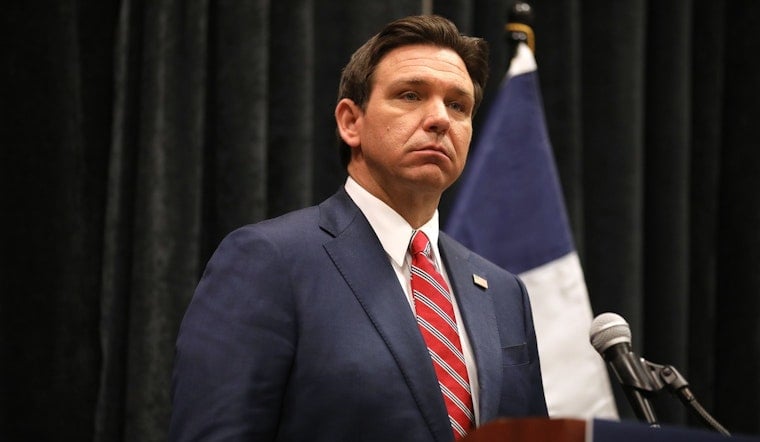
Governor Ron DeSantis says Florida's rapidly multiplying network of Flock license plate reader cameras has spun out of control, and he wants state lawmakers to overhaul how the technology is used before it slides further into what he called a surveillance state. Speaking at a news conference at Florida International University in Miami, DeSantis said the cameras' evolution far beyond original uses like toll collection has raised real concerns about who is watching Floridians' movements and why.
DeSantis said he supports using the technology to go after criminals but drew a hard line against turning it into a tool for tracking ordinary residents. He pointed to an alleged instance of a police officer using the technology to track an ex-girlfriend as an example of the kind of misuse that worries him, according to WPEC. He said flatly that the cameras are out of control and questioned whether adequate safeguards exist around the information they collect.
The governor asked for an overview of how state agencies use license plate readers, noting that state-level deployment is relatively limited compared with local police departments and sheriffs' offices, which use the technology heavily for criminal surveillance. That local dominance tracks with statewide numbers reported by Florida Politics, which found at least 100 law enforcement agencies across the state now operate nearly 7,500 Flock cameras, part of a nationwide network exceeding 100,000 devices.
A Legislative Fight DeSantis Already Lost Once
DeSantis tied his renewed concerns to his broader push for an artificial intelligence bill of rights, and any new protections for license plate reader data would have to come through the Florida Legislature. That's a familiar obstacle: his AI Bill of Rights proposal, SB 482 and SB 2D, passed the Florida Senate overwhelmingly earlier this year but died in the House after Speaker Daniel Perez argued that AI guardrails belong at the federal level, a position that aligned with Trump administration guidance favoring unified national policy over state-by-state rules, per Florida Politics' reporting from April.
As a possible model for reform, DeSantis is reviewing a New Hampshire law as a starting point for Florida. Under that state's statutes, RSA 236:130 and RSA 261:75-b, automated surveillance is generally banned on public highways, and officers must purge non-matching plate data within three minutes while being barred from photographing vehicle occupants, according to details shared on Reddit. That framework prevents commercial vendors like Flock from building the kind of rolling, multi-day location databases that have become standard in Florida, where Statute § 316.0777 permits highway-adjacent ALPR installations for active investigations but sets no single statewide deletion deadline for the resulting records, per VP.net.
National Data Shows a Pattern of Abuse
The governor's concerns echo findings well beyond Florida's borders. An August investigation by The Washington Post identified at least 50 law enforcement officers nationwide who have been accused, charged, or convicted of misusing Flock and similar systems to spy on ex-partners or romantic interests, including one officer who searched a single plate more than 3,700 times. The Post found that most departments never audited officer search histories until journalists or victims flagged the activity.
An ACLU report from earlier this month put the scale of the underlying data collection in perspective: Flock Safety now operates more than 120,000 automated readers across roughly 5,000 agencies nationwide, yet the civil rights organization found less than 1% of scanned plates connect to any crime or wrongdoing. In response to the mounting scrutiny, Flock announced policy changes making criminal case number logging mandatory for every search by January, adding automated tools to flag suspicious lookup patterns, and cutting its default data retention from 30 days down to seven, with CEO Garrett Langley describing the shift as converting optional privacy settings into mandatory standards across every client agency.
Florida's Own Misuse Case and Local Spending
Florida has its own recent example of the kind of abuse DeSantis referenced. A Sarasota Police Department officer was fired and charged with official misconduct and computer crimes after internal investigators found he had run a single license plate 358 times over five months through the city's Flock database without an assigned criminal case, as Hoodline reported. That internal investigation only began after a reporter questioned the department about the unusually high number of queries logged in a public database.
Local spending on the camera networks has also drawn scrutiny. Public records compiled this month show Hollywood has invested more than $5.5 million in its ALPR network since 2014, while Fort Lauderdale has spent $5.1 million since 2011, much of it approved through routine consent agendas with little standalone public debate. Hollywood's police department has reported sharing its data with over 360 agencies nationwide, a scope that has fueled resident pushback in cities including St. Petersburg and Davie, where activists have demanded oversight or removal of camera systems purchased without a public vote.
Vandalism Spreads as Frustration Boils Over
Public frustration in Florida hasn't stayed limited to city council meetings. Incidents of physical vandalism against the cameras were reported in Port Orange, Fort Lauderdale, Cape Coral, Jacksonville, and Oviedo in August, with individuals arrested for cutting down poles, melting camera housings, or spray-painting devices, according to Local 10. Grassroots anti-surveillance groups like DeFlock have gained traction statewide by publishing crowdsourced maps that pinpoint local camera locations, feeding both the backlash and, now, the governor's own call for a legislative fix.
Whether DeSantis can succeed where his AI Bill of Rights failed remains to be seen, especially with House leadership previously favoring federal preemption over state action. But between the Sarasota firing, the Washington Post's national findings, Flock's own policy retreat, and the wave of vandalism spreading across the state, the pressure on lawmakers to address license plate reader oversight heading into the 2027 legislative session appears to be building from multiple directions at once.





.jpg)