

























































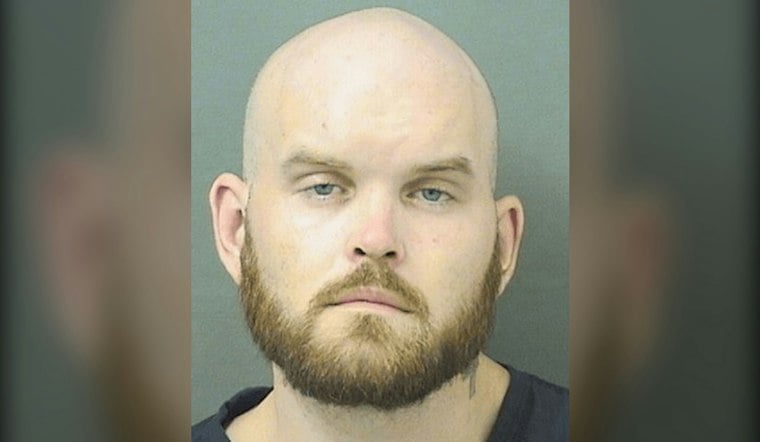
A 31-year-old Palm Springs man was arrested outside a Wawa on South Congress Avenue on Tuesday afternoon after telling a crisis text line he had an AR-15 and planned to kill everyone inside before forcing police to shoot him. Officers who converged on the store found no gun anywhere near him.
Andrew David Tumey began texting the Crisis Text Line at 2:23 p.m. Tuesday, according to court documents cited by CBS12. Four minutes later, at 2:27 p.m., he wrote that he was going to kill himself in the next five minutes. By 2:31 p.m. he described a plan to rob the Wawa before forcing a fatal confrontation with police, and at 2:38 p.m. he identified the weapon as an AR-15 and threatened to kill everyone inside, per the same court records.
At 3:02 p.m., Tumey told the crisis line operators he wanted police to arrive so he could die in a suicide-by-cop scenario, and he separately said he intended to force officers to kill him, police say. Mobile crisis dispatchers alerted the Palm Springs Police Department, and officers responded to the Wawa at 3950 S. Congress Avenue, arriving at 3:09 p.m.
Officers Find No Weapon Despite the Threats
A responding officer spotted Tumey lying on the sidewalk west of the store, next to a black backpack. Backup officers ordered him to the ground at gunpoint and intercepted him before he could enter the Wawa, though he had already attempted to enter the store's restrooms. Dispatchers confirmed his identity by calling the phone number tied to the crisis-line texts.
Officers noted that Tumey was heavily intoxicated and struggled to stand. He was taken into custody at 3:23 p.m. A search turned up a cell phone in his pocket, but police found no firearms or other weapons in his backpack or on his person, according to the report. He was medically cleared for a minor elbow scrape before being booked into the Palm Beach County jail, where he remains on suicide watch.
Why Threat Charges Don't Require a Gun
Tumey faces felony charges for written threats to kill. Under Florida Statute § 836.10, transmitting a written or electronic threat to commit a mass shooting or act of terrorism is a second-degree felony carrying up to 15 years in prison, 15 years of probation, and fines up to $10,000, according to the Florida Senate.
Florida case law under that same statute establishes that prosecutors do not need to prove a defendant actually possessed the physical capability or weapons to carry out a mass-shooting threat — only that he intentionally transmitted a communication that a reasonable person would interpret as a serious threat of violence, according to the Sammis Law Firm. That legal standard explains why the absence of a weapon in Tumey's backpack does not, on its own, undercut the felony case against him.
The charge is also possible because of a 2021 change to state law. Attorney Richard Hornsby notes that a legislative amendment that year removed the requirement that a written threat be sent directly to the targeted individual, opening the door to felony prosecution for threats transmitted to third parties or digital platforms — including, in this case, a crisis-line operator rather than Wawa itself or its customers.
How a Text to a Crisis Line Reached Police
Crisis Text Line's own protocols explain the handoff that brought officers to the scene. When a texter presents an imminent risk of suicide or violence and cannot be safely de-escalated, clinical supervisors initiate what the organization calls an “active rescue,” sharing caller data and phone details with local 911 dispatchers, per Crisis Text Line. That is a rare step: the organization's own metrics show clinical supervisors trigger such emergency interventions in roughly 0.82% of total crisis conversations, meaning the vast majority of texters are de-escalated without a law enforcement dispatch.
Statements threatening “suicide by cop” present distinct escalation challenges for first responders arriving on an active call, according to Active Minds, since officers must weigh de-escalation against the stated intent to provoke lethal force.
Mental Health and Firearm Statutes That Could Still Apply
Florida law offers officers several tools beyond the criminal charge Tumey now faces. The Baker Act, codified at Florida Statute § 394.463, allows law enforcement to take someone into custody for an involuntary 72-hour mental health evaluation when mental illness causes a substantial likelihood of serious bodily harm to themselves or others, according to the Florida Department of Children and Families. Separately, Florida Statute § 790.401 — enacted in 2018 after the Marjory Stoneman Douglas High School shooting — lets agencies petition circuit courts for Risk Protection Orders that temporarily bar someone deemed a danger from possessing or purchasing firearms for up to a year, per the Volusia Sheriff's Office.
It remains an open question whether local prosecutors will pursue a civil Risk Protection Order against Tumey or instead route the case toward court-ordered mental health treatment given his heavy intoxication and his current suicide watch status.
A Growing Palm Beach County Suburb
The Village of Palm Springs, where the arrest happened, is a 4.2-square-mile municipality in central Palm Beach County whose population grew from 18,928 residents in 2010 to 26,890 in the 2020 U.S. Census, according to the U.S. Census Bureau. The Palm Springs Police Department operates as its own independent municipal force, per annual reporting from the Florida Department of Law Enforcement, handling patrol and dispatch along the South Congress Avenue corridor where the Wawa sits.


