

























































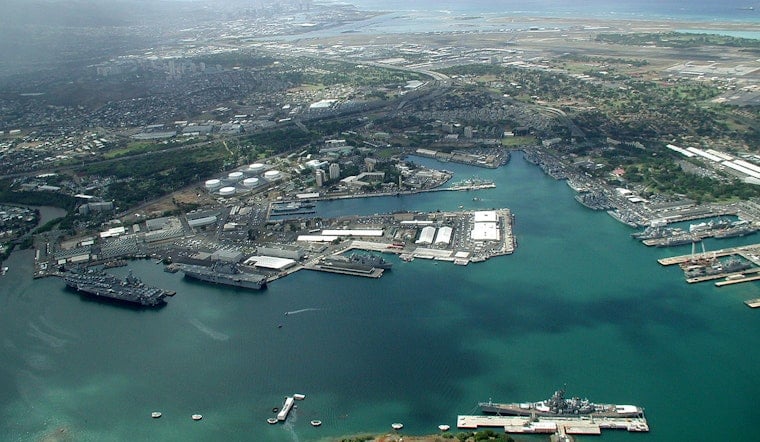
Nearly five years after the U.S. Navy shut down its ʻAiea Hālawa Shaft over petroleum contamination fears tied to the Red Hill fuel disaster, state regulators have conditionally approved bringing the well back online as a drinking water source for Joint Base Pearl Harbor-Hickam. The approval addresses a vulnerability that has quietly persisted since December 2021: roughly 93,000 military and civilian users on the Joint Base system have depended entirely on a single active well, the Waiawa Shaft, located about 6.2 miles from Red Hill.
The Hawaiʻi Department of Health's approval, first reported by Maui Now, allows the Navy to reactivate the ʻAiea Hālawa Shaft as a supplemental water source intended to enhance system reliability. Regulators had raised concerns about the Navy's previous reliance on that single-source Waiawa well, and the newly approved shaft is located roughly two miles from the Red Hill Bulk Fuel Storage Facility. A geologic barrier situated in the Hālawa Stream valley separates the Red Hill site from the ʻAiea Hālawa Shaft, according to Maui Now's reporting.
It is important to keep two similarly named wells straight. The Navy's ʻAiea Hālawa Shaft is a distinct well from both the Navy's Red Hill Shaft and the Honolulu Board of Water Supply's much larger civilian Hālawa Shaft. That municipal well, which the Board of Water Supply shut down separately in December 2021 to protect metropolitan drinking water, removed roughly 10 to 17.5 million gallons a day, about 20% of Honolulu's water supply, from service and remains offline, per Fitch Ratings.
How the Approval Process Unfolded
The regulatory groundwork for this moment was laid in a February 7, 2025 revised conditional approval letter from the Hawaiʻi Department of Health, which spelled out 12 specific technical and environmental requirements the Navy had to meet, according to the U.S. Environmental Protection Agency. Under the Safe Drinking Water Act, state health authorities retain strict oversight over military public water systems, and that oversight shaped nearly every condition attached to the shaft's return.
Among those requirements, the Navy completed testing for more than 50 contaminants, including PFAS and total petroleum hydrocarbons, according to Maui Now. PFAS was detected at the ʻAiea Hālawa Shaft as recently as June 2024, but the Navy has since demonstrated that its treatment systems can effectively remove the chemicals, per the same reporting. The Hawaiʻi Department of Health folded newly established 2024 federal Maximum Contaminant Levels for six PFAS compounds into its evaluation criteria for the shaft, according to the department's own April 2026 responses to community questions. PFAS compounds are persistent industrial chemicals historically linked to firefighting foams used at military installations.
Filtration Requirements Won't Disappear Anytime Soon
The shaft must be equipped with granular activated carbon treatment, ion exchange treatment, and disinfection systems, per Maui Now's reporting. State health conditions go further, requiring the Navy to keep those carbon and ion exchange systems running for at least nine consecutive quarters of compliant water testing before it can even ask the state for permission to phase them out, according to the Hawaiʻi Department of Health. Those treatment units trap both PFAS chemicals and petroleum hydrocarbons before water reaches the base distribution network.
The Navy also faces tight reporting timelines under the approval. It must notify customers and the Department of Health at least 10 days before actually reactivating the shaft, and it must report any conditions that could contaminate the source within 24 hours of discovery, according to Maui Now. A separate DOH emergency order requires the Navy to continue pumping from its Red Hill Shaft to minimize potential contaminant migration, and the newly approved shaft includes sampling taps for ongoing testing. The department has said it will monitor groundwater data after reactivation and can suspend or revoke the conditional approval if requirements go unmet or a future public-health threat emerges.
A Track Record of Clean Testing, But Lingering Skepticism
The Joint Base Pearl Harbor-Hickam water system has been in compliance with federal and state drinking water regulations since 2022, according to Maui Now, and the EPA has released a report concluding the system has been free of fuel contamination since that year. That conclusion is backed by a full year of joint split-sample testing, conducted from April 2024 through March 2025 and evaluated by both the EPA and Hawaiʻi DOH, which found drinking water across the Joint Base system remained free of fuel contamination and in compliance with federal standards.
Not everyone is fully reassured. The Red Hill Community Representation Initiative, a group formed under a 2023 EPA administrative consent order to give residents a direct voice in Red Hill remediation, raised public safety and transparency concerns in March 2025 about the state's plan to conditionally approve the shaft as a drinking water source, according to a statement the group posted on Facebook. That skepticism traces back to the scale of the original disaster: the November 2021 Red Hill spill released an estimated 5,500 to 20,000 gallons of JP-5 jet fuel into the aquifer beneath 20 underground fuel tanks situated just 100 feet above Oahu's main groundwater source, contaminating tap water in military housing, causing acute illnesses, and forcing nearly 10,000 households into temporary hotel lodging, according to the University of Hawaii Economic Research Organization.
Part of a Larger Fuel-Infrastructure Overhaul
The shaft's reactivation lands amid a much broader restructuring of Navy fuel infrastructure ordered by Congress after Red Hill. In August, the Navy awarded a global fuel infrastructure contract with a ceiling of nearly $1 billion to rebuild and modernize military fuel facilities worldwide, Hoodline previously reported, following FY2022 NDAA mandates that also directed the permanent defueling and closure of the Red Hill facility itself.
For the roughly 93,000 people relying on Joint Base Pearl Harbor-Hickam's water system, the practical upshot is straightforward: a second working well means the system no longer hinges entirely on the Waiawa Shaft holding up on its own. Whether that redundancy eases the deeper trust concerns raised by community advocates is likely to depend on how the coming quarters of groundwater monitoring play out.





_2004.jpg)