

























































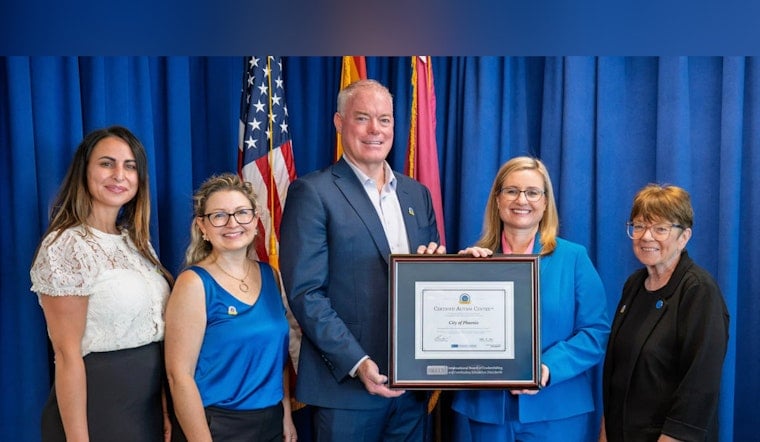
Phoenix has become the largest municipality in the United States to earn a Certified Autism Center designation, with more than 80% of the city's front-facing employees trained to assist autistic or sensory-sensitive residents and visitors. Phoenix Mayor Kate Gallego said the city is now a Certified Autism Center and aims to meet the needs of its entire community, a milestone that touches everything from Sky Harbor airport terminals to public library storytimes.
The designation comes from the International Board of Credentialing and Continuing Education Standards, which reviewed the City of Phoenix's operations before granting the credential, according to KTAR News 92.3 FM. Exactly 8,816 municipal staff members, including police officers and firefighters, completed IBCCES training across four role-specific modules to reach the required 80% threshold among front-facing employees, per YourValley. IBCCES is an international organization endorsed by the Autism Society of America that requires certified entities to train at least 80% of public-facing staff and undergo periodic on-site sensory audits, according to a release carried by the National Law Review.
Sensory Rooms, Hearing Tech and Redesigned Homes
The certification effort produced concrete physical changes across city facilities. A quiet sensory room now operates in Terminal 4 at Phoenix Sky Harbor International Airport, alongside sensory kits at the Phoenix Convention Center and adaptive storytimes at Phoenix Public Library branches, the same YourValley report notes. The city also added better hearing technology for its council chambers, improved wayfinding for people with low or no vision, and implemented different design standards for newly built homes.
Sky Harbor's accessibility upgrades extend beyond the new sensory room. The airport has integrated the free Aira visual navigation app for travelers who are blind or have low vision and installed hearing loop technology in renovated terminals that transmits audio directly to hearing aids in noisy concourses, according to Phoenix Sky Harbor International Airport. The airport's Compassion Corner also distributes what it calls Compassion Cacti lanyards, allowing non-verbal or sensory-sensitive travelers to voluntarily signal to staff that they may need additional assistance or time, the airport says.
A Councilwoman's Years-Long Push
City leaders credited the years-long work of the Strategic Workgroup on Accessibility task force, which helped implement multiple inclusive efforts across departments. Councilwoman Debra Stark, who led that task force, said the certification moves Phoenix closer to a city where everyone can help improve it. Gallego thanked Stark for her leadership in making Phoenix more welcoming, according to the KTAR report.
Phoenix draws thousands of daily visitors to its facilities, parks and destinations, a scale that made the citywide training push especially heavy lifting compared to smaller certified jurisdictions. Phoenix has also been designated a Dementia Friendly City, a complementary initiative established alongside the accessibility task force to support residents with memory loss and cognitive impairments, according to the National Law Review release.
Following Mesa's Regional Lead
Phoenix's designation extends a broader movement across Maricopa County. Neighboring Mesa became the nation's first IBCCES-designated Autism Certified City back in November 2019, an effort that included certifying local tourism operators, police, fire and cultural institutions, according to Visit Mesa. Mesa retained that status for a fifth year in December 2024 after its museums renewed their commitments, as Hoodline reported in Mesa Museums Renew Autism Commitments.
Other East Valley agencies have pursued similar credentials. The Mesa Police Department achieved Certified Autism Center recognition in June 2024 after specialized training meant to improve interactions during emergency responses, a milestone Hoodline covered at the time. Gilbert's Parks and Recreation Department earned the same status around its inaugural Public Safety Day for the special needs community that April, giving families a chance to interact with first responders in a low-pressure setting.
Why Sensory Accommodations Are Expanding
The push toward sensory-friendly public services comes as autism prevalence continues to climb nationally. Centers for Disease Control and Prevention surveillance data updated in April 2025 found that about 1 in 31 8-year-old children, or 3.2%, in the United States were identified with autism spectrum disorder in 2022, up from 1 in 36 in 2020. Arizona's own CDC surveillance figures showed roughly 3.13% of 8-year-olds, or about 1 in 32, diagnosed with autism spectrum disorder in 2022, up from 2.7% in 2020, Hoodline has reported.
Phoenix's new status also follows other recent local efforts tied to autism services in the region. In August, Hoodline reported on a Phoenix charter school opening what it described as Arizona's first autism-focused primary care clinic. Questions remain about how Phoenix will maintain recertification as new employees are hired and how advocacy groups will measure the program's real-world success in crisis situations involving neurodivergent residents.




