

























































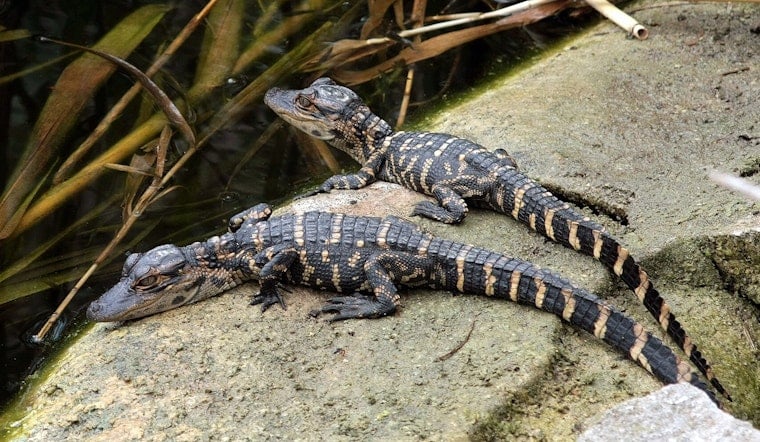
Four baby alligators have hatched at Gator Country Adventure Park & Sanctuary in Beaumont, making Boots — the once-famous Port Aransas alligator relocated earlier this year — a father for the first time. The hatchlings emerged from a clutch of 31 eggs laid by Boots' mate, an 8-foot female alligator named Blossom, and sanctuary staff say the newborns are strong and thriving.
The births cap a fast-moving romance that began almost as soon as Boots arrived at the sanctuary. According to Chron, Boots began spending time with Blossom within weeks of his relocation, and Gator Country owner Gary Saurage had predicted Boots would become a father by August. Saurage told the outlet he had also predicted Blossom would lay between 30 and 35 eggs, a forecast that landed almost exactly on the 31 she produced. Chron reporter Ariana Garcia noted that a captive alligator's diet can affect its reproduction, one of several variables sanctuary staff track closely.
From Port Aransas Boardwalk to Beaumont Sanctuary
Boots spent roughly 15 years living primarily at the Leonabelle Turnbull Birding Center in Port Aransas, resting under the boardwalk piers of what is a major local ecotourism attraction, according to MySA. Before his February relocation, wildlife and city officials estimated Boots at roughly 50 years old, more than 12 feet long, and over 600 pounds, per the same outlet. Over time, he began wandering into town drainage ditches near local retail businesses, a shift that eventually forced officials' hand.
Port Aransas Mayor Wendy Moore later explained that while Boots was a beloved local figure, growing crowds gathering at unsafe distances had made him, in her words, “too much of an entertainment factor” for public safety, as reported by KIII TV. Under Texas law, intentionally feeding a wild alligator is a Class C misdemeanor punishable by a fine of up to $500, a rule the Texas Parks and Wildlife Department enforces specifically because feeding causes gators to lose their natural fear of people. State regulations under Title 31 of the Texas Administrative Code define a nuisance alligator as one that threatens human health and safety or preys on livestock or pets, making physical removal a last resort rather than a routine response.
A Familiar Pattern in Port Aransas
Boots isn't the first Port Aransas gator to make the trip to Beaumont. Animal control officers in the coastal town have periodically called on Gator Country trappers before, including in 2022 when an alligator named Stumpy was captured and relocated to the same sanctuary, per MySA's earlier reporting. Texas wildlife officials log hundreds of nuisance alligator calls annually across southeast Texas, with volume spiking each spring as male alligators travel widely to establish territory, according to the Houston Chronicle. Hoodline reported on a related pattern in 2024, when gators fled South Padre Island storm surge ahead of Tropical Storm Beryl and were also sent to Gator Country.
Founded in 2005, Gator Country spans 15 acres and houses more than 450 rescued crocodilians, including Big Tex, recognized as the largest captive alligator in the United States at 14 feet, 1 inch. It's within that sprawling sanctuary that staff have now taken on the delicate work of raising Boots and Blossom's hatchlings.
Careful Handling for Fragile Hatchlings
Gator Country staff removed Blossom's eggs from her nest and placed them with nesting material inside a protected building, since larger alligators — including mothers in open ponds — can and do prey on smaller alligators. Handlers typically pull eggs from outdoor nests about a week before they're expected to hatch specifically to prevent that kind of cannibalism, though staff say Blossom herself will not eat her own hatchlings. Viable eggs typically hatch within a short window of one another, and staff helped some of the four babies break free of their shells.
The newborns will spend their first few days in a nursery while staff monitor the areas where each hatchling's embryo was attached. Gator Country is still waiting to see whether more of Blossom's remaining eggs will hatch; Saurage said the sanctuary will give them extra time before intervening to help them crack out. Whether Boots and Blossom's offspring turn out to be mostly male or female may come down to incubation temperature — alligator sex is determined entirely by temperature during incubation, with nest temperatures at or above 91.4 degrees Fahrenheit yielding mostly males and temperatures at or below 86 degrees yielding mostly females, since crocodilians lack sex chromosomes.
Public Debut and a Naming Contest Ahead
The hatchlings don't have names yet, though Chron reports that Saurage's wife will likely make that call. Gator Country may also hold a public naming contest, and the sanctuary is working with the Port Aransas Chamber of Commerce on a traveling live show that could eventually bring Boots and his offspring back to the town where he spent most of his life. Saurage said plans for that roadshow currently look positive.
For now, the babies will make their public debut this weekend before moving into individual indoor aquariums. As they grow, Gator Country separates alligators by size to keep hatchlings safely away from larger animals: the babies will graduate to larger tubs once they reach about 2 feet long, remain indoors until they hit roughly 3 feet, and only then move to outdoor ponds alongside similarly sized alligators. Visitors to the sanctuary have grown used to seeing Boots and Blossom side by side whenever alligators are fed — a pairing that, for now, has quietly grown into a family.





