

























































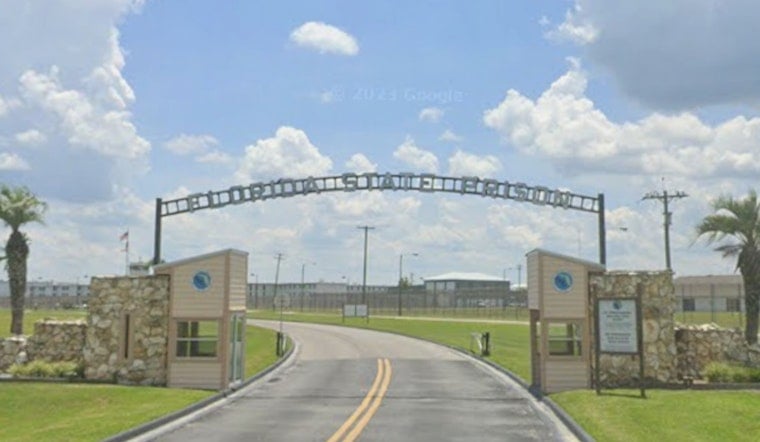
A 38-year-old Jacksonville woman who worked as a corrections sergeant at Florida State Prison in Raiford has been charged with conspiracy to introduce contraband into a prison after investigators say she teamed up with an inmate she was romantically involved with to sell drugs behind the facility's walls. Rachel M. Black allegedly received an $1,800 payment for cannabis and methamphetamine as part of the scheme, according to the arrest affidavit.
According to Action News Jax, an inmate told authorities that Black was romantically involved with a fellow inmate who helped set up the drug sales. Investigators say that inmate approached another prisoner as a possible client, and that another inmate's girlfriend ultimately made the $1,800 payment to Black for the cannabis and meth. The affidavit states that investigators found evidence Black sold cannabis and narcotics inside the prison, with the sales allegedly including at least one transaction with another inmate.
Per the outlet's report, Black allegedly placed repackaged paper drugs, including LSD, in a mop closet so inmates could retrieve them without direct contact. The report also states that Black acknowledged her alleged inmate boyfriend asked her to bring drugs into the prison.
A Maximum-Security Backdrop
Florida State Prison in Raiford is a maximum-security institution that houses the state's execution chamber and death row inmates, according to Corrections1. The facility sits directly adjacent to Union Correctional Institution in rural Raiford, forming one of the largest confinement hubs in the state, per PrisonAssist, though the two neighboring institutions are frequently confused despite functioning separately.
The facility drew attention earlier this year for a different security lapse. In June, an inmate armed with an improvised contraband weapon attacked two corrections officers inside the prison, an incident Hoodline previously covered that prompted an internal investigation into weapon smuggling, as reported by Action News Jax.
What Florida Law Says About Staff-Assisted Smuggling
Under Florida Statute § 944.47, introducing controlled substances or narcotics into a state correctional institution is classified as a second-degree felony, carrying a statutory maximum of up to 15 years in state prison and a $10,000 fine, according to Leppard Law. The statute also includes a provision that specifically targets employees: when a correctional facility worker uses the authority or privileges of their job to commit a contraband violation, the offense severity ranking under Florida's Criminal Punishment Code is automatically increased by one level, per the Florida Legislature's Online Sunshine statutes.
Criminal and administrative investigations into internal prison corruption are handled by the Florida Department of Corrections' Office of the Inspector General Bureau of Investigations, which refers cases with probable cause to state prosecutors, according to the department's own records. That structure has produced a steady stream of arrests in recent years. A review of FDC records published by Prison Legal News found that between March 2021 and April 2022 alone, at least 18 FDC employees and contractors were arrested on criminal charges for bringing contraband into state prisons.
Not an Isolated Case in Florida Corrections
Black's case fits a pattern that has repeated across Florida's correctional system. In June 2021, the Miami-Dade State Attorney's Office and the FDC Inspector General charged a corrections sergeant and an officer at Dade Correctional Institution with felony corruption for allegedly accepting cash bribes from inmates to smuggle contraband, according to the Office of Miami-Dade State Attorney Katherine Fernandez Rundle. And in March, a federal indictment exposed a multi-person contraband ring at the Citrus County Jail, charging eight people, including corrections officers and facility staff, with taking thousands of dollars in bribes to smuggle drugs and cell phones to inmates, as reported by FOX 13 Tampa Bay.
The dynamic at the center of Black's case, a sergeant with unmonitored access to storage areas like mop closets who is also tasked with maintaining facility security, illustrates why prosecutors and investigators have flagged staff-assisted smuggling as a persistent vulnerability inside Florida's prison system. The charges against Black remain allegations, and the case is still pending in court.



