

























































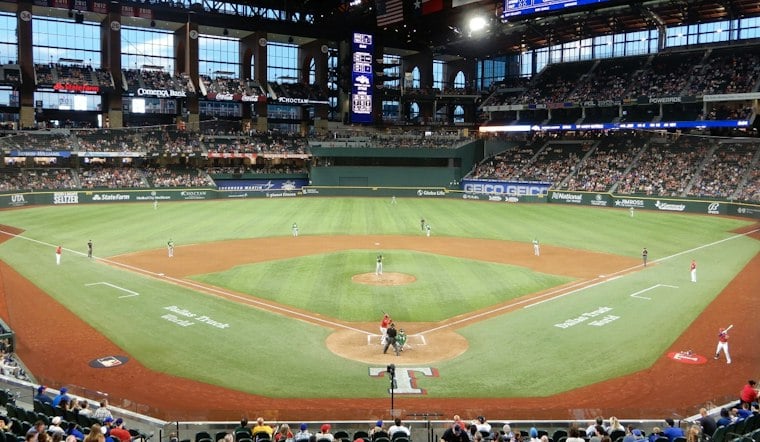
The Texas Rangers closed out their final home game of the 2026-27 regular season Thursday with a 3-1 win over the New York Mets at Globe Life Field, sending fans home happy even as a much bigger question loomed over the offseason: whether there will be a full 2027 season to look forward to at all.
MLB's collective bargaining agreement with the players union expires Dec. 1, according to Fort Worth Report. If owners and the MLB Players Association can't reach a new deal, owners could lock out all players, a move that would freeze free-agent and trade transactions across the league. Owners could also choose to extend the current agreement to keep talking, but if negotiations stretch into late March or early April, games themselves could be delayed or canceled.
That uncertainty hasn't stopped Arlington from planning ahead. City leaders have authorized City Manager Trey Yelverton to tap roughly $4 million in a business continuity reserve fund to offset lost revenue if a work stoppage hits, per the same outlet's reporting. Yelverton first floated using reserve funds for that purpose back on Aug. 4, and the Arlington City Council has since unanimously passed the 2026-27 budget with that contingency in place.
Why the City Has Skin in the Game
Rangers home games are not just entertainment for Arlington — they're a revenue stream. Ticket sales, concessions and related activity around Globe Life Field generate city revenue through sales tax, fees and other taxes, the report notes, which is part of why officials are treating a potential lockout as a budget issue rather than just a sports story. Fewer games, or a delayed start, could mean a real dent in what the city collects.
The city’s exposure is tied to more than game-day spending: Globe Life Field was built through a public-private partnership with a project cost of about $1.2 billion, and Arlington’s contribution was capped at $500 million. The city’s share is funded through a half-cent sales tax, a 2% hotel tax and a 5% car-rental tax, while the Rangers’ agreement with Arlington runs through Jan. 1, 2054, under the ballpark’s financing and partnership terms. That long-term arrangement makes the team’s presence a continuing civic and financial commitment, not just a seasonal attraction.
Joe Hoofnagle, who the outlet describes as a Rangers fan of roughly 45 years from Rockwall, said a lockout would ripple beyond the ballpark and hit tourism and restaurants in the area. Globe Life Field staff could also be harmed by a lockout and a shortened or delayed season, according to the same account.
Fans clearly aren't ready to let go of the season just yet. Some traveled from as far as Frisco to Arlington just to catch the Rangers-Mets finale, according to the report — a reminder of how much local goodwill is riding on whatever happens at the bargaining table this winter.
The Sticking Point: A Salary Cap
At the center of the dispute is MLB's proposal for a salary cap on team roster spending. The league has argued the cap would level the playing field for teams, but MLBPA representatives have called it a nonstarter, saying it would simply take money out of players' pockets, the outlet reported. Bruce Meyer, cited via the Associated Press, said players believe in a system that rewards performance rather than one built around a spending ceiling.
The salary-cap debate would reshape a labor system that also governs how players reach higher pay and free agency. The MLB Players Association, a union since 1966, represents major- and minor-league players; under the current rules, most players become eligible for salary arbitration after more than three years of major-league service, while players generally qualify for free agency after six years. Those pathways are among the existing bargaining rules the union represents players in negotiating, beyond the headline dispute over a spending ceiling.
Not everyone in the stands Thursday sounded eager for a fight. Michelle Salazar, of Fort Worth, said owners and players need to reach a compromise rather than let the dispute drag on, according to Fort Worth Report's account of the finale.
What History Says Could Happen Next
Baseball's labor disputes have gone both ways before. The 1994 negotiations broke down into a player strike that August, ultimately wiping out the rest of that season and the World Series entirely; the standoff wasn't resolved until a federal court issued an injunction restoring the prior agreement in March 1995. More recently, the lockout ahead of the 2021-22 season lasted 99 days but didn't end up affecting the regular season at all.
Baseball’s history also shows that timing matters: a 32-day stoppage in 1990 delayed Opening Day by a week but cost no regular-season games, while the 50-day 1981 strike during the season resulted in 713 games missed. The contrast underscores why an offseason lockout can remain a threat to the calendar without immediately wiping out games—and why a labor dispute that carries into the playing season can have much greater consequences, as MLB’s labor timeline records.
Which outcome awaits the Rangers and their fans this winter remains unclear. The Rangers themselves have called Globe Life Field home since moving from the open-air Choctaw Stadium, and for now, the ballpark sits quiet until owners and players settle a fight that could determine when — or whether — regular-season baseball returns to Arlington on schedule.




