

























































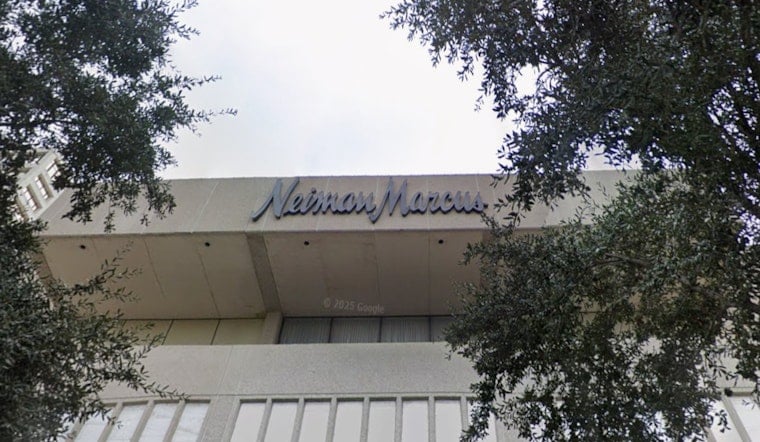
A shopper outside Neiman Marcus at the Galleria on South Post Oak Boulevard looked up recently and caught something most Houstonians will never see in person: a band of rainbow color stretched flat across the sky, parallel to the horizon, glowing beneath the sun like a strip of fire. The image, submitted by a reader, shows a textbook circumhorizontal arc — the striking optical phenomenon known popularly as a fire rainbow.
The photo was published by Click2Houston, which credited the sighting to a user submission taken outside the department store at the Galleria. Despite the dramatic name, a fire rainbow involves neither flames nor rain. According to Wikipedia, the display is properly called a circumhorizontal arc, an atmospheric optical effect created when sunlight refracts through flat, hexagonal, plate-shaped ice crystals suspended in high-altitude cirrus clouds.
Why the Sun Has to Be Almost Overhead
Unlike a standard rainbow, which forms when light bounces through liquid raindrops, a circumhorizontal arc depends entirely on ice and geometry. Atmospheric optics guidelines from the National Weather Service state that the arc can only form when the sun sits at an elevation angle of 58 degrees or higher above the horizon, a detail highlighted by HowStuffWorks. Sunlight has to enter a vertical side face of a plate-shaped ice crystal and exit through its horizontal bottom face for the colors to split apart correctly.
That steep sun-angle requirement is also why the phenomenon has strict geographic limits. Because of the required 58-degree solar angle, circumhorizontal arcs are physically impossible to observe at latitudes north of 56 degrees North or south of 56 degrees South, according to Snopes' review of the science, which rules out sightings in places like northern Alaska or Scandinavia entirely.
Houston, sitting at roughly 29.7 degrees North latitude, is nowhere near that boundary. Per Wikipedia's entry on the phenomenon, the city's position on the globe means the sun climbs above that critical 58-degree threshold for hundreds of hours between late spring and late summer, giving Southeast Texas a wide seasonal window for sightings. The Hong Kong Observatory notes that mid-latitude locations like Houston get multi-hour midday stretches during summer when solar angles are optimal for the arc to appear.
Distinguishing a True Fire Rainbow From Look-Alikes
Atmospheric scientists stress that fire rainbow is something of a double misnomer, since the phenomenon involves neither fire nor liquid raindrops, as National Geographic has explained. A fully formed circumhorizontal arc runs parallel to the horizon with red strictly at the top of the band and violet at the bottom, positioned below the sun at twice the distance of a standard 22-degree halo, according to Wikipedia. Patchy or sparse cirrus clouds often mean only isolated fragments of the arc show up rather than the full spectrum.
The effect is also frequently confused with cloud iridescence, a different phenomenon caused by light diffraction through uniform tiny water droplets or ice crystals near the sun, which can occur regardless of solar elevation, National Geographic notes. Iridescence tends to create irregular pastel patches in clouds rather than the structured horizontal color band of a true circumhorizontal arc.
NOAA reports cited by HowStuffWorks suggest that public documentation of rare optical weather events like this one has increased significantly in recent years, largely thanks to smartphone camera adoption and photo-sharing tools offered by local news stations. That trend helps explain why a passerby outside a Houston department store was able to capture and share a phenomenon that, decades ago, might have gone unnoticed by anyone without a camera in hand.
A Landmark Backdrop for a Rare Sky Show
The setting adds its own layer of local history to the sighting. The Galleria opened in November 1970 after developer Gerald D. Hines persuaded Dallas-based Neiman Marcus to serve as its original anchor tenant, according to Bisnow's account of the mall's founding, a partnership that helped transform post-war farmland into what became Houston's premier shopping district.
Today the Galleria is the largest shopping center in Texas and the third-largest mall in the United States, spanning 2.4 million square feet of retail space in Houston's Uptown District, per Wikipedia's entry on the complex. The mall anchors an Uptown submarket that includes roughly 24 million square feet of office space, making it one of the most heavily trafficked spots in the city for a rare sky phenomenon to be caught on camera.





