

























































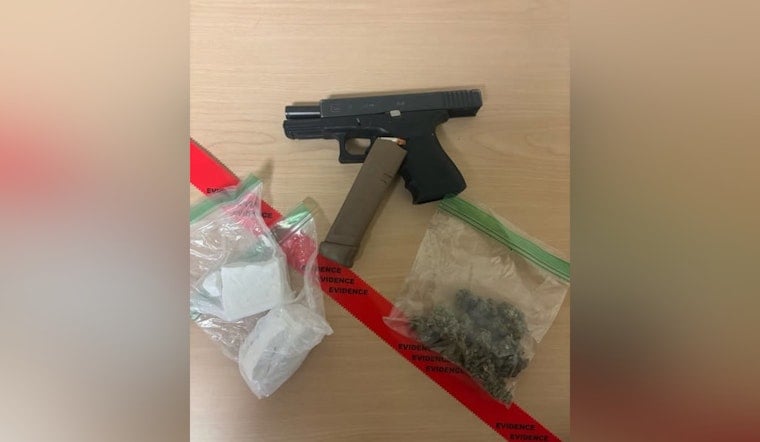
A 28-year-old Reno man is facing multiple felony charges after detectives say they caught him conducting repeated hand-to-hand fentanyl deals near Neil Road and Moana Lane, then found 205.70 grams of the drug and a loaded, unpermitted firearm in his possession. Damion Thompson was arrested following a month-long undercover investigation into fentanyl distribution across the Reno-Sparks metropolitan area, and he has since been booked into the Washoe County Sheriff's Office detention facility.
The Regional Narcotics Unit and Northern Nevada Drug Task Force announced Thompson's arrest in a statement, according to the Reno Police Department. Detectives say Thompson was charged with trafficking of a controlled substance, possession of a controlled substance with intent to sell, possession of a controlled substance, and carrying a concealed weapon without a permit. The Regional Narcotics Unit, described as a multi-agency task force, comprises detectives from the Reno Police Department, Sparks Police Department, and Homeland Security Investigations, with the Washoe County Sheriff's Office and Reno Police Department K9 units also assisting in this particular investigation and arrest.
Investigators say the 205.70 grams of fentanyl recovered from Thompson carries a street value in excess of $30,000, according to the DEA. The same federal metric places the seizure at nearly 103,000 lethal doses, since the DEA considers just 2 milligrams of fentanyl a potentially fatal amount. The U.S. Department of Justice has noted that illicit synthetic fentanyl is roughly 50 times more potent than heroin and 100 times more potent than morphine, underscoring why even street-level quantities carry such danger.
A Pattern of Big Busts in Reno-Sparks
Thompson's arrest follows a string of similar undercover fentanyl operations by the Regional Narcotics Unit in recent weeks. On August 27, the same task force arrested 27-year-old Reno resident Kamaryn Hart after an undercover investigation turned up more than 15 grams of fentanyl, with Hart reportedly out on bail for prior drug and firearm charges at the time.
That followed an even larger seizure earlier in the month. On August 5, RNU detectives arrested 49-year-old Jimmie Parker and a companion at a Reno hotel and casino after seizing 472.59 grams of fentanyl — an amount Hoodline previously reported as roughly 236,000 lethal doses — along with a concealed handgun and $20,000 in cash. Parker was held on $2.05 million bail on multiple trafficking and weapons charges, per that report.
What Nevada Law Says About the Charges
The trafficking charge Thompson faces stems from Nevada Senate Bill 35, enacted in 2023, which set specific weight thresholds for fentanyl trafficking prosecutions. Per Nevada legal statute references, the law classifies 28 to 41 grams as mid-level trafficking and 42 to 99 grams as high-level trafficking, while quantities of 100 grams or more — like the amount found on Thompson — fall under NRS 453.3385 as Category B felonies carrying 2 to 20 years in prison. State lawmakers lowered those thresholds specifically to enable stiffer prosecutions against mid-level dealers.
The concealed weapon charge carries its own consequences. Under Nevada Revised Statutes § 202.350, carrying a concealed firearm without a valid permit is a Category C felony punishable by 1 to 5 years in Nevada State Prison and fines up to $10,000, according to Justia Law. Nevada is technically a “shall-issue” state for concealed carry permits, but it still criminalizes carrying concealed without one.
Overdose Deaths Drive a Dual Strategy
The enforcement push comes as Washoe County continues to record some of the highest overdose fatality rates in Nevada. CDC data published in 2026 shows the county recorded a drug overdose fatality rate of 38.8 per 100,000 residents in 2024, according to USAFacts, a rate that places it among the state's worst.
Local officials have paired that enforcement with public health spending. In June 2026, the Washoe County Board of Commissioners allocated more than $3.3 million from the Washoe Opioid Abatement and Recovery Fund to support street outreach, mobile health services, and housing programs for people with opioid use disorder, with the funds distributed under the One Nevada Agreement settlement framework.
The Regional Narcotics Unit operates within the Northern Nevada Regional Intelligence Center alongside the Regional Gang Unit and Human Exploitation and Trafficking Unit, using shared technology such as GeoShield to track illicit activity across Reno, Sparks, and Washoe County, according to the Nevada Commission on Homeland Security. That regional intelligence-sharing structure was built specifically to let Northern Nevada agencies track street-level transactions across jurisdictional lines in real time.





