

























































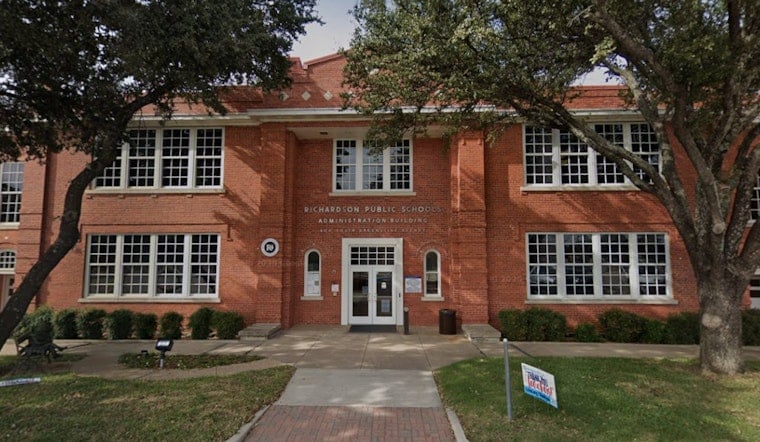
A Richardson ISD parent says her son hit a wall while doing homework on the district's network: a search for sitting President Donald Trump returned a blocked-website message, even though searches for Joe Biden, Kamala Harris, and Jeffrey Epstein all went through without issue. The parent, who spoke anonymously, says her child was researching the current president for a school assignment when the block appeared.
The allegation comes from an exclusive report by The Dallas Express, written by Carlos Turcios, which says the parent provided video showing what appeared on her son's device at the time of the search. According to the outlet, the parent said the search for Trump was blocked while Biden and Harris searches were not, and she suggested the restriction functioned as a keyword-specific block aimed only at Trump. The video shows a website-blocked message on the student device, but as the report notes, the footage does not establish whether a website, a search result, a filtering category, or third-party software actually caused the message, nor does it establish why the Trump search triggered the block or whether Richardson ISD intentionally configured the restriction.
The parent has asked the district to identify which department or vendor configuration is responsible for the rule, and has requested the specific board policy, administrative regulation, or filtering standard that would authorize blocking a sitting president's name while allowing searches for other officials. The Dallas Express says it asked Richardson ISD whether the restriction was intentional, why the Trump search was blocked, and whether the district plans to remove or modify it. As of publication, the outlet reports, Richardson ISD had not responded to those questions.
How Richardson ISD's Filtering System Works
Richardson ISD's internet filtering system inspects both encrypted and unencrypted web traffic, using category rules, application controls, file upload restrictions, and search-engine safe-search enforcement to monitor and block content district-wide, according to the district's own technology security portal. The district serves 36,142 students across 51 campuses under Superintendent Tabitha Branum and earned an overall B rating from the Texas Education Agency for the 2025–2026 school year.
The filtering push comes amid a broader technology reset at Richardson ISD. In August, the district rolled out new “technology with purpose” guidelines meant to cut down on classroom screen time, stop the use of devices as a free-time reward, and give parents whitelist controls for pre-approved content, as reported by NBC DFW. That policy shift is separate from the search-filtering system now under scrutiny, but it reflects a district actively rewriting its rules around student device use this fall.
What Federal and State Law Actually Require
Neither federal nor Texas law appears to require blocking a political candidate or sitting official by name. Under the federal Children's Internet Protection Act, schools that receive E-rate funding must adopt internet safety policies filtering obscene content, child pornography, and material harmful to minors — but CIPA does not mandate or authorize blocking political candidates, government officials, or political news, according to the Federal Communications Commission. Texas's own SCOPE Act, codified at Texas Education Code Section 32.1021, similarly requires districts to filter content related to self-harm, suicide, violence, or illicit drugs while giving parents oversight tools, without authorizing any political keyword filtering.
Federal courts have also weighed in on the constitutional stakes of viewpoint-based filtering. In PFLAG v. Camdenton R-III School District, a 2012 federal district court ruling found that public school districts commit unconstitutional viewpoint discrimination when web filters block non-explicit political or educational content, according to the American Civil Liberties Union. That precedent sits alongside the U.S. Supreme Court's foundational 1969 ruling in Tinker v. Des Moines Independent Community School District, which held that public school students retain First Amendment rights to free expression and access to information unless officials can show a substantial disruption to the educational process, per the Oklahoma Bar Association.
Glitch, Policy, or Something Else
Technical missteps are a documented possibility. Major web-filtering vendors serving schools, including Lightspeed Systems, have previously had to modify default software settings after automated category rules mistakenly blocked non-explicit educational and political content, according to a report from Pride Source. Because filtering vendors rely on complex, automated domain classifications and inspect encrypted traffic, false positives involving political news or candidate pages are not unheard of — leaving open the question of whether the Trump block traces back to a deliberate district policy or an unintended vendor misfire.
Texas lawmakers have separately pushed districts toward teaching students to navigate exactly this kind of online friction. Texas Senate Bill 2787 requires public schools to build digital citizenship and media literacy into curriculum for grades 6 through 12, helping students identify credible online sources and spot misinformation, according to the Texas Legislature. Richardson ISD has faced other allegations of censorship and First Amendment concerns before, as have other North Texas school districts, per the Dallas Express report, which also referenced a separate 2022 dispute in which former Dallas ISD trustee Dustin Marshall allegedly asked the district's IT department to block emails from a family that had accused officials of colluding to violate their right to petition the government — an allegation the family's spokesperson, Ben Davis, raised at the time, according to the same outlet.
A District Already Under Legal Scrutiny
This is not the only accountability question facing Richardson ISD this fall. The district was sued over a disabled teen's placement in a juvenile detention program, a federal civil rights case filed in the U.S. District Court for the Northern District of Texas alleging violations of the Individuals with Disabilities Education Act. The district has also seen a Berkner High School teacher arrested on a felony online solicitation charge and a bomb threat that disrupted SAT testing at Lake Highlands High earlier this year, adding to a run of scrutiny over how the district manages both student safety and student rights.
For now, the core question raised by the parent's allegation remains unresolved: whether the block on searches for the sitting president reflects an intentional administrative choice, a specific board-approved standard, or a technical misconfiguration in the district's filtering software. Richardson ISD has not publicly clarified which it was, and the parent's requests for the underlying policy or vendor rule have gone unanswered as of publication.





