

























































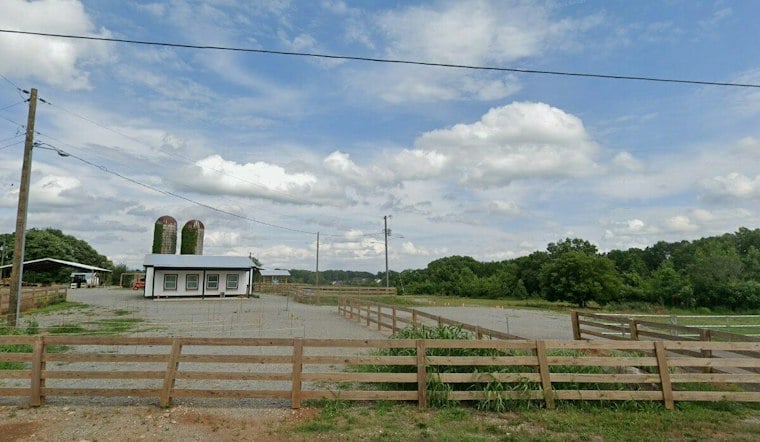
Republican gubernatorial candidate Rick Jackson stood at Cagle Farms in Canton on Thursday and pitched a sweeping agricultural plan for Georgia, including a 250-million-gallon daily emergency water reserve, a push to recruit fertilizer manufacturers to the state, and an automatic suspension of the state diesel tax during price spikes. Democratic nominee Keisha Lance Bottoms' campaign has also outlined a competing vision for rural Georgia.
Jackson unveiled his strategy for supporting Georgia agriculture at the Cherokee County agritourism farm, framing it around automatic tax relief that would kick in during market shocks. The plan also calls for establishing cooperative processing centers for meat and produce, according to Capitol Beat, which detailed the full scope of Thursday's announcement.
Bottoms' campaign said she had already met with farmers and unveiled her own agricultural proposals, focusing on property tax relief for heirs' property owners, tuition-free technical college pathways for agricultural education, help navigating federal paperwork, and shared processing cooperatives. Heirs' property, where unresolved land titles are passed down through generations without clear legal ownership, presents a significant barrier for family farms trying to access loans or government aid.
Two Very Different Economic Bets
Jackson's farm proposal builds on the broader “Jackson Action Plan” he announced earlier this month, which promises a 50% cut to the state income tax over four years, a freeze on property values, and elimination of state taxes on tips and residential energy, as reported by WABE. Jackson has said budget cuts and digital efficiencies would offset the lost tax revenue.
Bottoms, meanwhile, has focused her cost-of-living pitch on more targeted relief. Her plan, unveiled earlier this month, would let local municipalities waive local sales taxes on groceries, diapers, and baby formula, backed by a proposed $250 million state stabilization fund to cushion local government budgets, according to The Current GA. Georgia already exempts groceries from the state sales tax, but municipalities can still levy their own local taxes on food.
Why Farmers Are Central to the Pitch
The competing platforms land at a moment of real strain for Georgia farms. Food and fiber production generated more than $18 billion in direct commodity value in 2024, contributing $100.4 billion to the state's total economic output and supporting over 370,000 jobs, per the University of Georgia's 2026 Georgia Ag Impact Report from the school's College of Agricultural and Environmental Sciences.
Yet the university's 2026 Ag Economic Outlook, released in January, projected stagnant crop prices and squeezed profit margins across Georgia farms this year, driven by elevated costs for fertilizer, fuel, and equipment. That backdrop helps explain why both candidates are leaning so hard into farm country with the general election just weeks away.
A Dead-Heat Race Heading Into October
The stakes are high: November's election is an open-seat gubernatorial contest, according to Ballotpedia. And the race appears to be as close as it gets. A YouGov poll conducted September 15 through 18 showed Jackson at 45% support among registered voters compared to 44% for Bottoms, with 9% still undecided, per Fox 5 Atlanta's earlier reporting on the survey.
Jackson, the self-made billionaire founder and CEO of Alpharetta-based Jackson Healthcare, secured the Republican nomination in June after spending tens of millions of dollars of his own money to defeat Lt. Gov. Burt Jones in a primary runoff, according to Forbes. Jackson dropped his defamation suit against Jones as he sought to consolidate party support following that bruising primary fight.
Debate Disputes Simmer in the Background
Campaign tactics have also become a flashpoint. Jackson formally declined an invitation to join the Atlanta Press Club's televised debate series scheduled for October 12 and 13, opting instead to focus on grassroots campaign stops, while agreeing to a single separate broadcast debate on October 6, according to WABE's reporting on the dispute. Bottoms had pushed for six televised debates held across the state.
That disagreement over debates has become its own subplot in a race where both campaigns are racing to define themselves to rural voters before ballots are cast. With agriculture serving as a proxy battleground for broader affordability arguments, how Jackson and Bottoms fare with Georgia's farm communities could prove decisive in a contest still separated by a single percentage point.





