

























































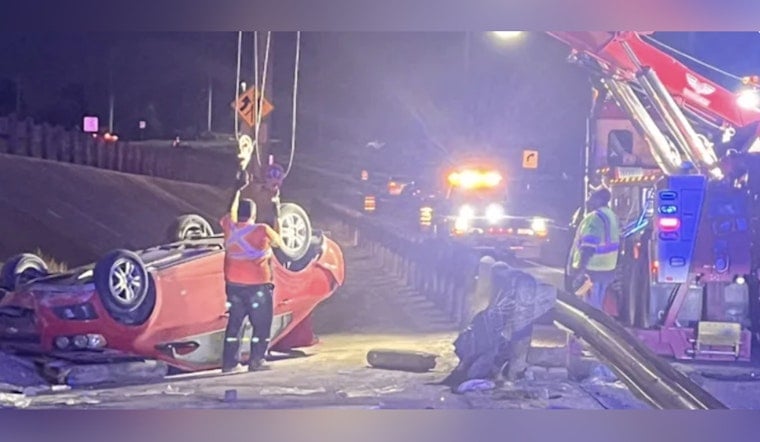
Amethyst Delgado was driving on Highway 151 near where Military Drive passes overhead when a truck slammed into the back of her car, flipping it upside down. The driver never stopped. “When I came out, there was nobody there. It was just me and my car upside down,” Delgado said.
The crash happened Thursday, September 3, according to WOAI, which first reported Delgado's ordeal. Delgado, a law student in San Antonio, said she squeezed the steering wheel and shut her eyes in the moments before impact. “I remember just squeezing the wheel, and I closed my eyes,” she said.
She crawled out of her badly damaged vehicle on her own, left with bad bruising but no broken bones. Delgado said she considers herself fortunate that her injuries were not more serious, though the crash has already made it harder for her to get to her two jobs while she keeps up with school. A GoFundMe has been created to help her get back on her feet financially as she recovers.
A Corridor With a History of Collisions
The stretch of roadway where Delgado's car ended up overturned sits at one of Bexar County's known trouble spots. San Antonio traffic analysis data has documented that the intersection of Highway 151 and West Military Drive recorded 56 motor vehicle collisions in a single calendar year, according to the Gamez Law Firm, which tracks local crash data. Major interchanges that combine high-speed access roads with surface streets tend to produce frequent wrecks, and this one is no exception.
Delgado's case is also part of a much larger pattern across the region. Texas has ranked eighth in the country for fatal hit-and-run crashes over a decade, according to one study, and Bexar County recorded 153 fatal hit-and-run crashes between 2019 and 2024 based on federal crash data. The Texas Department of Transportation has separately found that Bexar County logged 48,522 reported traffic collisions in 2024 alone, ranking second among all Texas counties behind only Harris County and including 205 fatal crashes and 773 crashes causing suspected serious injuries.
A Nationwide Surge in Drivers Who Flee
Delgado's experience mirrors a trend playing out nationwide. A March 2026 study by the AAA Foundation for Traffic Safety found that 15% of all police-reported traffic crashes in the United States in 2023 involved a driver who fled the scene, the highest annual percentage on record in recent years. Hit-and-run crashes have been climbing steadily since 2010 and spiked sharply during the COVID-19 pandemic.
The consequences of fleeing fall disproportionately on the most vulnerable people on the road. A report from the Colorado Department of Transportation analyzing AAA Foundation data found that more than 70% of people killed in hit-and-run collisions nationwide are pedestrians and cyclists, with 1 in 4 pedestrian fatalities and 1 in 5 cyclist injuries in 2023 resulting from hit-and-run drivers. That same research found nearly 80% of fatal hit-and-run crashes in the U.S. occur during hours of darkness, when reduced visibility and fewer bystanders lower a fleeing driver's odds of being caught. The AAA Foundation also reported that at least 6 out of 15 roadside service workers struck and killed on U.S. roads in 2023 were killed by drivers who fled the scene, a reminder that the danger extends beyond the drivers and passengers directly involved in a crash.
What Texas Law Says About Leaving the Scene
Texas law treats leaving the scene of an injury crash as a serious criminal matter. Under Texas Transportation Code Section 550.021, leaving the scene of a crash involving personal injury is punishable by up to five years in state prison or one year in county jail, along with fines up to $5,000, according to FindLaw. Penalties escalate to a third-degree felony for serious bodily injury and a second-degree felony if the crash proves fatal. State law requires drivers involved in injury collisions to stop immediately, determine whether aid is needed, and remain at the scene.
San Antonio's Broader Push for Safer Streets
Delgado's crash adds to a string of recent hit-and-run incidents Hoodline has covered across San Antonio, including a downtown sidewalk hit-and-run in late August and a fatal case near Bandera Road in June. Regional planning data from the Alamo Area Metropolitan Planning Organization has shown that pedestrian and bicycle collisions across the eight-county San Antonio area exceeded 1,000 annually between 2016 and 2025, with Bexar County accounting for 93% of those regional incidents.
In response, San Antonio has implemented its Vision Zero Action Plan and launched the federally funded Keep Crossings SAfe initiative to install visual warnings and infrastructure improvements along dangerous corridors. The city introduced a High-Injury Network Dashboard in late 2024 to map street segments with high collision concentrations. Whether that effort will eventually reach the Highway 151 and Military Drive interchange remains an open question, as does whether investigators will identify the driver who hit Delgado's car and drove away.





