

























































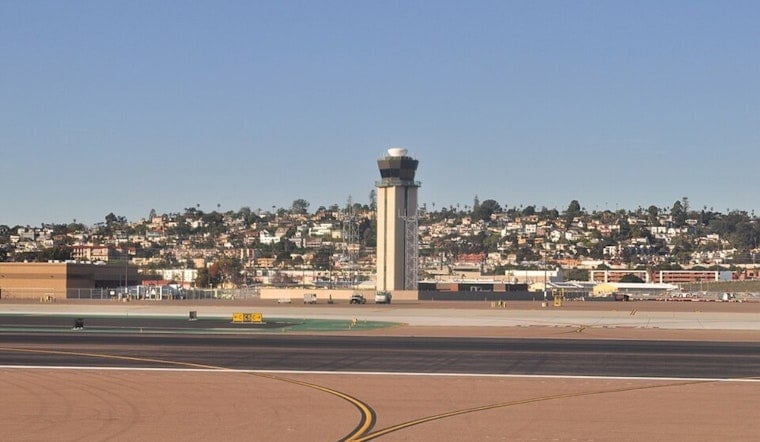
Roughly 400 more households living under San Diego International Airport's flight path are in line for free soundproofing after the Federal Aviation Administration awarded the San Diego County Regional Airport Authority a $15.3 million grant. The money will fund new windows, doors, weather stripping and ventilation upgrades for homes in neighborhoods including Loma Portal, Ocean Beach, Bankers Hill, Middletown, Golden Hill and South Park.
The grant is the latest infusion for the airport's Quieter Home Program, which as reported by ABC 10News has completed retrofits on 6,238 homes since it began in 2001. U.S. Senator Alex Padilla said the federal investment will make homes quieter for hundreds of San Diego families, while Rep. Scott Peters called the funding good news for the roughly 400 households near the airport in Point Loma, Little Italy and surrounding neighborhoods who will soon enjoy quieter homes and improved ventilation.
San Diego County Regional Airport Authority President and CEO Atif Saeed said the agency is grateful for the funding that supports the Quieter Home Program. The grant is one of 232 awarded nationwide through the FAA's Airport Improvement Program, which is financed through aviation user fees and fuel taxes, and it will cover roughly 400 homes located within the FAA's 65-decibel-or-greater noise contour surrounding the airport.
How the Retrofits Work
Eligible homes must show average interior noise levels of 45 decibels or greater with windows closed to qualify. Once accepted, the program uses a multi-step evaluation process to determine which sound-attenuated products a home needs, which can include noise-mitigating exterior doors and windows, weather stripping and caulking around openings, and ventilation systems such as air conditioning units so residents can keep windows shut without losing airflow.
The Quieter Home Program traces back to 1998, when it began as a pilot effort under the Unified Port of San Diego before becoming a fully operational program in 2001, according to San Diego International Airport. The Airport Authority took over administration in 2003, and the program now ranks among the largest remaining airport residential sound insulation efforts in the country. In September 2020, the FAA expanded its scope to allow soundproofing of non-residential noise-sensitive sites, and the program's earliest non-residential projects covered two local churches and preschool facilities in high-impact flight corridors, per the National Business Aviation Association.
Federal Funding Has Swung Widely Year to Year
Federal support for the program has fluctuated significantly. In September 2021, the FAA awarded the airport authority $25.9 million in noise mitigation grants, the largest single-year allocation in the program's history, funding retrofits for an estimated 400 to 500 homes along with non-residential facilities. This year's $15.3 million award is smaller by comparison but still substantial, arriving as part of an $81 million distribution across 18 California airports, which also included $22.8 million for a similar program at Los Angeles International Airport, according to OB Rag.
Demand for the program far outpaces the pace of retrofits. Prioritization goes to homeowners in the loudest noise-impacted areas who have owned their homes the longest, but high demand means applicants often wait years for construction, and community estimates suggest thousands of eligible properties remain on long-term waiting lists, per Axios. To verify the work actually holds up, program guidelines require acoustic testing on 10% of participating homes before and after retrofitting, confirming that insulation measures meet the FAA's goal of at least a five-decibel reduction in interior noise, with candidate homes also evaluated for historical significance to determine which materials can be used.
A Single Runway, a Growing Terminal, and a Nighttime Curfew
The pressure on nearby neighborhoods stems partly from geography. San Diego International Airport operates with a single runway squeezed against dense urban neighborhoods, making it the busiest single-runway commercial airport in the country, having served more than 25 million passengers in 2024, according to research from Enclos. Adding a second runway isn't an option given the surrounding terrain, which keeps flight paths concentrated directly over central San Diego homes.
To limit overnight disruption, the airport enforces a nighttime departure curfew barring takeoffs between 11:30 p.m. and 6:30 a.m., since departing jets generate far more noise than arriving flights. Airlines that violate the curfew face review by an internal panel and fines starting at $2,000 for a first offense, climbing to $6,000 for a second and $10,000 for subsequent violations within six months, though delays caused by weather or air traffic control are exempt from penalty.
Meanwhile, the airport is pushing ahead with a $3.8 billion redevelopment of Terminal 1, expanding it to 30 gates by 2028 to handle passenger demand projected to reach 20 million annually at that terminal by 2050, as reported by SFGATE. The new terminal replaces a structure built in 1967 for just two million travelers a year, underscoring the gap between the airport's growth ambitions and the noise mitigation still owed to the neighborhoods living beneath its flight path. Airport officials describe San Diego International Airport as a vital economic engine for the region, even as families in Golden Hill and South Park wait their turn for quieter windows and doors.





