

























































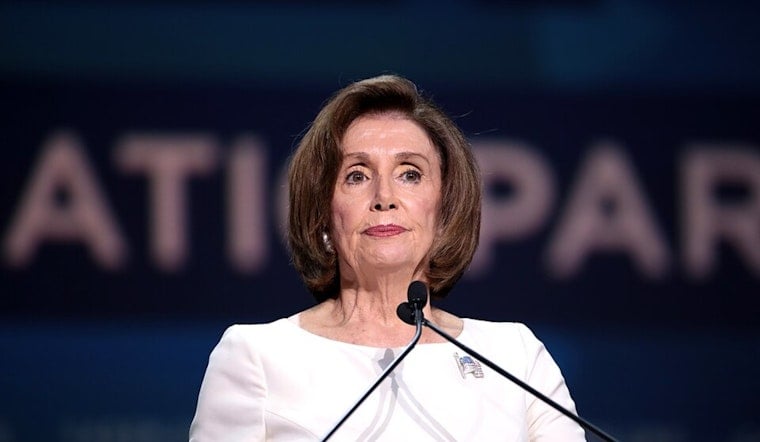
Nancy Pelosi's household disclosed an investment worth between $3 million and $12 million in San Jose-based Bloom Energy in the weeks before the fuel-cell maker's stock soared and the company was tapped to join the S&P 500. The trades, made through accounts owned by her husband Paul Pelosi, included shares and call options purchased in late July, just days before Bloom Energy posted blowout earnings and roughly six weeks before its index inclusion was announced.
According to the New York Post, the household account bought 10,000 Bloom Energy shares and 100 call options on July 24, when the stock closed at $184.89 per share. That day's purchases carried a combined minimum value of $2 million, with the shares alone valued between $1 million and $5 million and the options between $1 million and $5 million. Four days later, on July 28, the account added 5,000 more shares and 100 additional call options, a combined purchase worth $1 million to $2 million, as Bloom Energy's stock closed at $166.84 per share that day.
The call options give the household the right to buy Bloom Energy shares at a fixed $100 strike price before they expire on June 17, 2027, according to official House periodic transaction records filed on August 21, 2026. Nancy Pelosi signed that disclosure report herself, though a spokesperson for the speaker maintains that she does not own any stocks and has, per the report, no knowledge or subsequent involvement in any transactions made by her husband.
A Stock on a Historic Run
Bloom Energy's timing looks remarkable in hindsight. The stock has increased more than 400% over the past 12 months and more than 100% so far in 2026, and it has climbed nearly 40% in just the five days before September 8, according to the same disclosure report cited by the Post. By September 8, shares were trading at $282.50, up sharply from the $166.84 close on July 28 when the household made its second round of purchases.
The rally accelerated after Bloom Energy reported extremely upbeat second-quarter earnings on July 28, 2026 — the same day as the household's second purchase. The San Jose company posted revenue of $1.07 billion, a 165.5% year-over-year jump that beat analyst estimates by nearly 29%, and raised its full-year revenue outlook to between $3.9 billion and $4.2 billion, according to PrimeXBT. Bloom Energy's solid-oxide fuel cell systems generate power on-site for AI data centers and can be deployed in three to four months, compared with four to seven years for traditional utility grid expansion, per NAI500 — a speed advantage that has made the company a go-to power source as data center operators race to bypass utility connection queues. According to the Department of Energy's Microgrids R&D Strategic Plan, microgrids can help rapidly interconnect economically important new loads such as datacenters by reducing their reliance on the grid.
The momentum culminated on September 4, when S&P Dow Jones Indices announced Bloom Energy would officially join the S&P 500 before trading opens on September 21, replacing Molson Coors Beverage Company. The company's market capitalization now sits near $83 billion, comfortably clearing the roughly $22.7 billion threshold S&P set under its updated inclusion criteria this year, which also require sustained positive cumulative quarterly profitability.
Intel and a San Francisco Hotel Deal, Too
The same August 21 filing showed the Pelosi household didn't stop at Bloom Energy. On July 24, the account also purchased 10,000 shares of Intel Corporation and 50 Intel call options with a $50 strike price, also expiring June 17, 2027 — a broader tech-options strategy executed the same day as the Bloom Energy buy.
The filing additionally disclosed a local San Francisco investment of $500,001 to $1 million made on July 27, 2026, in REOF XXV, LLC, an entity acquiring and restoring a luxury hotel property in the city. Paul Pelosi has previously invested in multiple commercial real estate entities around the region.
Denials and a Growing Congressional Trading Debate
Nancy Pelosi has denied accusations of insider trading and says she supports a ban on congressional stock trading, even as her portfolio has drawn outsized attention — it returned 65% in 2023, and Paul Pelosi made $38 million worth of stock trades in the weeks before President Trump's 2025 inauguration. An app called the Pelosi Tracker, which follows the trading activity of Nancy Pelosi and other members of Congress, has more than 20,000 copiers and estimates $44 million in copier trades tied to following her disclosures.
The disclosure lands amid a broader legislative push on the issue. The U.S. House passed H.R. 7008, the Stop Insider Trading Act, on July 22, 2026, in a 232–198 vote that would bar lawmakers and immediate family members from buying individual stocks and require seven-to-14-day public notice before selling existing holdings, according to the U.S. House of Representatives Committee on Rules. Hoodline previously covered the House vote in a story on Ann Wagner's disclosed net worth. Separately, a Republican-led bill from Senator Josh Hawley, introduced in early 2023 and known as the Pelosi Act — formally the Preventing Elected Leaders from Owning Securities and Investments Act — has also pushed for tighter restrictions, while the Senate Committee on Homeland Security and Governmental Affairs voted 8 to 7 in 2025 to advance a modified ETHICS Act requiring lawmakers, the president, vice president and their spouses to fully divest from individual stocks by March 31, 2027, according to the Campaign Legal Center.
Watchdogs argue existing law offers little deterrence. The House Committee on Ethics identifies STOCK Act filings as Periodic Transaction Reports, or PTRs. The 2012 STOCK Act requires members of Congress and their families to disclose trades over $1,000 within 45 days of a transaction, or 30 days of notification, whichever comes first, but late-filing penalties start at just $200 for a first offense. A United States Senate Select Committee on Ethics report lists a $200 penalty for late filing of a financial disclosure report. Congressional stock disclosures have become a recurring storyline this year, with Hoodline reporting on similar scrutiny facing Representative Kelly Morrison, who moved to divest private stakes after ethics heat, and Representative Tony Wied's disclosed $1.3 million in February trades.





